

If you want motivated seller leads starting this week — not in 90 days — Google Ads is your fastest path to a ringing phone. While SEO builds your long-term organic foundation, Google PPC puts your cash buying business at the top of search results immediately, capturing sellers the moment they type “sell my house fast” into Google.
The problem is that most wholesalers either aren’t running Google Ads at all, or they’re running them poorly — burning through budget on irrelevant clicks, using the wrong keywords, and sending traffic to pages that don’t convert. I’ve audited hundreds of Google Ads for Real Estate Wholesalers campaigns, and the same mistakes come up over and over.
This guide covers everything you need to run Google Ads profitably as a real estate wholesaler in 2026 — from account structure to keyword strategy, ad copy, landing pages, and ongoing optimization. Let’s get into it.
“We took over a campaign that was spending $3,800/month for 6 leads. After restructuring with this exact framework, the same budget produced 41 leads the following month.” — James Mitchell, REI Rank
Why Google Ads Works So Well for Wholesalers
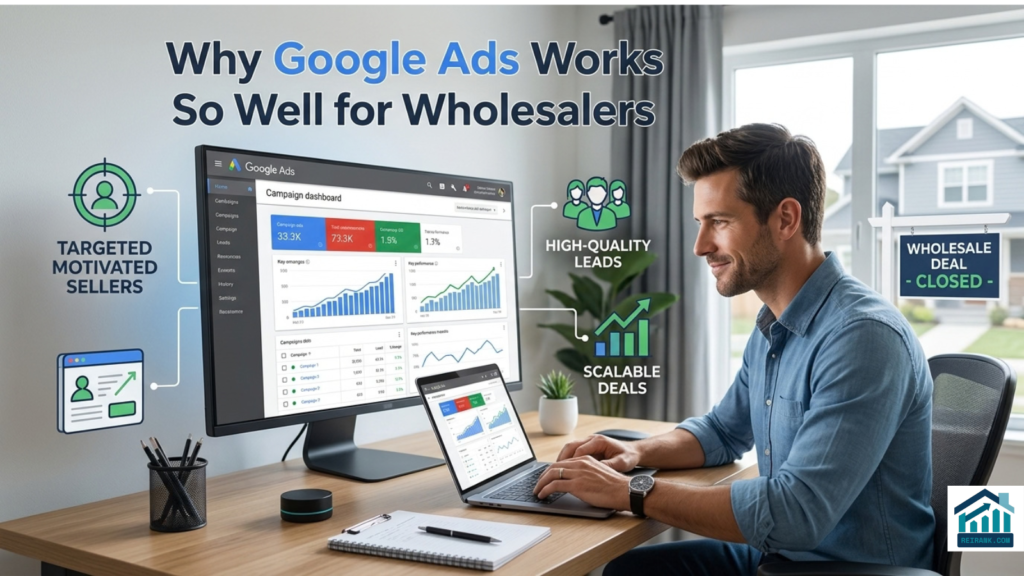
Google Ads works for wholesalers for one simple reason: intent. When someone types “sell my house fast Dallas” into Google, they are not browsing. They are not curious. They have a problem they need solved right now, and they are actively looking for someone to solve it.
Compare that to Facebook ads, where you’re interrupting someone scrolling through their feed. Or direct mail, where you’re hoping your postcard lands on the right day.
Google Ads puts you in front of the exact person, with the exact problem, at the exact moment they’re ready to act. That’s why our average cost per motivated seller lead across all client campaigns is $18 — a fraction of what most wholesalers pay for direct mail or cold calling lists on a per-deal basis.
The other major advantage is speed. SEO takes 3–6 months to produce consistent results. Google Ads can have your phone ringing within 48 hours of launch. For wholesalers who need deal flow now, that’s not a small thing.
How Much Should You Budget for Google Ads?
This is the first question every wholesaler asks, and the honest answer is: it depends on your market. A mid-sized city like Memphis or Albuquerque might only require $1,500/month in ad spend to generate 15–20 leads. A major metro like Los Angeles or Chicago could require $5,000+/month to be competitive.
Here’s a practical framework for setting your starting budget:
#1. Research your target CPC (cost per click). For “sell my house fast” keywords, expect to pay anywhere from $8–$35 per click depending on your market. Use Google’s Keyword Planner to estimate this before you start.
#2. Work backward from your lead goal. If your landing page converts at 10% and you want 20 leads per month, you need 200 clicks. At $15/click average, that’s $3,000/month in ad spend.
#3. Start with a minimum of $1,500/month. Below that, you won’t generate enough data to optimize effectively, and your results will be inconsistent.
#4. Plan to scale. Once you know your cost per lead and cost per deal, scaling is simple math. If one deal nets you $15,000 and Google Ads produces deals at $800 in ad spend each, there’s no reason not to spend more.
The Right Keywords for Wholesale PPC Campaigns

Keyword selection is where most wholesale Google Ads campaigns win or lose. You need to be surgical — targeting the highest-intent searches while aggressively filtering out the traffic that will never convert.
Your core keyword list should include:
- “sell my house fast [city]” — your highest-intent, highest-converting keyword
- “we buy houses [city]” — searchers already know they want a cash buyer
- “cash home buyers [city]” — high intent, often slightly lower CPC
- “sell house as is [city]” — captures sellers with distressed properties
- “sell inherited house [city]” — probate/inheritance motivated sellers
- “stop foreclosure [city]” — extremely urgent, highly motivated sellers
- “sell house fast cash [city]” — variation of your primary keyword
Use match types strategically. Start with Exact Match and Phrase Match for your highest-intent keywords. This gives you control over what triggers your ads while still generating enough volume. Broad Match can work once you have enough data to identify the right search terms, but it burns budget fast if used prematurely.
Negative Keywords: Where Most Budgets Are Wasted
This section could save you hundreds of dollars every single month. Negative keywords tell Google what searches you do NOT want to show up for — and for wholesale campaigns, this list is just as important as your target keywords.
Add these as negative keywords from day one:
- Realtor, real estate agent, listing agent, MLS
- Buy a house, homes for sale, houses for sale, purchase
- Rent, rental, tenant, lease
- Mortgage, refinance, loan, lender
- Real estate school, license, course, certification
- Wholesaling, wholesale real estate (you’re targeting sellers, not other investors)
- Free, cheap, discount (price shoppers rarely convert)
- How to sell, tips for selling (informational intent, not buying intent)
Review your Search Terms report weekly, especially in the first month. Every irrelevant search term you find is a negative keyword waiting to be added. Campaigns that are actively managed with negative keywords typically see a 30–50% improvement in cost per lead compared to set-and-forget campaigns.
Writing Ad Copy That Motivates Sellers to Click
Your ad copy has one job: get the right person to click and the wrong person to keep scrolling. Here’s what works for motivated seller campaigns in 2026.
Headline formula that consistently outperforms:
- Headline 1: Benefit + Location — “Sell Your [City] House Fast”
- Headline 2: Remove friction — “No Repairs, No Fees, No Waiting”
- Headline 3: Social proof or urgency — “127 Homeowners Helped | Call Today”
Description lines: Lead with your offer and follow with trust. “We buy houses in any condition for cash. Get a fair offer in 24 hours and close on your timeline. No agent fees, no commissions, no hassle.”
Always use ad extensions. Callout extensions (“Any Condition,” “Close in 7 Days,” “No Fees”), sitelink extensions linking to your testimonials and FAQ pages, and call extensions showing your phone number directly in the ad — these consistently improve click-through rate by 15–30%.
Pro tip: Run at least 3 headline variations per ad group and let Google’s responsive search ads optimize toward the best performers. After 30 days, pause the weakest performer and write a new challenger. This continuous testing compounds over time into significantly lower CPCs.
Landing Pages: Where Leads Are Won or Lost
Sending Google Ads traffic to your homepage is one of the most expensive mistakes a wholesaler can make. Your homepage is designed for multiple audiences and multiple goals. A landing page is designed for one thing: converting a motivated seller into a lead.
Every PPC landing page needs:
- A headline that matches your ad copy. If someone clicks an ad that says “Sell Your Atlanta House Fast,” the first thing they should see on the page is a headline about selling their Atlanta house fast. Message match is critical for conversion.
- A phone number above the fold in large text. Many motivated sellers — especially older homeowners — prefer to call rather than fill out a form. Make it impossible to miss.
- A short, simple lead form. Name, phone number, and property address. That’s it. Every additional field reduces conversion rate by 10–15%.
- Trust signals immediately visible. Google review count and rating, BBB badge, years in business, number of houses purchased — anything that answers “why should I trust these people?”
- Your process explained in 3 steps. “1. Tell us about your property. 2. Receive your cash offer. 3. Choose your closing date.” Simple, clear, low-friction.
- Fast load time. Every additional second of load time costs you conversion rate. Your landing page should load in under 2 seconds on mobile.
Tracking: You Can’t Optimize What You Don’t Measure
Without proper conversion tracking, you’re flying blind. You might be spending $500/day and have no idea which keywords, ads, or times of day are producing leads versus wasting budget. Here’s the minimum tracking setup every wholesale PPC campaign needs:
- Google Ads conversion tracking for form submissions — so you know which keywords produce leads
- Call tracking (we use CallRail) — assigns unique phone numbers to different ad groups so you know which ads drove which calls
- Google Analytics 4 linked to your Google Ads account — gives you session data, bounce rates, and user behavior on your landing pages
- CRM integration — every lead that comes in should automatically enter your CRM with source attribution so you can track from lead to deal
Once you have this data, you can make intelligent optimization decisions: pause keywords with high cost and no conversions, increase bids on keywords that produce cheap leads, adjust your schedule to run ads only during hours that generate calls, and allocate more budget to the campaigns and markets producing the best ROI.
Month-by-Month Optimization Roadmap: Google Ads for Real Estate Wholesalers
Google Ads campaigns improve over time when you manage them actively. Here’s what to focus on each month:
- Month 1: Launch, gather data, add negative keywords aggressively, monitor search terms daily. Don’t make major bid changes yet — let the algorithm learn.
- Month 2: Pause keywords with zero conversions after 50+ clicks. Test new ad copy variations. Review landing page performance and make CRO improvements based on real data.
- Month 3: You should have enough conversion data to move to Target CPA bidding on your best-performing campaigns. This lets Google’s algorithm optimize toward your cost-per-lead goal automatically.
- Month 4+: Scale what works. Add new city targets. Build out separate campaigns for different seller situations (foreclosure, inherited, divorce). Test display and remarketing campaigns to recapture visitors who didn’t convert.
The 5 Biggest Google Ads Mistakes Wholesalers Make
- Sending traffic to the homepage. Always use dedicated landing pages for PPC traffic.
- No negative keywords. Your campaign will bleed budget on irrelevant searches without an aggressive negative keyword list.
- Too broad a geographic target. Target your actual buying area, not the entire state. Tighter geo-targeting means more relevant traffic and lower CPCs.
- Setting and forgetting. Google Ads requires weekly attention, especially in the first 90 days. Unmanaged campaigns get worse over time, not better.
- Not tracking calls. In most wholesale markets, more than 60% of inbound leads come via phone call, not form submission. If you’re not tracking calls, you’re missing most of your conversion data.
Want us to audit your current Google Ads campaign? We’ll show you exactly where your budget is being wasted and what a restructured campaign could produce in your market — completely free, no strings attached.