

Most cash home buyers lose money on Google Ads for the first 3-6 months. Not because Google Ads doesn’t work — it’s the highest-intent lead source in the category — but because they treat it like a roofer or a dentist would, and motivated seller advertising has its own rules.
This playbook is built for cash buyers running their first Google Ads campaign, for the best Google Ads for Cash Home Buyers, or for anyone whose current campaigns are burning budget without producing leads. By the end, you’ll know exactly how to structure a campaign that generates motivated-seller leads at a sustainable cost per acquisition.
Understand the economics before you spend a dollar
Cash home buying has unusual economics. Your average deal margin might be $15,000-$40,000. That means you can pay $200-$500 per lead and still be highly profitable, as long as you close 10-20% of those leads.
But — and this is the trap — you can also spend $200 per lead and lose money fast if your lead-to-close rate is 2% instead of 12%. Before you scale spend, your sales process needs to be tight: speed-to-lead under 5 minutes, a clear qualifying script, and a defined offer process. If those aren’t in place, fix them before you increase Google Ads spend.
Campaign structure that works
For a cash buyer in a single market, you want three campaign types running in parallel:
#1. Search campaign — your primary, highest-intent driver. Targets terms like ‘we buy houses [city]’ and ‘sell my house fast [city].’
#2. Call-only campaign — runs only on mobile; the ad IS a phone number. Sellers tap; the call comes through. High-converting for this category because sellers prefer the phone.
#3. Performance Max campaign (small budget) — Google’s AI-driven campaign type that uses your assets across Search, Display, YouTube, and Discover. Treat it as a test until you have data.
ALSO READ: 7 Proven Ways to Track Motivated Seller SEO Leads
Don’t run Display-only campaigns until you have 50+ Search conversions. Display traffic for this category is mostly junk.
Keyword strategy — the right 30 terms
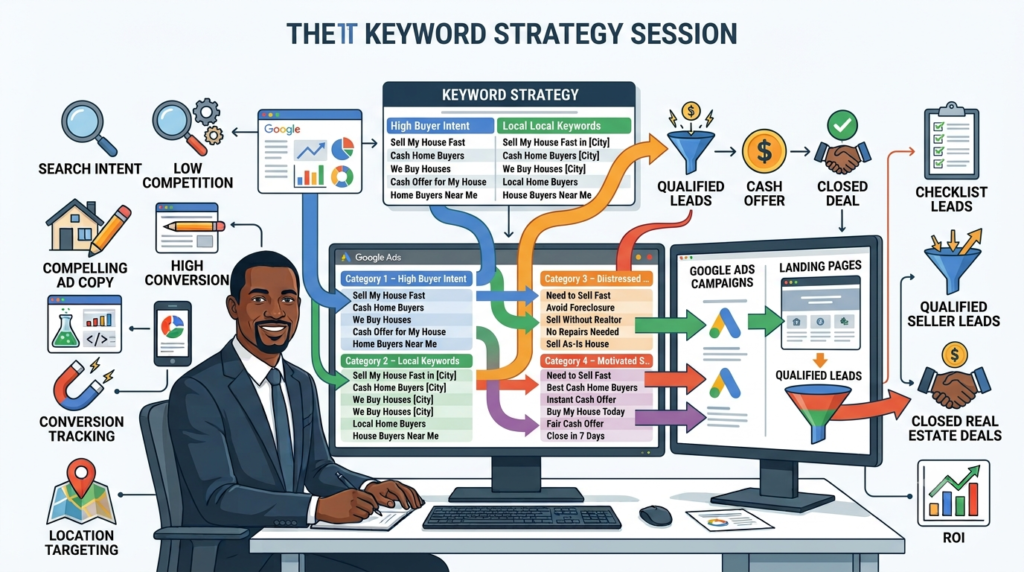
Your keyword list should be tight and high-intent. The terms that produce motivated seller leads:
- ‘we buy houses [city]’ — your highest-intent term
- ‘Sell my house fast [city].’
- ‘cash for houses [city]’
- ‘cash home buyers [city]’
- ‘sell house as-is [city].’
- ‘sell house without realtor [city].’
- Situation-based: ‘sell inherited house [city],’ ‘sell house in foreclosure [city],’ ‘sell house divorce [city]’
Use ‘phrase match’ or ‘broad match modifier’ (BMM) for these, not exact match alone — exact match limits your reach too aggressively in 2026.
Negative keywords — at least as important as positive ones
Cash buyer campaigns leak money to off-intent searches: people researching home values, looking for rentals, real estate agents, MLS listings, FSBO advice, or ‘how to sell a house yourself.’ Every click from those is wasted.
Start every campaign with at least 50 negative keywords. Common categories to negate: ‘free,’ ‘value,’ ‘estimate,’ ‘rental,’ ‘rent,’ ‘agent,’ ‘realtor,’ ‘MLS,’ ‘Zillow,’ ‘Redfin,’ ‘how to,’ ‘tips,’ ‘jobs,’ ‘salary,’ ‘careers,’ ‘investment property,’ ‘wholesale.’
Then pull your search terms report weekly and add new negatives based on what queries are actually triggering your ads. Negative keyword maintenance is the single highest-ROI ongoing task in Google Ads management.
Ad copy that converts motivated sellers
Generic Google Ads templates won’t work. Your ad copy needs to speak to the seller’s situation, not just your features.
Strong headlines for cash buyer ads: ‘Sell Your [City] House Fast,’ ‘Cash Offer in 24 Hours,’ ‘No Fees. No Repairs. No Showings, ‘Close in 7-14 Days,’ ‘Get a Fair Cash Offer.’ Mix and match — Responsive Search Ads let Google test combinations and find what works.
Descriptions should emphasize speed, certainty, local presence, and no obligation. Avoid: lofty marketing language (‘Transform your selling experience’), vague benefit claims (‘the easiest way to sell your home’), and anything that sounds like a real estate agent.
Landing pages — Google Ads’ multiplier

Your Google Ads ROI depends as much on landing page quality as on the ads themselves. Sending traffic to your homepage instead of a dedicated landing page is the single biggest mistake new advertisers make.
Build a campaign-specific landing page with: one clear headline that matches the ad, one primary CTA above the fold (form or phone), seller-focused trust signals (recent purchases, reviews, team photo), under 6 form fields, and no navigation menu (you don’t want the seller wandering off). Page speed under 2.5 seconds on mobile.
Bidding strategy — start manual, move to smart
Google’s recommended bidding strategy for new campaigns is ‘Maximize Clicks’ or ‘Maximize Conversions.’ For cash buyers, this is a trap when you start — Google’s AI needs conversion data to optimize, and you don’t have any yet.
Start with Manual CPC, set reasonable max bids ($8-15 depending on market), and run for 2-4 weeks to build conversion data. Once you have 20+ tracked conversions, switch to Maximize Conversions with a tCPA cap set to 1.5x your target cost per lead. Then Google can actually optimize toward your goal.
Tracking — without it, you’re flying blind
Conversion tracking has to be set up correctly before you spend money, not after. At minimum: form submissions tracked via Google Tag Manager, phone call conversions tracked via Google forwarding numbers or a service like CallRail, and offline conversion imports from your CRM if you can swing it (closed deals, not just leads).
Without these, you’re optimizing toward clicks instead of leads, and toward leads instead of deals. The wholesalers who scale Google Ads profitably are the ones who track all the way down to closed transactions and feed that data back to Google for optimization.
Realistic budgets and timelines
Most cash buyers should start at $50-$100 per day in their primary market. That’s $1,500-$3,000 per month. Below that, the algorithm doesn’t get enough data to optimize. Above that, you scale linearly only after you’ve proved unit economics work.
Expect to lose money the first 30-60 days while you’re collecting data, adding negatives, and optimizing. By day 90, you should have clear cost-per-lead and cost-per-deal metrics. By day 180, the channel should be one of your top sources.
Where REIRank takes over: best Google Ads for Cash Home Buyers
REIRank’s Google Ads service is built specifically for cash home buying companies — we know the keywords, we know the negative-keyword universe by heart, and we know which ad copy themes convert in this category. If you’d rather not spend 6 months learning what to bid on at 2 a.m., the link below is your free consultation.