

Properties hit by high-risk flood exposure in Texas saw an additional 37% decline in sale price on top of standard floodplain discounts, and that number tells you everything about why PPC strategies for distressed property leads following Texas flash floods need to move fast right now.
Homeowners in Kerrville, Austin, Burnet County, and dozens of other communities are sitting on damaged houses they can’t afford to repair, and they’re searching Google today looking for a way out.
Key Takeaways
| Question | Answer |
|---|---|
| What makes flood-related PPC leads different from regular seller leads? | Flood victims are moving on a compressed timeline, often uninsured, and searching with urgency language like “sell flood damaged house Austin” instead of generic “sell my house” terms. |
| Which Texas counties should PPC campaigns target first? | Start with the 59 counties named in the state’s disaster declaration, then layer in Kerrville, Austin, Burnet, Travis, and Williamson County zip codes. |
| How fast should campaigns launch after a flash flood? | Within days, not weeks. Search volume for “sell flood damaged house” spikes immediately after news coverage and fades as sellers find buyers. |
| Should PPC target only mapped flood zones? | No. A large share of flood damage claims happen outside official high-risk flood areas, so geographic targeting needs to cast wider than FEMA maps. |
| What’s the average cost per qualified distressed lead? | Costs vary by market, but our $57-per-lead case study shows what’s achievable when campaigns are built around motivated seller intent. |
| Is PPC or organic search better for flood-driven distressed leads? | PPC wins on speed. Organic SEO for real estate investors builds long-term dominance, but PPC captures sellers the same week a flood hits. |
| What’s the biggest mistake investors make with flood PPC campaigns? | Running the same generic “we buy houses” ad they run everywhere else instead of speaking directly to flood damage, insurance gaps, and repair timelines. |
Why Texas Flash Floods Are Creating a Surge in Distressed Property Leads
Texas flooding doesn’t create a one-time spike in sellers. It creates a slow bleed that lasts for months.
A single flash flood event dumped 12 to 16 inches of rain on parts of Burnet and Travis Counties in roughly six hours, and the aftermath speaks for itself. Williamson County alone reported an estimated $25 million in public infrastructure damage, and Burnet County logged another $6 million on top of that.
Behind those infrastructure numbers sit thousands of homeowners deciding what to do with a house that’s now unlivable. Some carry flood insurance. Many don’t. And the ones without coverage become distressed sellers within weeks, not years.
That’s the audience PPC strategies for distressed property leads following the Texas flash floods exist to reach. Not homeowners casually browsing Zillow. Sellers who need cash need it fast, and are already typing their situation into Google.
PPC Strategies for Distressed Property Leads Following Texas Flash Floods: Core Campaign Structure
A flood-response PPC campaign is not a repurposed version of your standard “sell my house fast” ad group. It needs its own structure, its own keywords, and its own message.
Here’s the framework we use for every flood-impacted market:
- Flood-specific ad groups are separated from general distressed seller campaigns, so bid strategy and messaging don’t get diluted.
- Geo-fenced targeting around declared disaster counties, not just the immediate floodplain.
- Urgency-driven ad copy that names the flood event directly instead of speaking in vague generalities.
- Dedicated landing pages built around flood damage, insurance gaps, and fast cash offers.
- Call tracking and lead scoring so you know which leads have equity and which are wasting your ad spend.
Every channel we manage is tuned to attract motivated sellers with equity, not casual browsers scrolling for information. That distinction matters even more after a flood, when panic clicks are cheap but real deals are scarce.

Geographic Targeting: Kerrville, Austin, and the 59-County Disaster Zone
Geography is the first lever in any distressed property PPC campaign, and after a flood, it’s the most important one.
The Office of the Texas Governor named 59 counties in a recent disaster declaration tied to severe storms and flash flooding. That list is your geo-targeting map. Layer it into your Google Ads campaign settings, and you’re already ahead of investors still running statewide, unsegmented campaigns.
Kerrville, Texas, took a direct hit, and searches for Kerrville, Texas, flash flood property damage spiked hard in the weeks following the event. Austin homeowners searching to sell a flood-damaged house in Austin represent another high-intent pocket worth its own ad group, separate from broader “sell house fast Texas” campaigns.
Did You Know?
On average, 40% of National Flood Insurance Program claims occur outside officially designated high-risk flood areas.
Source: Texas Department of Insurance
That single stat is why we never limit a distressed property PPC campaign to FEMA-mapped flood zones. Homeowners three streets outside the official floodplain are just as likely to be uninsured, just as likely to be flooded, and just as motivated to sell.
Keyword Strategy for Flood-Damaged Property Ads
Keyword selection makes or breaks a flood-response campaign. Generic distressed seller keywords compete against every wholesaler in the state. Flood-specific keywords don’t.
Priority keyword categories we build into every flood PPC campaign:
- Event-specific terms, like “texas flooding home damage” and city-specific variations.
- Sell-fast intent terms, like “sell flood damaged house Austin” or “cash buyer flood damage Texas.”
- Location-specific damage terms, like “kerrville tx flash flood property damage.”
- Insurance-gap terms, targeting the homeowners who discover their policy caps at $250,000 in coverage and realize the repair bill runs higher.
- Broad distressed property marketing terms that pick up sellers who haven’t connected their flood damage to a specific search phrase yet.
Negative keywords matter just as much here. You want to exclude renters, insurance adjusters, and contractors searching for repair work, none of whom are your buyer.
Ad Copy That Speaks to Flood Victims, Not Casual Sellers
Most marketing agencies dabble in real estate; REIRank is built exclusively for wholesalers, and that shows up most clearly in ad copy.
Generic “we buy houses” ads ignore what a flood victim is actually feeling. Fear. Overwhelm. Uncertainty about insurance. A sense that the 30-day waiting period on a new flood policy left them exposed right when the storm hit.
Effective flood-response ad copy names the problem directly:
“Flood Damage in Kerrville? Get a Cash Offer This Week. No Repairs. No Waiting on Insurance.”
That’s the difference between an ad that gets clicked by a curious neighbor and one that gets clicked by someone ready to sign a contract. We build your site and your ad copy around how motivated sellers think, search, and decide who to contact, and flood victims think differently than a seller going through a routine divorce or foreclosure.
Google Ads Management for Real Estate Investors: Why Purpose-Built Beats Generic Agencies
Your marketing budget is likely hemorrhaging cash on leads that will never close, especially if a generic agency is running your campaigns with the same playbook they use for restaurants and law firms.
Our Google Ads management for real estate investors is built around one goal: signed contracts, not cold leads. Every campaign is structured around motivated seller intent and real market data, not broad-strokes lead generation tactics borrowed from other industries.
After a flash flood, that specificity matters more than ever. Cost-per-click spikes as every wholesaler in the state scrambles to bid on the same flood-related terms. Whoever structures the smartest campaign, not just the biggest budget, wins the auction and the deal.
Landing Pages That Convert Flood-Damaged Property Leads
A great ad sending traffic to a weak landing page is money wasted. Real estate investor websites have one job: turn motivated seller attention into trust, and that job gets harder, not easier, when the seller just lost part of their home to a flood.
A landing page built for flood-driven distressed property marketing needs:
- A headline that names the specific flood event or region.
- A short form (name, phone, address) with no unnecessary fields.
- Trust signals: testimonials, years in business, local presence.
- A clear explanation of the cash offer process and timeline.
- Mobile-first design, since most flood-related searches happen on a phone.
Our web development team builds these pages specifically for wholesalers running high-urgency campaigns, not repurposed templates from a general contractor site.
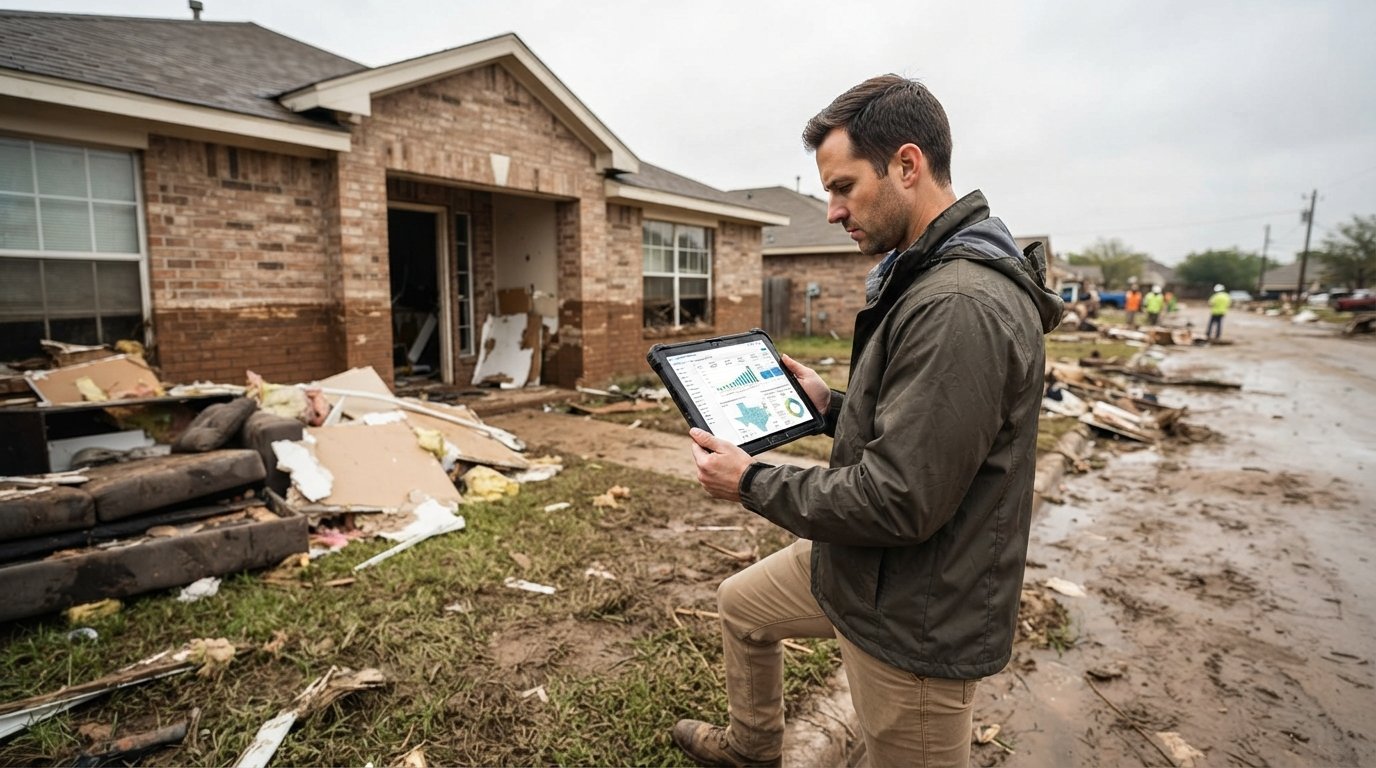
Uninsured owners become distressed sellers within weeks—prime targets for PPC lead campaigns
Budget Allocation and Bid Strategy for Distressed Property PPC Campaigns
Flood-driven demand doesn’t spread evenly across the calendar. It spikes hard in the first two to four weeks after an event, then tapers as sellers find buyers or repair their homes.
We build budget curves that reflect that reality instead of setting one flat daily spend for months on end:
| Phase | Timeframe | Budget Strategy |
|---|---|---|
| Immediate Response | Days 1-14 | Front-load spend, bid aggressively on event-specific and city keywords |
| Sustained Demand | Weeks 3-8 | Shift budget toward insurance-gap and repair-cost keywords |
| Tail Period | Months 3-6 | Scale back spend, keep evergreen distressed property terms running |
Data-driven decisions, not guesswork, decide when we shift budget from one phase to the next. That’s the difference between a campaign that runs out of steam and one that keeps your pipeline full through the entire recovery cycle.
Case Study: Turning $57 Leads into a 7.5X Return
Numbers matter more than promises. Our $57 leads to a 7.5X return case study shows exactly what a well-structured Google Ads campaign can deliver for a real estate investor working with motivated seller leads.
The same principles apply to flood-response campaigns, arguably with an even bigger upside. Flood victims move faster than the average distressed seller because their timeline is set by damage, insurance deadlines, and repair costs, not personal preference.
You can review additional results across different markets in our full case studies library and see how the same coordinated approach plays out for wholesalers outside flood-specific scenarios.
Did You Know?
59 Texas counties were included in a single disaster declaration for severe storms and flash flooding, giving PPC campaigns a precise geographic target list.
Source: Office of the Texas Governor
Combining PPC with Distressed Property Marketing for Long-Term Dominance
PPC wins the sprint. Organic search wins the marathon. Neither one alone builds the pipeline you need for the next flash flood, and Texas will have one.
One system, every channel: organic search, paid campaigns, and content run as a single coordinated engine, not disconnected tactics fighting for the same seller’s attention. Our SEO services for real estate investors build the city pages and situation pages that keep ranking long after your PPC budget shifts to the next disaster zone, while paid search captures the sellers who need an answer today.
REIRank owns that real estate so your competitors cannot, whether the conversation is about paid search bids or Map Pack rankings. Distressed property marketing built for Texas flooding needs both engines running at once, not one or the other.
You can see our full range of services, pricing tiers, and packages on our pricing page, along with answers to common questions on our FAQ page.
Conclusion: PPC Strategies for Distressed Property Leads
Texas flash floods create a predictable pattern: damaged homes, uninsured owners, and a short window to reach them before another wholesaler does. PPC strategies for distressed property leads following Texas flash floods work when they’re built around that specific window, not repurposed from generic distressed seller campaigns.
Geo-target the disaster counties. Speak directly to flood damage, not vague urgency. Send traffic to landing pages built for equity-rich, motivated sellers, not casual browsers. Do that consistently and your pipeline stays full long after the news cameras leave Kerrville and Austin.
We build exactly that kind of campaign, every time, for wholesalers who need results, not guesswork. Reach out to our team to talk through what a flood-response PPC campaign looks like for your market.
Frequently Asked Questions
What are the best PPC strategies for distressed property leads following Texas flash floods?
The best approach combines geo-targeting the officially declared disaster counties, using flood-specific keywords instead of generic distressed seller terms, and running dedicated landing pages built around insurance gaps and fast cash offers. Speed matters most, since demand spikes hard in the first two to four weeks after a flood event.
Is it worth running Google Ads to buy flood-damaged houses in Texas in 2026?
Yes, especially in counties covered by recent disaster declarations, where flooded homes are already selling at an average 10.8% discount and even steeper drops when future flood risk is high. Google Ads captures these sellers within days, faster than organic search alone can.
How do I target sellers looking to sell a flood-damaged house in Austin?
Build a dedicated ad group and landing page around “sell flood damaged house Austin” style keywords, separate from broader Texas-wide campaigns, and use ad copy that names the flood event and offers a fast, no-repair cash sale.
Are PPC leads from Kerrville flash flood damage still active in 2026?
Yes, demand for cash sales following the Kerrville flash flood remains strong as homeowners continue to deal with repair costs and insurance shortfalls months after the initial event. Ongoing distressed-property marketing in that region continues to attract qualified leads.
Should I target areas outside the official flood zone with my PPC campaign?
Absolutely. Around 40% of flood insurance claims come from outside officially designated high-risk flood areas, meaning plenty of distressed sellers live outside the mapped floodplain and won’t be reached if your targeting stops at the flood zone line.
How much should I budget for distressed property PPC after a Texas flash flood?
Front-load your budget in the first two weeks after the event when search demand peaks, then taper spend over the following months as urgency settles into a steadier, longer-term recovery cycle. Exact numbers depend on market size, but our case study shows what a well-run campaign can deliver on a modest per-lead cost.
What’s the difference between PPC and SEO for distressed property marketing after a flood?
PPC delivers immediate visibility for time-sensitive flood-related searches, while organic SEO builds long-term authority for ongoing distressed property marketing terms. Running both together, rather than choosing one, keeps your pipeline full during the flood spike and afterward.