

If you have been managing your real estate investing business out of a spreadsheet, a notebook, or worse, just trying to remember everything in your head, you already know the pain that comes with it.
Leads slip through the cracks. Follow-ups happen too late or not at all. A motivated seller who called three weeks ago and was not quite ready moves on to the next investor who stayed in touch.
Deals you could have closed ended up in someone else’s pocket simply because you were disorganized.
That is the problem a good CRM solves. And in 2026, finding the best CRM systems for real estate investors has become one of the most important decisions you can make for your business.
The market for CRM software is growing at a rate of nearly 10% annually, which tells you just how many businesses of all sizes have figured out that staying organized and following up consistently is not optional if you want to grow.
For real estate investors specifically, the right CRM for investors is the difference between a scattered operation that relies on luck and a systematic deal machine that generates consistent results regardless of market conditions.
ALSO READ:10 Best Ways to Build an Email List of Motivated Sellers and Buyers
This guide will walk you through exactly what to look for, how the best platforms compare, and how to choose the right one for where your investing business is at right now.
What a CRM Actually Does for Real Estate Investors
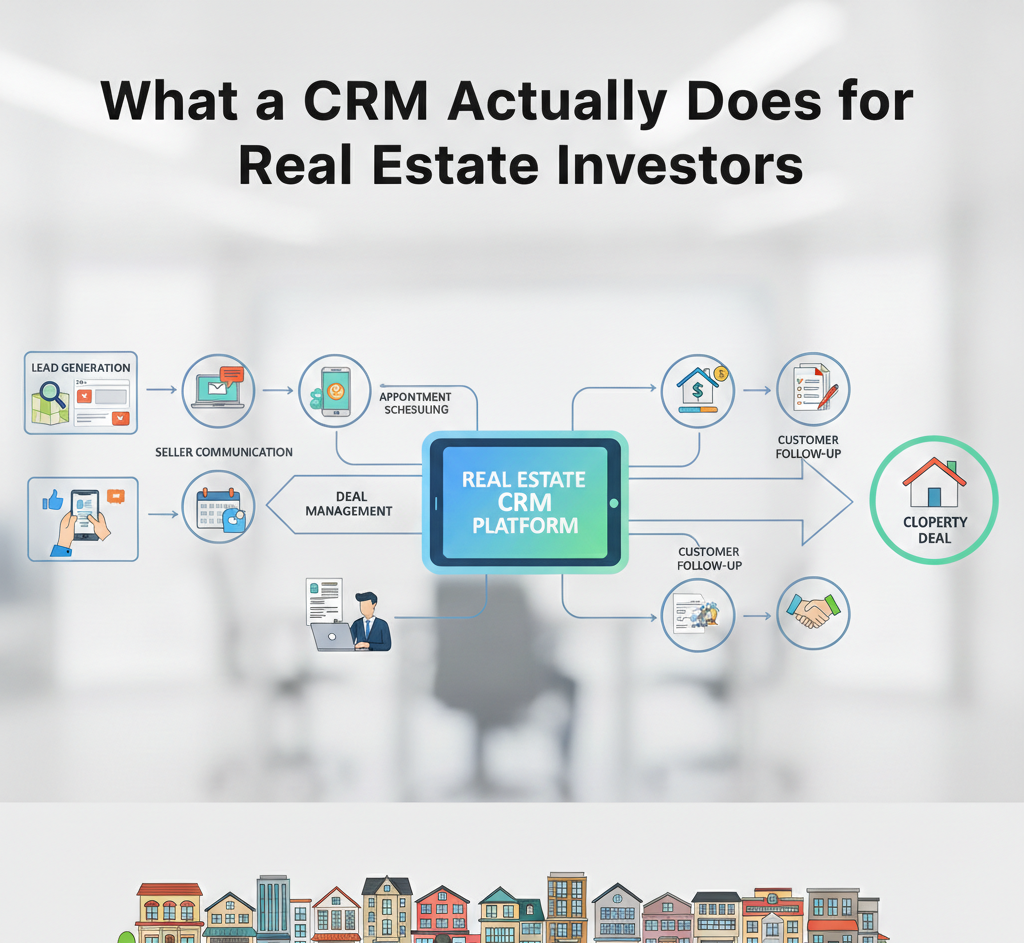
Let’s start with the basics, because many investors hear the term “CRM” and picture something complicated and expensive, better suited to a corporate sales team.
The reality is much simpler. CRM stands for Customer Relationship Management, and at its core, it is a system that organizes your contacts, tracks your conversations with them, and automates follow-up activities that keep your pipeline moving.
For a real estate investor, that means every motivated seller who has ever responded to one of your mailers, every buyer who has signed up to receive your deal alerts, every contractor, attorney, title company, and lender you work with regularly, all of them organized in one place where you can see exactly what stage of your process they are in, what the last communication was, and what needs to happen next.
What makes the best CRM systems for real estate investors different from generic CRM tools is that they are built around the specific workflows of a real estate investing operation.
According to research from JLL, real estate firms that maintain organized, accessible deal and relationship data close 25 to 35% more transactions annually than firms relying on fragmented communication tracking.
That is not a small edge. That is the difference between a mediocre year and a great one, and it comes entirely from being organized and consistent.
Why Most Standard CRMs Fall Short for Investors
Here is something worth understanding before you go shopping: most CRM platforms on the market were built for real estate agents, not real estate investors, and those are fundamentally different businesses with fundamentally different needs.
An agent CRM is designed to schedule showings, manage listing presentations, and send automated home search notifications to buyers.
It is built to manage a transaction that typically follows a predictable timeline from listing to closing. A real estate investor’s world looks nothing like that.
You are managing high volumes of off-market seller leads at various stages of motivation and readiness. You are running multi-channel outreach campaigns across direct mail, cold calling, SMS, and email simultaneously.
You are tracking deals through a pipeline that includes initial contact, property analysis, offer submission, negotiation, and closing, often with dozens of active deals in various stages simultaneously.
When investors try to force a standard agent CRM into their workflow, critical things fall through the cracks.
A seller who needs three more months of nurturing before they are ready to sell disappears from the radar because the system was not designed to handle long-term automated follow-up across months or years.
A buyer seeking specific deal criteria cannot be efficiently matched with new opportunities because the system lacks the necessary fields or filters.
The best CRM for investors is one that understands these distinctions and is built around the actual structure of an investing operation.
The Key CRM Features to Look for in 2026

Before getting into specific platforms, it helps to understand what features actually matter so you can evaluate any CRM with a clear framework.
These are the capabilities that separate the best CRM systems for real estate investors from the ones that will frustrate you within a month of signing up.
The first thing to look for is lead management and pipeline tracking that matches how you actually work. You need to be able to see every lead at a glance, know exactly where each one sits in your process, and understand what action is needed next.
A visual pipeline where you can move contacts from stage to stage, like motivated seller contacted, offer made, negotiating, under contract, or closed, is far more useful than a flat contact list.
Custom pipeline stages that you can configure to match your specific workflow are even better.
Automated follow-up is arguably the most valuable feature in any CRM for investors. The reality of real estate investing is that most sellers are not ready to move on the first, second, or even third contact.
Research consistently shows that a significant portion of deals come from leads that require months of consistent follow-up before converting.
A CRM that can automatically send scheduled emails, SMS messages, or task reminders based on where a contact sits in your pipeline means your follow-up happens reliably, whether you remember to do it manually or not.
Multi-channel communication capability is another essential feature in 2026.
Your sellers are reached through different channels at different times, and the best investor CRMs integrate phone, email, SMS, and sometimes even direct mail into a single platform where all communication history is logged automatically against each contact record.
Being able to see every text, call, and email you have ever had with a seller in one place, without having to search across multiple apps, saves enormous time and prevents the kind of context switching that leads to inconsistent follow-up.
Integration with your other tools matters too. If you use a skip tracing service to find contact information for property owners, a driving for dollars app to find distressed properties, or a direct mail platform to send marketing pieces, your CRM should connect with those tools so that data flows between them without requiring manual entry.
The best CRM systems for real estate investors in 2026 are designed to serve as the central hub of a complete technology stack, not an isolated tool that requires you to move data back and forth manually.
Finally, reporting and analytics are what allow you to run your business on data rather than gut feeling.
A CRM that tells you which lead sources are producing the best conversion rates, how long deals are taking to move through your pipeline on average, and which team members are converting the most prospects gives you the information you need to make smarter decisions about where to invest your time and marketing budget.
The Best CRM Platforms Worth Knowing in 2026
Now that you understand what to look for, let’s talk about the specific platforms that are earning the strongest recommendations from real estate investors and independent reviewers in 2026.
REsimpli is consistently ranked as the best all-in-one CRM for active investors and wholesalers in 2026. What makes it stand out is the sheer breadth of what it includes under a single login.
Lead management, skip tracing, a built-in phone system, multi-channel drip campaigns across SMS, email, voicemail drops, and direct mail, a website builder, e-signatures, and even basic accounting are all part of the platform.
For investors who have been cobbling together five or six separate tools with automation workarounds, REsimpli can replace most of that stack and significantly simplify operations.
The AI additions are genuinely useful, including VoiceFollow AI that handles inbound seller calls, collects property details, and schedules follow-ups automatically.
Pricing starts at $149 per month for the basic plan, with pro and enterprise tiers available. It is best suited for active investors and wholesalers who manage high volumes of motivated-seller leads.
REI BlackBook is another strong option for the investor and wholesaler market, particularly for those who want a platform specifically designed around the investor lead flow from initial capture through closing.
It includes a built-in phone and messaging, automated follow-up sequences, lead capture tools that connect directly to your website, and mobile access that lets you manage your pipeline on the go.
Pricing ranges from $97 per month for the basic plan to $297 for the professional tier, making it one of the more accessible options for investors in the early stages of growth.
DealMachine takes a slightly different approach by combining mobile-first lead capture with CRM functionality, designed around finding off-market deals in the field.
If a significant portion of your deal sourcing comes from driving for dollars, spotting distressed properties while out in the market, DealMachine is purpose-built for that workflow.
You identify a property, instantly pull up the owner’s contact information, and launch outreach directly from the app, with all activity automatically tracked in the CRM.
The platform also includes automated outreach sequences and direct mail integration. Pricing starts at $99 per month.
InvestorFuse is particularly well regarded among investors who manage acquisition teams rather than working solo.
Its design centers on structured follow-up processes and team accountability, with automated task assignment and workflow management that ensure every lead gets the right attention at the right time, regardless of which team member is responsible.
For investors who have moved past solo operations and are dealing with the challenges of managing team lead follow-up consistency, InvestorFuse addresses these challenges directly. Pricing starts at $147 per month.
For investors focused specifically on data and list building as the foundation of their sourcing strategy, BatchLeads is frequently described as the best-in-class option for property data, skip tracing, and list stacking.
It provides access to a massive national property database with extensive filtering options and built-in outreach tools, making it a powerful choice for investors who prioritize having the deepest possible data on the properties and owners in their target market.
PropStream occupies a similar space to one of the most comprehensive national property databases, offering over 120 lead filters and deep property intelligence to help investors identify the most motivated sellers in any geographic area.
For commercial real estate investors and investment firms managing capital raising and investor relations alongside deal management, Agora takes a completely different approach.
It is designed for the relationship-management needs of firms that work with limited partners and equity investors, rather than with motivated sellers.
Automated workflows for investor communications, document collection, reporting, and distributions make it a powerful tool for that specific use case, though its pricing starting at $749 per month reflects the institutional market it serves.
The Role of AI in CRM for Investors in 2026
One of the most significant shifts in the CRM landscape for real estate investors in 2026 is the integration of genuine AI capabilities that go well beyond the basic automation available for years.
According to independent analysis, AI-powered CRMs are reducing deal response time by 40 to 60% through automated follow-ups, intelligent deal scoring, and prioritized pipeline management that surfaces the most promising opportunities at the right moment.
The practical implications for investors are significant. AI assistants built into leading CRM platforms can now draft personalized outreach emails, summarize seller conversations, score leads based on behavioral signals indicating readiness to transact, and flag the deals in your pipeline most likely to close if contacted now.
Rather than manually reviewing every lead in your database to decide who deserves attention today, your CRM does that analysis for you and delivers a prioritized action list that focuses your time where it will have the greatest impact.
For investors managing larger teams or higher lead volumes, this kind of AI-assisted prioritization is not a luxury feature.
It is a meaningful competitive advantage that allows you to move faster and follow up more intelligently than competitors who rely on flat contact lists and manual processes.
How to Choose the Right CRM for Your Investment Business
With so many solid options available, the question is not really which platform is the objectively best CRM for investors in the abstract. The question is which platform is the right fit for where your business is today and where you want it to go.
If you are new to investing and working primarily as a solo operator, the most important things are affordability and ease of use. You want a platform you will actually log in to and use consistently, rather than one that is so complex it sits untouched.
REI BlackBook or DealMachine both offer strong functionality at accessible price points and have learning curves that most investors can navigate without hiring a technical consultant.
If you are running an established wholesaling or flipping operation with a team and high lead volume, the all-in-one capability of REsimpli or the team accountability focus of InvestorFuse are worth the higher monthly investment because the efficiency gains and the deals you avoid losing to poor follow-up will almost certainly more than justify the cost.
If your business centers on data-driven prospecting and you rely heavily on list building and skip tracing to find motivated sellers, a platform like BatchLeads or PropStream with robust property data and integrated outreach may be a better fit than a pure CRM platform.
Whatever platform you choose, the most important thing is to actually use it consistently. The best CRM for investors is ultimately the one you adopt fully, input your contacts into, and build your follow-up workflows around.
A $300 per month platform that you use every day will produce dramatically better results than a $30 per month tool that you log into once a week. Commit to the process, build your workflows around your CRM, and let it do the systematic follow-up work that turns leads into deals over time.
Conclusion: Best CRM Systems for Real Estate Investors
The best CRM systems for real estate investors in 2026 are more capable, more intelligent, and more accessible than ever.
Whether you are managing motivated seller leads as a solo wholesaler, running an acquisition team across multiple markets, or managing investor relations at a commercial real estate firm, there is a platform built specifically for your situation and scale.
The core principle behind all of them is the same: organize your relationships, automate your follow-up, and ensure no lead ever falls through the cracks simply because you were too busy or too disorganized to stay in touch.
In a business where timing and consistency determine whether you close a deal or watch it go to a competitor, having the right CRM for investors is not a nice-to-have.
It is a fundamental business advantage that compounds in value with every contact you add and every workflow you build.
Start by identifying the features that matter most for your specific operation, match them to the platforms that deliver them best, and choose the one that fits your current budget and technical comfort level.
ALSO READ: TikTok for Real Estate Wholesalers
Then use it every day without exception, and watch what happens to your conversion rates when consistent, systematic follow-up finally becomes something your business does automatically.