
Understanding the true Google Ads cost for real estate investors in 2026 is one of the most important things you can do before committing a dollar to paid search advertising, because this is a channel where the difference between a well-planned campaign and a poorly structured one can easily mean spending three times as much for half the results.
The real estate investor keyword space is genuinely competitive, costs have risen meaningfully over the past two years, and the investors who get the best return from their Google Ads budget are almost always the ones who understood the cost landscape before they started rather than learning about it through months of expensive trial and error.
This guide gives you an honest, current picture of what Google Ads actually costs for motivated seller campaigns in 2026, what drives those costs up or down, and how to approach your budget in a way that maximizes the quality and volume of leads your spend produces.
Why Google Ads Costs Have Risen for Real Estate Investors
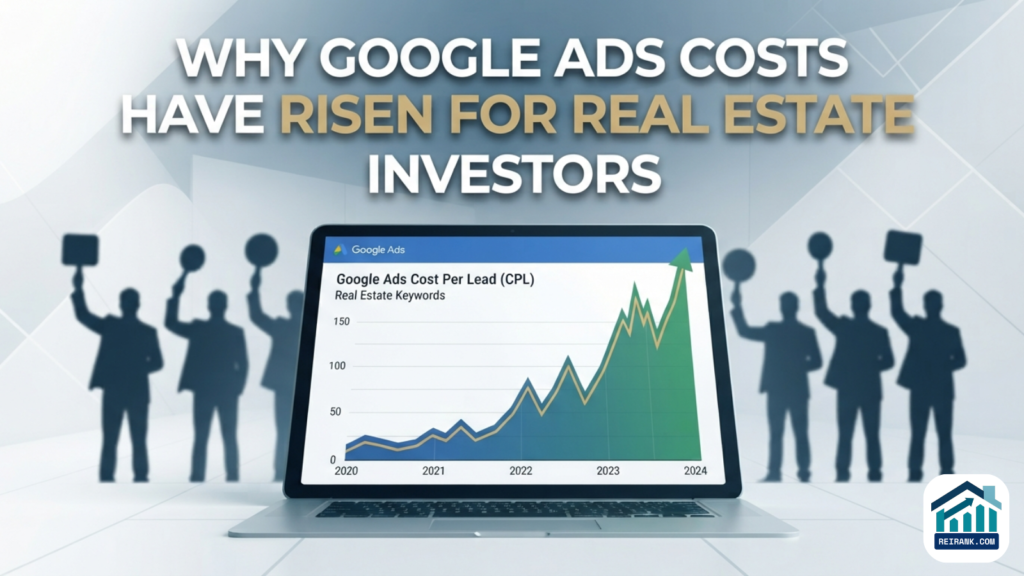
The cost of running Google Ads in the real estate investor space has increased consistently over the past several years, and 2026 is no exception to that trend. Several converging forces have driven costs upward in ways that are worth understanding before you build your budget expectations.
The first force is increased competition. As more real estate investors recognize the effectiveness of paid search for generating motivated seller leads, more of them are bidding on the same keyword phrases.
More bidders competing for the same ad positions drive up the cost per click across the board, particularly for the highest-intent phrases that everyone wants to appear for.
The second force is platform-level cost increases. According to data from WordStream and other PPC analysis platforms, average costs per click across Google Ads have risen significantly, with legal and real estate categories among the most affected.
The real estate investor PPC budget that generated a specific lead volume two years ago will typically produce fewer leads today for the same spend, which makes efficiency in campaign structure more important than ever.
The third force is the quality of competition. In many markets, the investors running Google Ads today are more sophisticated than those who ran campaigns several years ago.
They have better landing pages, better follow-up systems, and better keyword targeting, which means Google’s algorithm rewards them with lower cost per click through higher quality scores, making it harder for newer or less optimized campaigns to compete at the same cost level.
Understanding these forces does not change what Google Ads costs, but it does change how you think about structuring your campaign to get the best possible return on whatever budget you commit.
What Real Estate Investors Actually Pay Per Click in 2026
The most important cost figure for any investor evaluating Google Ads is the cost per click for motivated seller keywords, because this is the entry price for every visitor who arrives on your landing page through a paid search campaign.
For the core motivated seller keyword category, including phrases like “sell my house fast,” “we buy houses,” “cash home buyers,” and their local variations, cost per click figures in 2026 typically range from roughly fifteen dollars on the lower end in less competitive markets to fifty dollars or more per click in highly competitive metropolitan areas.
The national average for real estate investor keywords sits somewhere in the twenty-five to forty dollar range per click, though this varies significantly by market, by the specific keyword phrase, and by how well your campaign is structured.
These figures are meaningfully higher than general Google Ads averages across all industries, which reflects both the competitive nature of the motivated seller keyword space and the high transaction value associated with real estate deals.
An investor who closes even one additional deal from their Google Ads motivated seller leads campaign is generating returns that justify a relatively high cost per click, which is part of why bidding in this space remains intense despite rising costs.
What these click costs mean in practice depends on your landing page conversion rate. If you are paying thirty dollars per click and your landing page converts visitors to leads at a three percent rate, you are spending one thousand dollars for every lead your campaign generates.
If your conversion rate improves to six percent, that same spend produces two leads for the same cost. This is why landing page quality and optimization are just as important to your Google Ads cost efficiency as your bidding strategy.
Breaking Down the Real Estate Investor PPC Budget Requirements

When investors ask about Google Ads budget for motivated seller campaigns, the question they are usually really asking is how much do they need to spend to generate a meaningful volume of leads.
The honest answer depends on your market, your target lead volume, and your campaign efficiency, but there are useful benchmarks worth understanding.
For most local markets, a minimum meaningful monthly budget for a Google Ads motivated seller campaign sits somewhere between fifteen hundred and two thousand five hundred dollars per month.
Below this range, the daily budget available is often too limited to generate consistent data or meaningful lead volume, particularly in markets where cost per click is on the higher end of the range.
In moderately competitive markets, a monthly budget of two thousand to four thousand dollars typically generates somewhere between four and twelve motivated seller leads per month, depending on keyword selection, landing page quality, and campaign structure.
In highly competitive major markets, the same budget range may produce fewer leads at a higher cost per lead, while less competitive regional markets may produce stronger results from the same investment.
For investors who want to generate higher lead volumes or who operate in competitive markets, monthly budgets in the four thousand to eight thousand dollar range or above are common among established operations running serious Google Ads campaigns as a primary lead generation channel.
At this budget level, campaign data accumulates faster, Google’s algorithm has more to optimize with, and consistent management produces progressively more efficient results over time.
These ranges are starting points rather than fixed expectations. Your actual results will depend on factors specific to your market and your campaign that no general benchmark can fully account for.
The Factors That Affect Your Cost Per Lead Most Significantly
The cost per lead from a Google Ads motivated seller campaign is determined by two variables working together: the cost per click you pay to get visitors to your landing page, and the conversion rate at which those visitors become leads.
Understanding what drives each of these variables gives you the clearest possible picture of where to focus your optimization efforts.
On the cost per click side, keyword selection is the primary driver. Broad, highly competitive phrases like “sell my house fast” carry the highest click costs and the most competition.
More specific, longer-tail variations like “sell inherited house fast in [city]” or “how to stop foreclosure in [state]” often carry lower click costs meaningfully while still attracting highly motivated sellers who are close to making a decision.
A well-structured real estate investor PPC budget allocates spend across a mix of keyword types rather than concentrating everything on the most expensive phrases.
Quality score is another significant driver of your effective cost per click. Google rewards advertisers whose ads, keywords, and landing pages are closely aligned in relevance with lower costs per click.
An investor who builds tightly themed ad groups where every keyword, ad, and landing page are precisely aligned around the same seller situation will typically pay less per click than one running broad, loosely organized campaigns where relevance signals are weak.
On the conversion rate side, landing page quality is the single biggest variable. A landing page that loads in under two seconds on mobile, presents a clear and compelling headline immediately, places a simple contact form above the fold, and builds trust through testimonials and transparent process information will convert paid traffic at a meaningfully higher rate than a generic homepage or a slow, cluttered landing page. Improving conversion rate is often the most cost-effective way to reduce cost per lead without increasing budget.
Google Ads Motivated Seller Leads: Understanding What You Are Actually Buying
It is worth being clear about what Google Ads motivated seller leads actually are in 2026, because the nature of paid search leads differs from organic search leads in ways that affect how you evaluate the return on your investment.
A seller who finds your website through a Google Ad has expressed the same basic intent as one who finds you through organic search, which is that they are actively searching for a way to sell their property quickly. In this sense, paid search leads share the high intent quality that makes organic seller leads so valuable compared to purchased list leads or cold outreach contacts.
Where paid and organic leads differ is in what happened before they clicked. An organic lead has often spent time reading your content, understanding your process, and building some degree of familiarity with your business before making contact.
A paid lead may have clicked your ad as the first touch with your business, which means the landing page and immediate follow-up experience carry more weight in building the trust that moves them through your pipeline.
This distinction matters for how you structure your landing pages and your follow-up system for Google Ads traffic specifically. A paid lead who does not hear back within minutes of submitting a form is more likely to move on to the next result than an organic lead who has already engaged with your content and developed some connection to your business.
Speed to lead on paid campaigns is not just a best practice. According to research on lead response time, the odds of reaching a lead decline dramatically with each passing hour after submission, and for paid motivated seller leads in particular, a response within the first five to ten minutes produces significantly better contact rates than responses delayed even by thirty minutes.
Realistic Return on Investment Expectations for Motivated Seller Google Ads
Setting realistic return on investment expectations for Google Ads motivated seller campaigns requires honest accounting of all the costs involved rather than just the advertising spend itself.
Your real cost per deal from Google Ads includes the total advertising spend, your cost to manage the campaign whether in-house or through an agency, your landing page costs, and any CRM or follow-up automation costs attributable to this channel.
With average cost per lead figures for motivated seller campaigns ranging roughly from three hundred to eight hundred dollars per lead depending on market and campaign quality, and typical lead-to-deal conversion rates for well-run investor operations ranging from roughly five to fifteen percent depending on follow-up quality and market conditions, the cost per closed deal from Google Ads commonly falls in the two thousand to twelve thousand dollar range for most markets.
Measured against typical assignment fees, wholesale profits, or fix and flip margins, this cost per deal range is financially viable for most active investor operations, particularly in markets where deal values are substantial.
The investors who see the strongest returns are almost always those who combine efficient campaign structure with excellent follow-up systems and high-quality landing pages, compressing their cost per lead while maximizing the percentage of leads they successfully convert.
How Reirank.com Helps Real Estate Investors Get Better Results From Their Google Ads Budget
Running a Google Ads campaign that generates motivated seller leads efficiently in 2026 requires expertise across campaign structure, keyword strategy, ad copy optimization, landing page performance, and follow-up system integration.
Most real estate investors have the investing expertise but not the paid search expertise, and that gap tends to be expensive in a channel where inefficiency is immediately measured in dollars.
Reirank.com helps real estate investors build and manage Google Ads campaigns specifically designed for motivated seller lead generation.
From initial keyword research and campaign architecture through landing page optimization, bid management, and conversion tracking, every element is built around the goal of generating the highest possible quality and volume of motivated seller leads from your available budget.
If you are currently running Google Ads without seeing the lead volume or lead quality you expected, or if you are considering starting a paid search campaign and want to build it correctly from the beginning.
Visit our services page today to see how Reirank.com can help you get better results from your real estate investor PPC budget. Your free consultation is the starting point for a paid search strategy built around your specific market, your goals, and your available investment.
Conclusion: Google Ads Cost for Real Estate Investors
The Google Ads cost for real estate investors in 2026 is real, high, and rising in most markets. Understanding the benchmarks covered in this guide, what you can expect to pay per click, what monthly budget generates meaningful lead volume, and what factors drive your cost per lead up or down gives you the foundation you need to make informed decisions about whether and how to invest in this channel.
Google Ads motivated seller leads remain among the highest-intent leads available when campaigns are structured correctly, managed actively, and supported by landing pages and follow-up systems that convert that traffic efficiently.
The investors who generate the best return from this channel are the ones who treat it as a system requiring ongoing optimization rather than a set-and-forget expense.
Visit Reirank.com today to explore how a professionally managed Google Ads strategy can help you generate consistent motivated seller leads in your market while keeping your real estate investor PPC budget working as efficiently as possible.