

If you run a cash home buying business and your phone is not ringing as much as it should, the problem is rarely your offer. In most cases, it comes down to one thing: motivated sellers in your market simply cannot find you online.
That is where local SEO for real estate investors becomes the most valuable tool you have in your entire marketing arsenal.
Not ads, not cold calling, not driving for dollars. Organic local search is what moves the needle. When a homeowner in your city types “sell my house fast” or “cash home buyers near me” into Google, the investors who show up at the top of those results are the ones getting the calls.
And in 2026, with competition tighter than ever in the real estate investing space, mastering local search optimization is no longer optional. It is the foundation of a sustainable and scalable wholesale business.
This guide was written to give you a clear, practical, and complete understanding of how local SEO works, why it matters specifically for real estate investors, and exactly what steps you need to take to start dominating your local market in search results.
Whether you are just getting started or have been wholesaling for years with little online presence, what you are about to read will change how you think about your business’s digital footprint.
What Local SEO Actually Means for Real Estate Investors
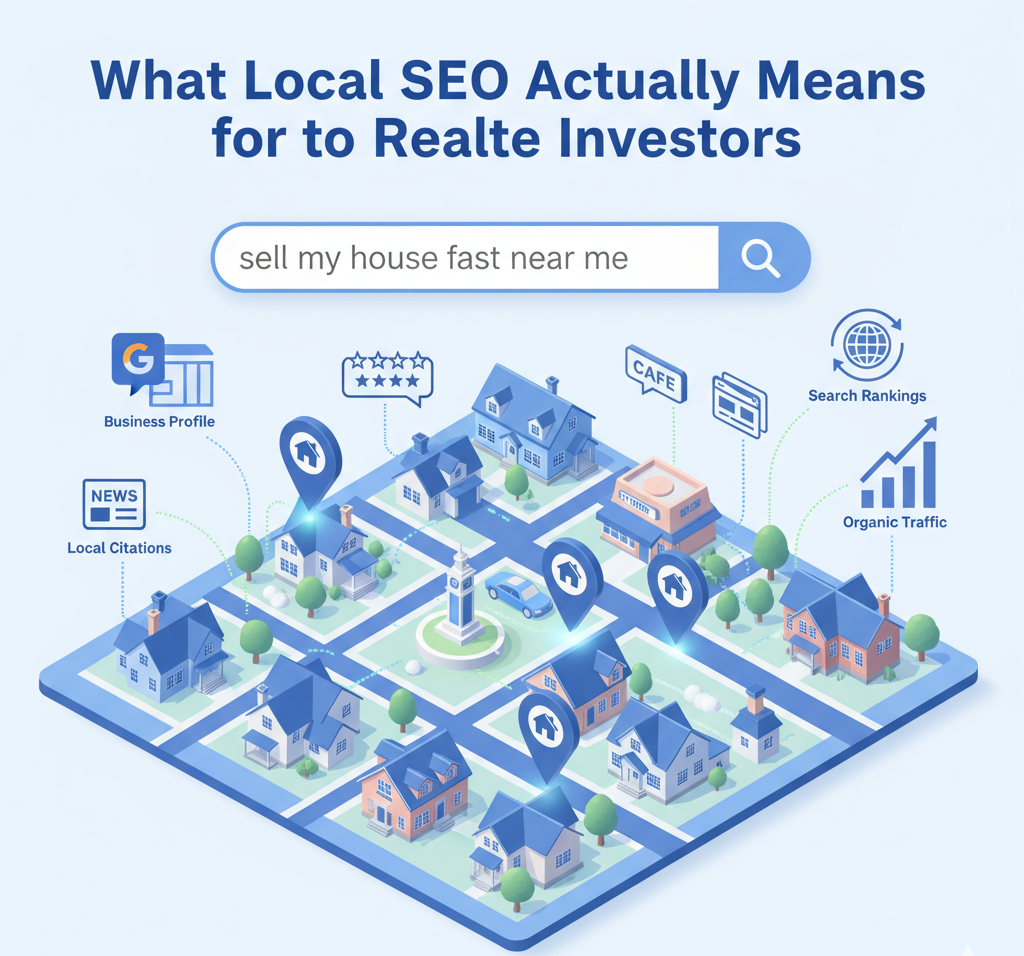
Before getting into tactics, it helps to understand what local SEO really is, because it is different from general SEO in some very important ways.
Local SEO is the process of optimizing your online presence so that your business shows up when people search for services in a specific geographic area.
For a real estate investor, that means making sure your website and online profiles appear prominently when someone in your target city or county searches for terms like “we buy houses [city],” “sell my house fast [city],” or “cash home buyers [city].”
The reason this matters so much for wholesalers specifically is that your business is entirely location-dependent. You are not selling a product to someone across the country. You are buying homes from people who live within driving distance of your operation.
Your market is intensely local by definition, and your marketing needs to reflect that. A real estate investor SEO guide that focuses solely on general traffic, without tying it to geography, misses the entire point.
What makes local SEO for real estate investors so powerful is that the people searching those terms are not casual browsers. They are homeowners under pressure, dealing with foreclosure, divorce, probate, financial hardship, or properties in disrepair, and they need a solution quickly.
That combination of high intent and urgency means that ranking well for local investor search terms converts at a significantly higher rate than almost any other form of digital marketing.
Why 2026 Is a Critical Year to Get This Right
The real estate investing space has seen an explosion of online competition over the past few years. Larger iBuyer platforms, national cash buyer networks, and private equity-backed wholesale operations have poured enormous resources into their digital marketing.
At the same time, Google has continued to refine its local search algorithms, placing greater emphasis on proximity, relevance, trust signals, and content depth than ever before.
What this means practically is that the window for smaller, independent wholesalers to carve out strong local search positions is still open, but it is getting narrower every month.
Investors who build their local search optimization foundations now, in 2026, will be the ones who enjoy consistent organic lead flow for years to come.
Those who wait will find themselves competing against more entrenched competitors with deeper content libraries, more backlinks, and longer-established Google Business Profiles.
The good news is that local SEO still rewards specificity and consistency over sheer budget. A focused and well-executed REI local SEO strategy from a single market investor can absolutely outrank a national competitor that is spreading its content thin across dozens of cities.
Local authority is something you can genuinely build even as a small operation, and that is what makes this such a worthwhile investment of your time and energy.
The Three Pillars of Local SEO for Real Estate Investors

Understanding the structure of local SEO helps you prioritize your efforts intelligently. There are three foundational pillars that every investor website SEO strategy needs to address, and when all three are working together, the results compound quickly.
The first pillar is your Google Business Profile. This is the listing that appears in what is commonly called the Map Pack, which is the section of Google’s search results that shows a map with three business listings beneath it.
When someone searches “cash home buyers in [your city],” the Map Pack is often the first thing they see, sitting above the regular organic results.
Getting into those three spots is enormously valuable, and it starts with claiming, verifying, and fully optimizing your Google Business Profile. That means selecting the right business categories, writing a keyword-rich but natural description of what you do, uploading photos, and generating a consistent stream of genuine reviews from past sellers, partners, and contacts.
The second pillar is your website’s on-page SEO. This is where your actual web pages need to do the heavy lifting of telling Google and potential sellers exactly who you are, where you operate, and what you offer.
Every page on your site needs to be built around specific search terms that your target sellers are actually typing into Google. Your homepage should make it crystal clear that you are a cash buyer operating in a specific market.
If you serve multiple cities, you need individual landing pages for each one, each written with enough unique content that Google recognizes them as genuinely useful local resources rather than thin duplicate pages.
The third pillar is authority, and more specifically, the external signals that tell Google your business is a trustworthy and established presence in your local market.
This includes backlinks from local websites, consistent business citations across directories like Yelp, BBB, and real estate-specific platforms, and engagement signals that show real people are interacting with your content.
Building authority takes time, but it is what separates the investors who rank well from those who are stuck on page two, no matter how many tweaks they make to their website.
Setting Up and Optimizing Your Google Business Profile
Your Google Business Profile is arguably the single highest leverage element in local search optimization for investors, and most wholesalers are either not using it at all or leaving massive potential on the table with an incomplete profile. Setting it up correctly from the start makes everything else easier.
Start by claiming your profile if you have not already, and make sure your business name, address, and phone number, commonly referred to as NAP, are accurate and consistent with how that information appears everywhere else on the internet.
Inconsistencies in your NAP data send confusing signals to Google and can suppress your local rankings significantly.
Choose your primary business category thoughtfully. For most cash buyers, “Real Estate Investor” or “Real Estate Agency” are reasonable choices, but you should also look at what categories your top-ranking local competitors are using and consider whether those might be a better fit for your operation. Add secondary categories where relevant to broaden your profile’s relevance across related search terms.
The description section of your profile is prime real estate for naturally including your target keywords. Write two to three sentences that describe what you do, who you serve, and where you operate.
Something that reads naturally, mentions your city, and includes phrases like “cash home buyers” and “motivated sellers” will serve you well both with Google and with real humans who read your profile before deciding to call.
Reviews are where many investors drop the ball entirely. Google uses the quantity, recency, and quality of your reviews as a significant local ranking signal.
Make it a habit to ask every past seller, business partner, and referral source to leave you a review. Responding to every review, whether positive or negative, also signals to Google that your business is active and genuinely engaged with its community.
Building Keyword Optimized Pages That Actually Rank
Getting your website’s pages to rank for investor search terms requires a clear understanding of what your potential sellers are actually searching for.
The core keyword cluster for most cash buyers revolves around variations of “sell my house fast,” “we buy houses,” “cash home buyers,” and “sell my house as is,” all combined with your city or region name.
Your homepage should target your primary market city with these terms woven naturally throughout the content, the page title, the meta description, and the section headings. But beyond the homepage, the most impactful SEO investment you can make is creating dedicated city-specific landing pages for every market or neighborhood you actively buy in.
If you buy in five surrounding cities or suburbs in addition to your primary market, you need a well-developed page for each one. Each page should include locally relevant information, mention neighborhood landmarks or county names where natural, and make a clear case for why a homeowner in that area would want to work with you specifically.
This is where investor website SEO separates the professionals from the amateurs. Thin city pages that are essentially the same page with the city name swapped out will not rank, and may actually hurt your overall site authority.
Google’s systems are sophisticated enough to detect low-effort duplicate content, and when it does, it tends to ignore those pages entirely.
Instead, take the time to write genuinely useful and locally flavored content on each page, addressing the specific real estate market conditions in that area, the types of homes you buy there, and any local considerations that matter to sellers.
Your blog is another powerful tool for building topical authority over time. Consistently publishing articles that address the questions and concerns your target sellers are already researching, things like “what happens to my mortgage when I sell my house fast” or “can I sell my house during foreclosure in [state],” demonstrates to Google that your site is a knowledgeable resource in the real estate space. That topical credibility reinforces your rankings for the commercial pages that actually generate leads.
Citations, Backlinks, and Building Local Authority
Once your Google Business Profile is optimized and your website pages are properly built out, the next focus for your local search optimization strategy is building the external authority signals that push your rankings higher and cement your position in the Map Pack.
Citations are listings of your business name, address, and phone number on external directories and websites. Getting listed consistently across platforms like Yelp, Angi, the Better Business Bureau, Manta, Hotfrog, and real estate-specific directories sends Google a clear message that your business is legitimate and well established.
The keyword is consistency, because even minor variations in how your business name or address appears across different directories can create conflicting signals that dilute your local authority over time.
Backlinks, which are links from other websites pointing to yours, are one of the strongest ranking signals in all of SEO, and local backlinks carry particular weight for local search.
Think about what local websites might naturally link to a real estate investor’s site: local news outlets that might cover a story about your business, real estate attorneys or title companies in your area who might mention your services on their own site, local real estate investor association websites, and local business directories.
Building these relationships takes time and genuine community involvement, but the payoff in search rankings is substantial and durable in a way that paid traffic simply never is.
Tracking Your Progress and Knowing What to Measure
Local SEO is a long game strategy, and understanding how to measure your progress keeps you from getting discouraged when results do not appear overnight.
The most important metrics to track are your keyword rankings for your primary search terms, the number of calls and form fills that come directly from organic search, your Google Business Profile’s call and direction request counts, and your website’s overall organic traffic trend over time.
Setting up Google Search Console and Google Analytics on your site costs nothing and gives you direct visibility into which search terms are driving traffic, which pages are performing well, and where there may be gaps in your content.
Review these metrics monthly at a minimum, and pay attention to patterns rather than single session snapshots. Local SEO tends to build steadily over three to six months before you see significant ranking movement, and then results often compound quickly once you have established a credible and trusted local presence.
The investors who stay patient through the early months and keep executing consistently are the ones who end up owning their local search results. It is not luck, and it is not magic. It is the product of showing up with quality, relevance, and authority over a sustained period of time.
Conclusion: Local SEO for Real Estate Investors
Local SEO for real estate investors is not a complicated concept, but it does require consistent effort, strategic thinking, and a willingness to play the long game.
When you optimize your Google Business Profile, build out keyword-targeted pages for every market you serve, earn legitimate reviews, build local citations and backlinks, and consistently publish helpful content through your blog, you are building a marketing asset that grows more valuable every single month.
The investors who understand this and invest in their REI local SEO now are the ones who will still be generating consistent and high-quality motivated seller leads years from now, without depending entirely on paid ads or cold marketing channels that stop the moment you stop paying for them.
Organic local search is the most sustainable and cost-effective lead source available to a real estate wholesaler, and in 2026, with the right strategy in place, it is still very much winnable for investors who are willing to put in the work.
If you are ready to stop guessing and start building a local search presence that actually delivers motivated sellers to your pipeline on a predictable basis, the place to start is a comprehensive audit of where your business stands today. From there, every step in this guide gives you a clear and actionable path forward.