

You could have the best real estate investor website in your market. Great content, fast loading speed, solid backlinks. But if your title tags and meta descriptions are weak, none of that matters as much as it should.
Because before anyone visits your site, they see your title and your meta description. That two-line preview in Google search results is your first impression. And first impressions in real estate are everything.
This guide is for real estate investors who want to stop being invisible in search results and start winning clicks from motivated sellers.
We are going to break down exactly how title tags and meta descriptions work, how Title Tags and Meta Descriptions That Win Clicks for Investors why they matter so much in 2026, and how to write them in a way that gets people clicking on your listing instead of your competitor’s.
Why Title Tags and Meta Descriptions Matter More Than Ever
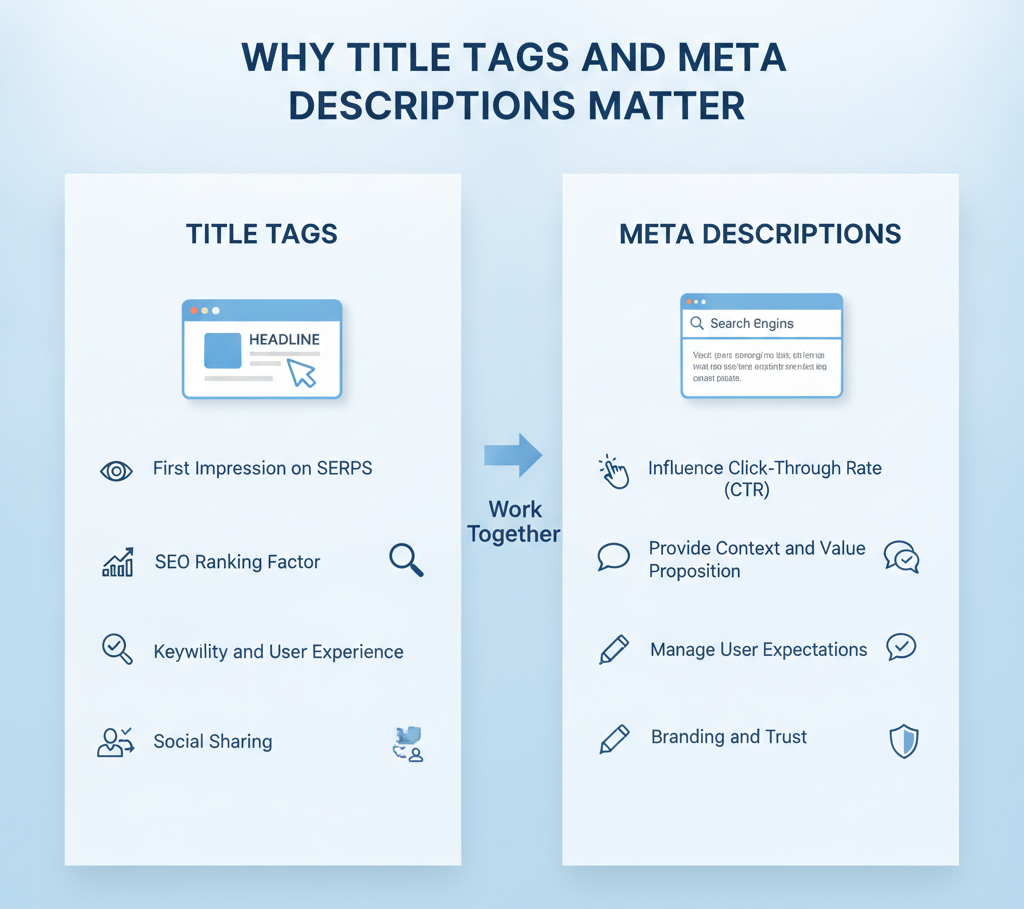
Google has gotten smarter every year. But one thing has not changed. The title and description of your page are still the primary factors that determine whether someone clicks on your result or scrolls right past it.
Think about it from the seller’s perspective. They are sitting at their kitchen table at 11 pm, stressed about a house they need to sell quickly. They type “sell my house fast in Atlanta” into Google. Ten results appear.
The ones with clear, specific, trustworthy-looking titles and descriptions get the clicks. The vague ones get ignored.
Title tags and meta descriptions that win clicks are not about being clever. They are about being clear, relevant, and compelling in about 160 characters or fewer.
That is a tight window. But when you nail it, the results show up quickly in your click-through rate and eventually in your inbound lead volume.
For real estate investors, this is not just an SEO technicality. It is a direct line to motivated sellers.
What Is a Title Tag and What Does It Actually Do
A title tag is the clickable headline that appears in Google search results. It is also the text that shows up on the browser tab when someone is on your page. Behind the scenes, it lives in the HTML of your webpage inside a title element.
Google uses your title tag to understand what your page is about. It is one of the strongest on-page SEO signals you can send. When your title tag includes the exact phrase a seller just typed into Google, your result feels immediately relevant to them.
The recommended length for a title tag is between 50 and 60 characters. Go too short, and you waste valuable space. Go too long, and Google cuts it off with an ellipsis, which makes your listing look unfinished and unprofessional.
For real estate investors, every page on your website should have a unique title tag. Your homepage title is different from your how-it-works page title, which is different from your contact page title.
Each one should speak to the specific intent of someone landing on that page.
What Is a Meta Description and Why Should You Care

A meta description is the short paragraph of text that appears beneath your title tag in search results. Google does not use it as a direct ranking factor, but that does not mean it is unimportant. Far from it.
The meta description is your pitch. It is the few sentences that convince someone who has already seen your title to actually click. Meta descriptions’ SEO value lies precisely in this ability to influence click-through rate, and click-through rate does influence rankings indirectly.
When more people click your result and spend time on your site, Google interprets that as a signal that your page is relevant and valuable.
A well-written meta description for a real estate investor website might say something like: “We buy houses in Dallas for cash, any condition, no agent fees.
Get your fair offer in 24 hours. No repairs, no stress.” That is specific, benefit-driven, and speaks directly to what a motivated seller wants to hear.
The ideal length is between 150 and 160 characters. Anything longer gets cut off on the desktop. On mobile, it can be even shorter, so front-load the most important information.
The Anatomy of a Winning Title Tag for Real Estate Investors
There is a simple formula that works consistently for investor websites. It goes: Primary Keyword plus Location plus Value Proposition. Let us look at what that means in practice.
A weak title tag looks like this: “Home – Cash Home Buyers LLC.” That tells Google and the searcher almost nothing useful.
A strong title tag looks like this: “Sell Your House Fast in Houston for Cash – No Repairs Needed.” That hits the search intent, the location, and the benefit all in one line.
Here are the elements that make title tags and meta descriptions that win clicks work for investors specifically.
Specificity beats vagueness every time. “We buy houses” is too broad. “We buy houses in any condition in Phoenix” is specific and immediately relevant to someone in Phoenix.
The city name matters enormously. Most motivated sellers search with their city included. If your title tag does not include the city you serve, you are missing a huge segment of your potential traffic.
Action words create momentum. Words like “sell,” “get,” “close,” and “start” push the reader toward action. Passive titles feel flat.
Numbers add credibility. “Get a cash offer in 24 hours” is more compelling than “get a fast cash offer” because it sets a concrete expectation.
Avoid using your company name in the title unless you are a known brand. Most sellers do not know your company. They care about what you can do for them.
ALSO READ: Top 5 Proven SEO Timeline Facts for Real Estate Investors
Writing Meta Descriptions That Actually Convert
Good meta descriptions for real estate investors are written for one specific person. The motivated seller.
Someone who is facing foreclosure, going through a divorce, dealing with an inherited property, or just needs to move fast. Your meta description needs to speak to their situation and their desired outcome.
The best meta descriptions SEO professionals write for investor sites follow a simple structure. They acknowledge the seller’s situation, present the solution, and end with a soft call to action.
Here is an example for a foreclosure-focused page: “Facing foreclosure in Memphis? We can close in as little as seven days and help you walk away with cash. No fees, no repairs, no waiting. Call us today.”
That meta description does several things at once. It addresses a specific pain point. It offers a concrete benefit. It removes common objections like fees and repairs. And it ends with a clear next step.
Here is what to avoid. Do not stuff your meta description with keywords. It reads as robotic, and it reduces trust. Do not write generic descriptions that could apply to any business.
And do not ignore the description entirely and leave it blank, because Google will pull random text from your page, which rarely sounds good.
One important note about meta SEO for real estate: Google sometimes rewrites your meta description if it does not think your version matches the search query well enough.
This happens more often when your description is too vague or does not match the content on the page. The solution is to write descriptions that closely mirror your page content and naturally include the key phrases your target sellers are searching for.
Meta SEO for Real Estate: Page-by-Page Strategy
Different pages on your investor website serve different purposes. Your title tags and meta descriptions should reflect that.
Your homepage title tag should focus on your core offer and primary market. Something like “We Buy Houses Fast for Cash in [City] – [Your Brand]” works well here. The meta description should summarize who you are, what you do, and why sellers should choose you.
Your how-it-works page should have a title that speaks to process and simplicity. “How Our Cash Home Buying Process Works – 3 Simple Steps” sets expectations and reduces anxiety for sellers who are researching before they commit.
Your testimonials or reviews page title should leverage social proof. “See What Homeowners Say About Selling to [Brand] in [City]” works because it positions the page as validation rather than a sales pitch.
Your FAQ page title should directly target question-based searches. “Frequently Asked Questions About Selling Your House for Cash in [City]” is the kind of long-tail title that captures sellers in the research phase of their journey.
Your contact page title should be action-oriented. “Get Your Free Cash Offer Today – No Obligation – [City]” removes hesitation and makes the next step feel easy.
This page-by-page approach to meta descriptions SEO is what separates investor websites that generate consistent inbound leads from those that get traffic but no conversions.
Common Mistakes Real Estate Investors Make With Title Tags
The most common mistake is using the same title tag on every page. This is called duplicate title tags, and it confuses search engines. Each page covers a different topic and should have a unique, specific title.
The second mistake is writing titles for search engines instead of people. Yes, you want to include your keyword. But the title also needs to sound natural and compelling to a real human being who is scanning search results.
The third mistake is ignoring mobile. More than half of all searches now happen on mobile devices. Mobile search results show even fewer characters than desktop. Keep your titles tight, and put the most important words first.
The fourth mistake is never testing or updating. Title tags and meta descriptions are not set-and-forget elements. Check your Google Search Console regularly. If a page has high impressions but a low click-through rate, that is a signal that your title or description needs work.
The fifth mistake is being generic with the value proposition. Every investor site says, “We buy houses fast.” You need to say why yours is different. Faster closing? Higher offers? More flexible terms? Weave that into your title and description.
How to Test Whether Your Title Tags Are Working
Google Search Console is your best friend here. Navigate to the Performance section and look at your pages sorted by impressions. Find pages that appear frequently in search but have a low click-through rate. Those are your priority pages for title and description rewrites.
A good benchmark for investor websites in competitive local markets is a click-through rate of three to five percent from organic search. If you are significantly below that on your main pages, your titles and descriptions need attention.
Make one change at a time and give it four to six weeks before evaluating the impact. SEO changes take time to reflect in data. Patience is part of the process.
You can also use free tools like Serpsim, which previews how your title and meta description will look in actual Google search results before you publish. This helps you catch truncation issues and make adjustments before they go live.
The Role of Title Tags in the Broader Investor SEO Picture
Title tags and meta descriptions do not work in isolation. They are one part of a complete on-page SEO strategy. But they are the part that directly faces the searcher.
Every other SEO effort you make, content writing, link building, schema markup, and site speed optimization, feeds traffic to your pages. Your title and description determine what percentage of that traffic actually clicks through.
Think of it this way. Your SEO strategy gets you in front of motivated sellers. Your title tags and meta descriptions that win clicks are what get them to your website. And your website converts them into leads.
Each stage matters, and this particular stage is often the most neglected.
The competition for motivated seller attention online is fierce. Investors who pay attention to the small details, like title tag optimization, are the ones who build sustainable lead pipelines. Those who ignore it keep wondering why their traffic does not convert.
Quick Reference: Writing Formulas That Work
For homepages, try: “Sell Your House Fast for Cash in [City] – Close in 7 Days”
For location pages, try: “We Buy Houses in [Neighborhood], [City] – Any Condition, Any Situation”
For process pages, try: “How to Sell Your House Fast for Cash in [City] – Simple 3-Step Process”
For FAQ pages, try: “Cash Home Buyer FAQs in [City] – Your Questions Answered”
For meta descriptions, pair each title with a two-sentence description that expands on the benefit and ends with a soft call to action like “Get your free cash offer today” or “Call us now to get started.”
Keep these formulas as templates, but always customize them for your specific market and offer. Generic templates get generic results.
Conclusion: Title Tags and Meta Descriptions That Win Clicks
Title tags and meta descriptions are small pieces of code with outsized impact. For real estate investors, they represent the difference between showing up in search results and actually getting clicked.
Between appearing credible and appearing invisible. Between a steady flow of motivated seller leads and a website that just sits there.
The investors who win in search in 2026 are the ones who treat every element of their online presence with intention. Meta descriptions SEO for real estate is not complicated once you understand the principles.
Be specific. Be clear. Speak to your seller’s situation. Remove their objections before they even visit your site. And test and refine consistently.
You now have everything you need to rewrite your title tags and meta descriptions with confidence. Start with your homepage and your highest-traffic pages. Make the changes. Monitor the results. And watch your click-through rate improve over the coming weeks.
Stop Leaving Motivated Seller Leads on the Table
Here is the hard truth. Optimizing your title tags and meta descriptions takes time, testing, and ongoing attention. And that is just one piece of your digital marketing puzzle.
Most real estate investors are great at finding deals and closing transactions, but stretched too thin to give their online presence the attention it deserves.
That is exactly the gap our REI digital marketing and lead generation services are built to close. We handle everything from title tag and meta description optimization to full local SEO strategy, Google Business Profile management, motivated seller content, and paid lead generation campaigns, all built specifically for real estate investors.
You should be spending your time evaluating properties and closing deals, not rewriting HTML metadata and analyzing search console data.
Visit our services page today and let us build you a digital marketing system that consistently brings motivated sellers to your door.