

There is a version of real estate investing that most people imagine when they first get started, one where the deals come from driving for dollars, knocking on doors, and sending out mailers by the hundreds, hoping that somewhere in that pile of paper a motivated seller will pick up the phone.
And while those methods still have their place, the investors who are consistently winning in 2026 are the ones who have figured out how to make Google do a significant portion of that prospecting work for them.
At the heart of that approach, quietly powering some of the most reliable lead pipelines in the business, is something called local citations.
If you are a real estate investor or wholesaler trying to build the best local citations for real estate investors, you are in exactly the right place.
This guide is going to walk you through everything you need to understand about what local citations actually are, why they matter so much in today’s search environment, and precisely how to build them in a way that drives consistent, predictable organic traffic to your website without spending a dollar on paid advertising.
Whether you are buying distressed properties, wholesaling deals to other investors, or running a cash-for-houses operation, the strategies covered here will help you dominate local search results in your target market.
What Local Citations Actually Are and Why They Matter
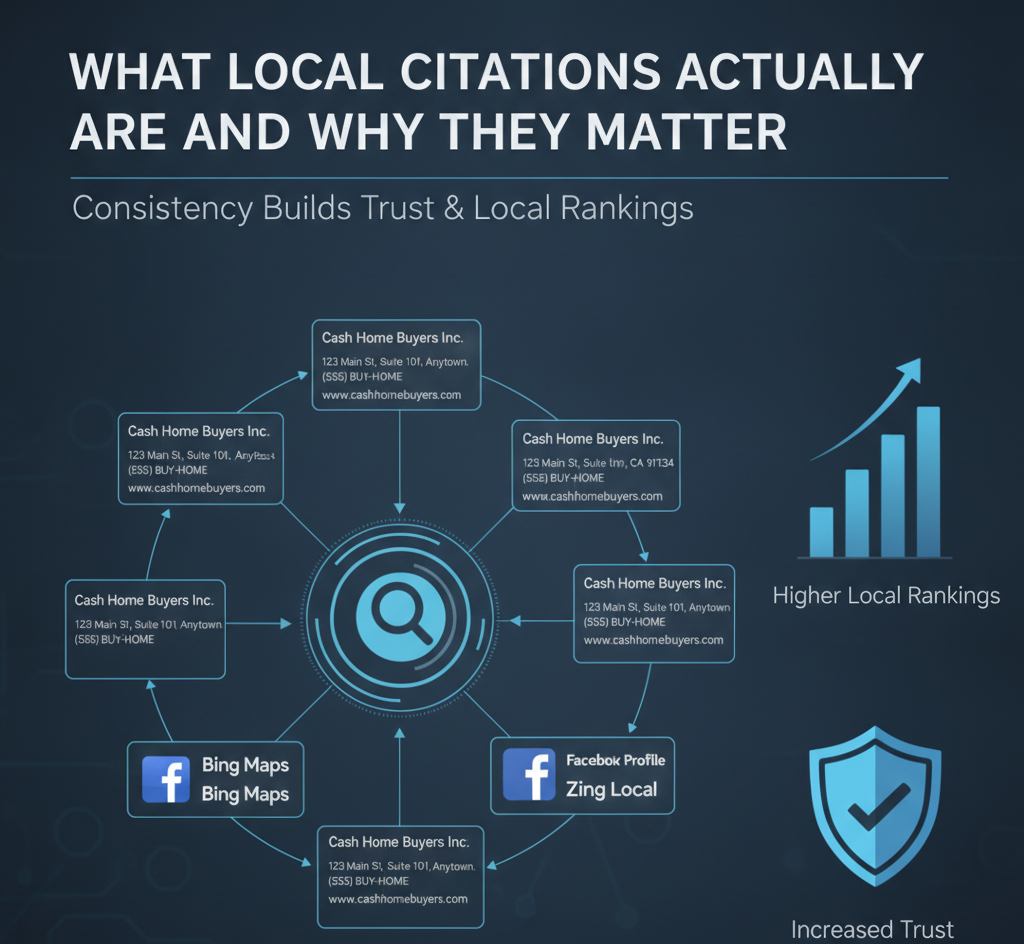
Before anything else, it is worth making sure we are all on the same page about what a local citation actually is, because many investors hear the term and assume it means something more complicated than it is.
A local citation is simply any place on the internet where your business’s name, address, and phone number appear, whether that is a business directory, a review platform, a social media profile, a local chamber of commerce listing, or any other third-party website that references your business information.
The combination of your business name, address, and phone number is referred to in the SEO world as your NAP, and NAP listing building is a foundational activity in any serious local search strategy.
When search engines like Google are deciding which local businesses to show in their results for a query like “sell my house fast in [your city],” one of the key factors they evaluate is how consistently and broadly your business information appears across the web.
Each accurate citation sends Google a clear signal that your business is real, that it operates at a specific address, and that multiple independent sources consistently confirm this information.
What makes this particularly important for real estate investors is the business’s deeply local nature. Unlike a software company that might have customers anywhere in the world, your motivated sellers are almost always within a specific geographic radius.
When someone in your target area searches for a solution to their property problem, Google is going to show them results it believes are most locally relevant and most trustworthy.
A well-built citation profile is one of the clearest ways to earn that trust, and for investors who have not yet invested time in citation building, REI, the opportunity to gain a meaningful competitive advantage right now is substantial.
The Role of NAP Consistency in Your Citation Strategy
If there is one principle that runs through every single aspect of local citation building, it is consistency. The concept of NAP consistency means that your business name, address, and phone number appear in the same format, with the same spelling and punctuation, across every platform where your business is listed.
This sounds straightforward, but in practice, it is one of the most common places where real estate investors unknowingly undermine their own local SEO performance.
Consider how many small variations can creep in over time. One directory might list you as “Smith Home Buyers LLC” while another has “Smith Homebuyers, LLC” and a third simply shows “Smith Home Buyers.” Your address might appear as “1402 Oak Street” in one place and “1402 Oak St.” in another.
Your phone number might use parentheses around the area code on some listings and hyphens on others. To a human reader, all of these variations obviously refer to the same company. But search engines process this information algorithmically, and even small inconsistencies can create confusion that dilutes the trust signals your citations are meant to provide.
The solution is to create what many SEO professionals call a master NAP record before you do anything else. This is a single document, kept somewhere accessible, that spells out exactly how your business name, address, and phone number should appear in every listing you create or claim.
Once you have locked that format, you use it identically everywhere without deviation. In 2026, experts recommend going even further and standardizing what is sometimes called your NAPW profile, which extends the concept to include your website URL, business hours, a keyword-rich description, your primary business category, professional photos, and any relevant secondary categories.
This expanded digital fingerprint gives search engines the richest possible picture of your business identity and helps you stand out in local search results.
Starting with Google Business Profile
When you are ready to begin building or improving your local citations real estate investor profile, there is one platform you should address before all others, and that is Google Business Profile, formerly known as Google My Business.
Google Business Profile is the most powerful single citation a real estate investor can have because it directly powers the “local pack,” those three prominent business listings that appear at the top of Google search results with a map, contact information, and reviews.
Claiming your Google Business Profile listing is free, and the process is relatively straightforward. You search for your business in Google’s system, claim the listing if it already exists, or create a new one, and then verify your ownership through a postcard, phone call, or email verification process.
Once you have access, the goal is to fill out every single field as completely and accurately as possible. Your business name should reflect what you actually call your company.
Your address needs to be precise and match the master NAP record you created. Your phone number should be a number you actively monitor. Your website URL should point directly to your investor website.
Beyond the basics, categories matter enormously for real estate investors. Choosing the most accurate primary category, something along the lines of “Real Estate Investor” or “Property Management Company,” depending on your specific business model, helps Google understand who you are and what you do.
Adding high-quality photos of your team, your office, if you have one, and properties you have worked with adds credibility and makes your listing more engaging.
And encouraging satisfied sellers to leave reviews on your Google Business Profile is one of the highest-leverage activities in your entire local SEO strategy, as positive reviews both build trust with new prospects and send strong ranking signals to the algorithm.
Building Citations on Core Data Aggregators
One of the most time-efficient aspects of citation-building REI strategy is understanding that a handful of major data aggregators distribute business information to dozens or even hundreds of smaller directories automatically. In the United States, the primary data aggregators are Data Axle, Neustar Localeze, and Foursquare.
When you submit accurate business information to these aggregators, that data flows downstream to a wide range of platforms that pull information from their databases, multiplying the impact of a single submission across a much broader footprint.
Getting your business listed correctly in these aggregators should be among your priorities after claiming your Google Business Profile. Many of them offer free submission options, though paid services can speed up the process and give you more control over how quickly your information propagates.
The key thing to understand is that even if you have never deliberately submitted your information to any of these aggregators, your business data may already exist in their databases, potentially with incorrect or outdated information. Claiming and correcting your records in these systems can clean up a surprising number of inconsistencies across the broader web.
Bing Places for Business and Apple Maps are also essential early submissions that many investors overlook. Bing still captures a meaningful share of search traffic, and Apple Maps and Siri rely on Apple’s location data to surface results for iPhone users asking location-based questions.
Given that a significant percentage of motivated sellers are searching from mobile devices, ensuring your investor directory listings are accurate and complete on Apple Maps is not something to skip.
Industry-Specific Directories for Real Estate Investors
Once you have the foundational platforms covered, the next layer of citation building involves getting listed on directories that are specifically relevant to the real estate industry and the cash buyer space. These industry-specific listings carry extra weight because they signal to search engines that your business is genuinely embedded in the real estate ecosystem, not just a generic business with a vague connection to property.
For real estate investors, the most relevant industry-specific directories include Zillow’s professional profile section, Realtor.com’s agent and investor directory, HomeAdvisor, Thumbtack, and various “we buy houses” style aggregator platforms that compile local cash buyers for sellers to browse.
Getting listed on these platforms does more than create citation signals; it can also generate direct inbound inquiries from motivated sellers who are already actively looking for cash buying options.
Local SEO citations wholesaler strategies should also include listings in real estate investor association directories. The National Real Estate Investors Association and its local chapters maintain directories of member investors, and being listed in these directories provides both citation value and credibility signals that can meaningfully strengthen your overall local authority.
Similarly, the Better Business Bureau, local chambers of commerce, and city or county business directories are all worth claiming because they represent high-authority, trusted sources that carry significant weight in Google’s local ranking algorithm.
Local Community and General Business Directories
Beyond the real estate-specific platforms, there is an entire universe of general business directories and local community platforms where getting your investor directory listings established contributes meaningfully to your citation profile.
Yelp, Yellow Pages, Foursquare, Angi, Manta, Hotfrog, Superpages, and the dozens of other general business directories that populate the internet each serve as an additional confirmation of your business’s existence, location, and legitimacy.
The logic behind listing on these platforms is straightforward. Each additional consistent mention of your NAP information across a reputable website adds another vote of confidence in your business’s local relevance. Search engines are essentially conducting a census of the web, trying to determine which businesses are genuinely active and trusted in a specific geographic area, and every consistent citation you build contributes to that picture.
The goal is not to have thousands of listings on every obscure directory imaginable; rather, it is to build a clean, consistent presence across the most authoritative and relevant platforms.
Community-focused platforms like Nextdoor deserve special mention for real estate investors because they offer something general directories cannot: a hyperlocal context that places your business directly within the specific neighborhoods where you want to do business.
When residents of a neighborhood see a credible investor presence on Nextdoor, it builds the kind of trust and familiarity that can lead to direct inquiries and referrals that no SEO tactic alone can replicate.
ALSO READ: 7 Essential NAP Consistency Tips for Better SEO That Every Real Estate Investor Needs to Know
How to Conduct a Citation Audit
If you have been operating as a real estate investor for any length of time, there is a strong chance that some version of your business information already exists in various directories, potentially with old phone numbers, outdated addresses, or slightly incorrect business names.
Before building new citations aggressively, it is worth conducting a citation audit to understand what already exists and identify inconsistencies that need to be corrected.
A citation audit begins with a simple search. Enter your business name in quotes in Google and review what appears. Do the same with your phone number and your address. This manual approach surfaces many of the most prominent citations that already exist and lets you assess their accuracy.
For a more comprehensive audit, tools like BrightLocal, Whitespark, and Moz Local are specifically designed to crawl the web, identify existing citations, flag inconsistencies, and suggest new citation opportunities.
BrightLocal’s citation finder is particularly popular among real estate investors and marketing agencies because it provides a clear dashboard view of your citation health and makes it easy to track what you have claimed and what still needs attention.
When you find existing citations with incorrect information, the right approach is to claim or access those listings and update them to match your master NAP record. Duplicate listings, which occur when the same business appears twice in the same directory, should be merged or the duplicate removed.
Duplicate listings can confuse search engines and dilute the authority of your primary listing, so cleaning them up is an important step in building a healthy citation profile.
Creating a Systematic Approach to Citation Building
One of the most common mistakes investors make when they first start paying attention to local SEO citations, wholesaler, and investor website rankings is approaching citation building in a random, disorganized way. They submit to a handful of directories they happen to think of, forget about them, and never develop a complete or coherent presence.
The investors who get the best results from citation building treat it as a systematic process with clear priorities, tracked progress, and regular maintenance.
A practical approach to organizing your citation-building effort starts with creating a spreadsheet that tracks every directory where you want your business listed, the status of each listing (claimed, pending, live, needs correction), the submission date, and the login information for each platform.
This living document serves as your citation management system, ensuring nothing falls through the cracks. Every time you build a new citation or update an existing one, you log it. Every time you need to update your business information for any reason, you have a complete list of all platforms that need updating.
The priority order for most real estate investors should follow a logical sequence that starts with the highest-authority and highest-traffic platforms and works outward. Begin with Google Business Profile, then Bing Places and Apple Maps, then the major data aggregators, then industry-specific real estate directories, then the large general directories like Yelp and Yellow Pages, and finally the broader universe of local and niche directories.
Working through this sequence methodically over several weeks or months builds a citation profile that grows in authority and consistency over time.
How Many Citations Do Real Estate Investors Need
A question that frequently comes up among investors new to local SEO is how many citations they need to achieve meaningful results in their local search rankings. The honest answer is that there is no universal magic number, and citation volume is only one of several factors that influence local search performance.
That said, most SEO professionals working in the real estate space suggest that a foundation of 30-50 high-quality, accurate citations on reputable platforms is a solid baseline for most markets.
In highly competitive markets with many investors competing for the same local search terms, you may need a more extensive citation profile to stand out. In smaller or less competitive markets, a well-optimized set of core citations on the most authoritative platforms may be sufficient to rank prominently for your target terms.
The quality of your citations matters far more than the raw quantity. A handful of accurate, consistently formatted citations on high-authority platforms will outperform hundreds of listings on obscure, low-quality directories every time.
What matters most is not reaching a specific number but rather achieving comprehensive coverage of the platforms most relevant to your business and your market, maintaining perfect consistency across all of them, and continuing to build new citations gradually over time as your business grows.
Citation building is not a one-time project; it is an ongoing element of your local SEO strategy that requires periodic attention to maintain accuracy and expand coverage.
Monitoring and Maintaining Your Citations Over Time
Building a strong citation profile is not something you do once and then forget about. Business information changes over time, and every change creates the potential for inconsistencies to creep back into your citation profile. If you change your phone number, move to a new office address, rebrand your business, or update your website URL, every single citation in your profile needs to be updated to reflect that change.
Failing to update your citations after a business change can undo months of careful work and create exactly the kind of conflicting information that hurts local rankings.
Setting a quarterly reminder to audit your most important citations is a practical habit that prevents small problems from compounding into large ones. Each quarter, you can quickly spot-check your Google Business Profile, your core directory listings, and any platforms that are particularly important for your market to confirm that your information is still accurate and that no duplicate listings have appeared.
Tools like BrightLocal and Moz Local offer ongoing monitoring features that can automate much of this process, alerting you when your information changes or new citations appear.
Reviews are another dimension of citation management that deserves ongoing attention. Responding to every review on your Google Business Profile and other platforms, both positive reviews with genuine gratitude and any negative reviews with professionalism and a commitment to resolution, demonstrates active engagement and builds the kind of credibility that converts website visitors into motivated seller leads.
The combination of consistent citations and active review management is one of the most powerful local SEO stacks available to investors who want to dominate their market organically.
Pairing Citations with a Broader Local SEO Strategy
While building the best local citations for real estate investors is a powerful and essential strategy, it is most effective when viewed as one component of a broader local SEO approach rather than a standalone tactic.
Citations tell search engines that your business is real, local, and consistent, but they work in concert with other signals, including the quality of your website content, the optimization of your on-page SEO elements, the strength of your local backlink profile, and the relevance and volume of reviews you accumulate.
The investors who see the most dramatic results from their local SEO efforts tend to be the ones who treat it holistically, ensuring that their citation profile is consistent and comprehensive, their website is well-optimized for local keywords, their Google Business Profile is regularly updated with fresh content and new photos, and their reputation is actively managed across all review platforms.
When all of these elements are working together, the cumulative effect on local search visibility can be genuinely transformative, moving you from invisible in Google’s local pack to a consistent first-page presence for the high-intent terms that drive your best leads.
Conclusion: Best Local Citations for Real Estate Investors
Building the best local citations for real estate investors in 2026 is not a complicated process, but it does require intentionality, consistency, and patience. It starts with locking down your NAP information in a master record and then systematically claiming and optimizing listings starting with Google Business Profile and working outward through data aggregators, industry-specific directories, and general business platforms.
It requires conducting a thorough audit to find and fix inconsistencies that may already be working against you, and it demands ongoing maintenance to keep your information accurate as your business evolves.
The reward for this investment of time and attention is a steady, predictable stream of organic leads from motivated sellers who found you because Google trusted your business enough to put it in front of them at exactly the right moment.
In a business where timing and trust are everything, there are few marketing activities with a better long-term return than getting your local SEO citations, wholesaler and investor profiles built correctly, maintained consistently, and supported by the rest of your digital marketing strategy. Start where you are, work systematically, and the results will compound in your favor over time.