

You have probably heard it before. Someone tells you that SEO takes time, and you nod along, half convinced, half skeptical. Because here is the thing.
When you are trying to generate motivated seller leads, time feels very personal. Every week you are not on page one is another week of mailers, cold calls, and chasing deals the expensive way.
So let’s have an honest conversation about the real estate SEO timeline, what it actually looks like, what happens when, and why the investors who understand it end up building the most sustainable lead generation businesses in the game.
These are not guesses or generic marketing claims.
These are five proven SEO timeline facts for real estate investors that will help you set the right expectations and take the right actions from day one.
Understanding the SEO timeline for real estate investors is what separates those who give up at month three from those who are closing deals from organic search by month nine. Let’s get into it.
#1: The First Three Months Are About SEO Foundation, Not Results
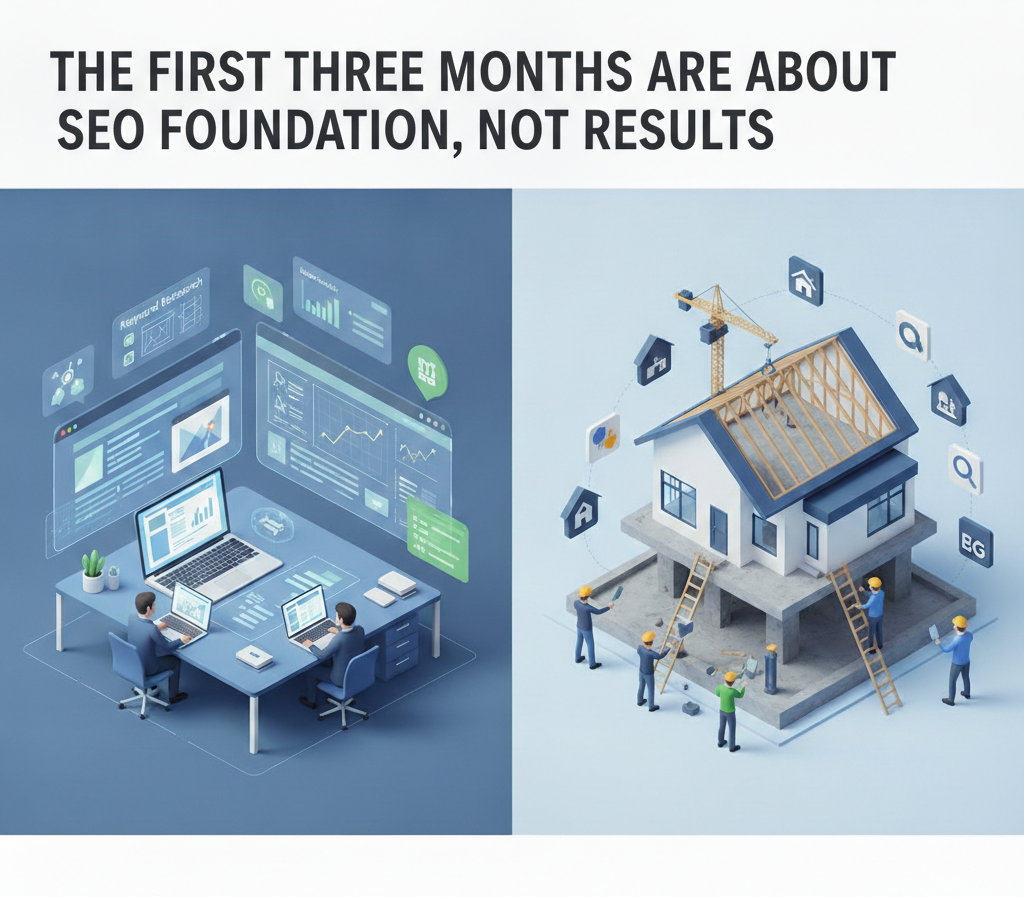
The very first thing you need to accept is that months one through three won’t produce a flood of motivated-seller leads. And that is completely normal.
In fact, it is exactly what should happen. This phase of the real estate SEO timeline is about building the infrastructure that everything else runs on, and rushing it or skipping it is one of the most costly mistakes an investor can make.
During this phase, Google is crawling and indexing your website. It is essentially discovering your pages, reading your content, and deciding whether your site is trustworthy enough to surface in search results.
If your website is brand new with a fresh domain, this process takes time because you have no track record yet. Google is cautious by nature, and new sites simply have to earn their way into the algorithm’s good graces.
<cite index=”88-1″>Quick wins in the one to three month window typically come from technical and on-page fixes, things like correcting your heading structure, updating meta tags, compressing images, and fixing crawl errors that were preventing Google from reading your pages properly.</cite> These changes are not glamorous, but they are essential.
Think of it as getting the house in order before you invite anyone to visit.
What smart investors are doing during these first three months is getting their Google Business Profile fully claimed and optimized, building their core location pages, publishing their first round of content, and submitting to key local directories for citation consistency.
None of this produces overnight results. All of it produces the conditions under which results become possible.
The critical mindset shift here is to stop measuring success in leads during this phase. Measure it in pages indexed, technical issues resolved, and keyword research completed. You are planting seeds right now. That is the only thing months one through three are designed to do.
#2: Months Three to Six Are When the Signals Start Coming In
This is the phase of the real estate SEO timeline that most investors find most encouraging, because it is when you first start to see real movement. It does not mean your phone is ringing off the hook yet, but the data is starting to tell a story you can feel good about.
<cite index=”93-1″>Months three and four typically produce the first early signals, with long-tail keyword movement beginning, impressions climbing in Google Search Console, and the very first leads from organic search starting to appear.</cite> For a real estate investor, a long-tail keyword might be something like “how to sell an inherited house fast in [your city]” or “stop foreclosure and sell my home in [neighborhood].” These are not the most competitive phrases in your market, but they attract highly motivated sellers exactly when they need help.
<cite index=”86-1″>SEO for real estate investors usually shows meaningful visibility around the three to four-month mark, with consistent leads beginning to arrive after five to six months.</cite> The word consistent is doing a lot of work in that sentence. One lead from organic search in month four is not consistent.
But it is a signal that the engine is warming up and that the work you did in months one through three is starting to take effect.
What you should be tracking during this phase is your Google Search Console data, specifically which queries are generating impressions for your pages, even if you are not ranking on page one for them yet.
Impressions mean Google knows your page exists and is considering it for those searches. That is a meaningful step forward, even when clicks have not followed yet.
Investors who stay the course during this phase are typically the ones who close the most SEO deals later.
The ones who get impatient and either stop the work or pivot to a completely different strategy right when momentum is building are the ones who have to start from scratch and wonder why SEO never seems to work for them.
#3: Six to Nine Months Is When Real Leads Start Flowing

This is the phase most investors are waiting for, and it is the most satisfying part of the real estate SEO timeline to experience firsthand. By month six, if the work has been done consistently and correctly, something meaningful begins to happen.
Your primary service keywords are starting to enter the top ten. Your organic traffic becomes measurable and grows week over week. And the leads, the actual motivated sellers filling out your contact form or calling your number, start arriving from organic search regularly.
<cite index=”87-1″>A real Carrot customer started with a fresh website and a brand new domain. Within eight to nine months, they overtook the number one position for their target keywords, started generating consistent leads and deals, and closed over 20 deals within the twelve months that followed. Nearly $100,000 in net profit.
One hundred percent from organic SEO.</cite>
That is not a hypothetical. That is a real result from a real investor who understood the timeline, committed to the process, and did not bail when the first few months did not produce instant gratification.
<cite index=”93-1″>The six to nine-month window is when primary service keywords typically enter the top ten search positions, organic traffic becomes a meaningful channel, and the cost per lead from SEO drops sharply compared to earlier in the campaign.</cite> That last point is particularly important for investors thinking about the economics of their marketing spend.
Every lead that comes through organic search costs you nothing additional beyond what you have already invested in the SEO work. Unlike direct mail, where you pay for every piece that goes out, organic leads from a well-ranked page keep arriving whether you are actively working that day or not.
This is also the phase where your Google Business Profile starts generating direct calls and inquiries in addition to your website traffic.
If you have been actively collecting reviews, responding to them professionally, and keeping your profile updated with fresh content, local pack visibility in this phase can become one of your most reliable sources of inbound leads.
#4: Nine to Twelve Months Is When SEO Becomes a Compounding Asset
Here is the fact about SEO for real estate investors that is genuinely different from every other marketing channel you might invest in. It compounds. Every piece of content you published in month two is now six months older and more authoritative.
Every backlink you earned through community sponsorships or press mentions has had months to strengthen your domain authority. Every page that started ranking at position eight in month four has had time to climb to position three.
<cite index=”93-1″>The nine-to-twelve-month phase is when compounding growth becomes visible. The authority accumulated from early work accelerates the ranking of newer content, and for many investors, organic search becomes the top traffic source of their entire marketing operation by month twelve.</cite>
This is also the phase where the real estate SEO timeline starts to diverge significantly between investors who invested in quality content and those who published thin, generic pages to check a box.
Shallow content might hold a mid-ranking position for a while, but it rarely competes for the top spots in a real market. Investors who took the time to create genuine, locally specific, genuinely helpful content during the first six months are the ones seeing those pages climb into positions one through three by month ten or eleven.
<cite index=”92-1″>The authority built from local business citations and consistent SEO work is evergreen. Once you occupy the top local positions, they continue to send signals to Google for years.
Your digital presence is either a lead-generating machine or a quiet brochure.</cite> By the twelve-month mark, for investors who have stayed consistent, the answer becomes clear. The site is a machine.
Another fact worth knowing is what happens when you layer paid advertising onto a maturing organic presence.
Investors who run targeted Google or Facebook ads alongside a strong organic foundation in this phase often see their overall cost per lead drop dramatically, as organic credibility reinforces the paid ad experience.
A seller who sees your site in organic results and also in paid ads perceives you as significantly more established and trustworthy than a competitor who appears only in paid results.
#5: The Biggest Variable in SEO Is Not Time, It Is What You Do with the Time
This is the most important of the five SEO timeline facts for real estate investors, and it is the one that is most often glossed over. The standard timeline of three to twelve months is not fixed.
It is a range that reflects what happens under average conditions with average execution. What you do, how consistently you do it, and how strategically you approach it can significantly compress or extend that range.
<cite index=”87-1″>Another investor who focused heavily on on-page optimization, creating unique and locally specific content rather than relying on generic templates, went from page three or page four for competitive terms like “we buy houses Houston” to the number one position in just ten months.
</cite> Ten months to the top of one of the most competitive real estate investor markets in the country.
That result was not luck. It was a function of strategic, consistent execution over a sustained period.
The variables that most directly affect where you land within the timeline are your domain age and authority when you start, which determine how much trust Google already extends to your site before any new work begins.
Market competition matters too. Ranking for “sell my house fast” in a small regional market is meaningfully faster than ranking for the same phrase in a major metropolitan area with dozens of competing investor websites.
Your content quality and publishing consistency determine how quickly Google develops confidence in your pages.
And the strength of your local citation profile and backlink acquisition shapes how quickly your domain authority grows to support the rankings you are chasing.
<cite index=”90-1″>The real estate SEO timeline depends on your market, your site quality, and your competition.
Technical fixes may show impact sooner, while content and local SEO often need several months to build traction.</cite> The investors who understand this and work on all fronts simultaneously, technical health, content quality, local citations, and backlink building, consistently see results at the faster end of the range.
Investors who work in only one of those areas, or who work inconsistently, typically end up on the slower end.
The other major factor is the freshness and relevance of your content over time. SEO is not a project you complete and set aside.
It is an ongoing practice that requires adding new content, updating existing pages, expanding into new neighborhoods and keyword areas, and monitoring your rankings to respond to competitive changes in your market.
The investors who treat SEO as a living, breathing part of their business strategy are the ones who maintain and grow their rankings year after year.
The ones who treat it as a one-time task tend to see early gains plateau and eventually erode as competitors who are more active move past them.
What This SEO Timeline Means for Your Business Right Now
If you are reading this and thinking that the SEO timeline for real estate investors sounds like more patience than you have, here is the practical reframe. The best time to start SEO was the day you launched your investor website. The second-best time is today.
Every month you delay the start of a serious SEO strategy is a month added to the end of the timeline. The investor who started nine months ago is already seeing consistent leads from organic search.
The investor who starts today will be in that same position nine months from now, but only if they start today.
The investors who generate the most deals from SEO are not necessarily the most tech-savvy or the ones with the biggest marketing budgets.
They are the ones who understood the real estate SEO timeline early, committed to the long game, and kept executing consistently through the phases that felt slow and uncertain.
The motivated sellers in your market are searching for solutions right now. Every day your site doesn’t rank for those searches is a day those leads go somewhere else.
ALSO READ: The Full Marketing Stack for a $1M+ Cash Buying Business — What to Invest in First
Conclusion: SEO Timeline Facts for Real Estate Investors
If this article made one thing clear, it is that the real estate SEO timeline rewards investors who start early, execute consistently, and have the right strategy in place from day one.
But knowing what to do and having the time, tools, and expertise to actually do it are two completely different things.
That is where REIRank comes in.
At reirank.com, we specialize in done-for-you digital marketing and lead generation services built specifically for real estate investors.
Whether you are starting from scratch with a brand new website, trying to accelerate an SEO campaign that has stalled, or looking to build a complete online lead generation system that combines SEO, local citations, content marketing, and targeted paid ads, we have the expertise and the track record to get you there.
You do not have to spend the next twelve months figuring this out on your own while deals go to competitors who invested in their online presence earlier.
You can shortcut the learning curve, avoid the costly mistakes, and start building momentum right now with a team that does this every single day for investors just like you.
Visit our services page today and get your free consultation to explore our full range of REI digital marketing and lead generation solutions.
See exactly how we help investors across the country move from invisible in search results to page one, from paying for every lead to generating consistent organic inbound, and from chasing deals to having motivated sellers call them.