

There is a moment that every successful real estate investor remembers clearly. The moment the phone rings, a homeowner who found them through Google is on the other end, with no cold calls, emails, or paid advertisements driving that conversation.
That is what happens when you get your SEO content right, and it is why understanding the best SEO tips for attracting motivated sellers has become one of the most valuable things an investor can spend time learning.
The research on this is compelling. Tyler Ford, a real estate investor based in Tucson, Arizona, made over $200,000 in just 4 months after focusing his energy on SEO and organic content.
He put it simply when he said that about 80% of the leads coming in from organic search were motivated sellers, compared to the opposite with direct mail, where most people who respond are not actually ready to act.
With SEO, the sellers are coming to you. That dynamic alone changes everything about the quality of the conversation before a deal can even begin.
This guide walks you through 10 proven SEO content tips to attract motivated sellers, explains the thinking behind each one, and shows you exactly how to implement them even if you are just getting started.
These are the same content strategies that the investors generating consistent organic leads in 2026 are using right now, and they work whether you are in a small regional market or competing in a dense metropolitan area.
Understanding Why Content Is the Engine Behind Seller Lead SEO
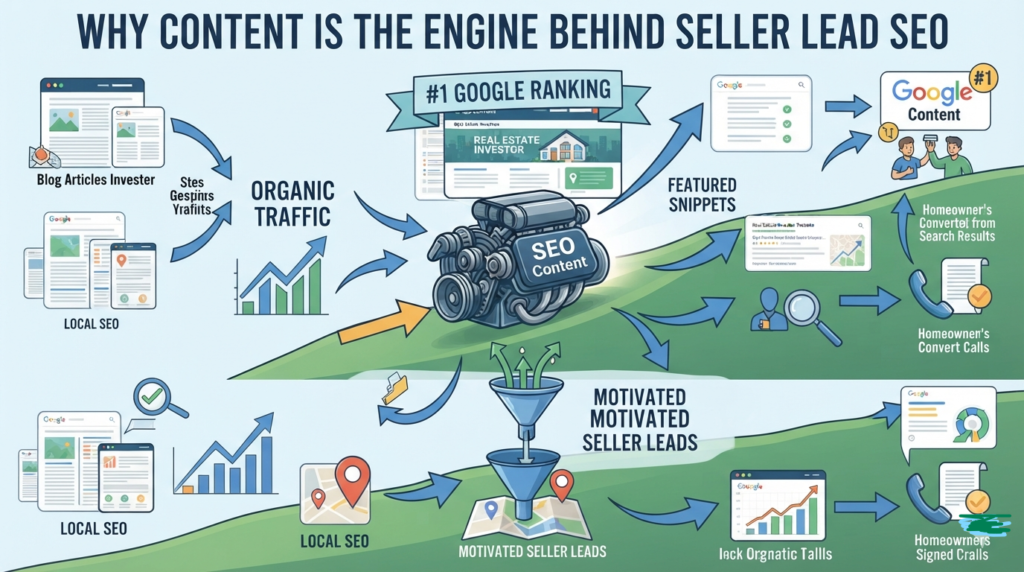
Before getting into the specific tips, it helps to understand what content actually does in the context of an investor’s SEO strategy, because the connection between what you write and who shows up at your website is more direct than most investors realize.
When a distressed homeowner types “how to sell my house fast without making repairs” into Google, they are not browsing casually. They have a real, urgent problem, and they are looking for a real answer.
What Google does in that moment is scan its index of every page on the web and decide which one best answers that question. The websites that most clearly and thoroughly address what the person is searching for appear first.
This is the fundamental principle behind every single one of the SEO content tips discussed in this article. You are not just writing content to fill space on a website.
You are creating answers to real questions that motivated sellers are already asking, positioning your business as the most helpful and relevant solution Google can find in your market, and building the kind of trust that makes a stressed homeowner feel safe enough to reach out.
The investors who consistently attract sellers with content are the ones who have stopped thinking of their website as a digital brochure and started thinking of it as a resource.
A resource that serves the real needs of the people they most want to reach, at the exact moment those people are searching for help.
Top 10 Proven SEO Content Tips to Attract Motivated Sellers

#1: Write for the Seller’s Situation, Not for Your Business
One of the most common content mistakes investors make is filling their website with content about themselves, their company history, how long they have been investing, and how many deals they have closed.
All of that information has a place, but it is not what a motivated seller is looking for when they first arrive at your site.
A seller facing foreclosure is not searching for a company biography. They are searching for a way out of their situation. A homeowner who has just inherited a property is not looking for a list of your credentials.
They are looking for a clear explanation of their options and the next steps. If your content addresses their situation honestly and thoroughly before it ever mentions anything about your business, you will build more trust in the first thirty seconds than a page full of self-promotional language ever could.
This shift in perspective is the starting point for understanding how to write SEO content that attracts motivated sellers.
Every page you create should begin from the seller’s point of view, their problem, their timeline, their emotional state, and their specific questions, and then gradually position your business as the solution to that specific situation.
#2: Build Situation-Specific Pages for Every Type of Motivated Seller
A seller dealing with an inherited property and a seller facing a tax lien are both technically motivated, but they have completely different concerns, questions, and reasons for needing to sell quickly.
Trying to speak to both of them on a single generic page dilutes the relevance of your message to both audiences.
The far more effective approach is to create individual pages dedicated to each major seller situation in your market, covering inherited property sales, pre-foreclosure situations, divorce-related sales, properties with major repair needs, landlords dealing with problem tenants, and any other distress scenario that regularly produces motivated sellers in your area.
Each of these pages can rank for the specific long-tail search phrases that sellers in each situation are actually using, and each one can speak with the kind of direct, compassionate specificity that resonates with a person in that exact circumstance.
This kind of content shows how to write SEO content that attracts motivated sellers in a way that actually converts, rather than generic content that ranks reasonably well but fails to resonate deeply with readers.
#3: Target Long Tail Keywords That Signal Real Urgency
If there is a single technical SEO content decision that separates investors generating consistent organic seller leads from those who are not, it is the choice to target long-tail, high-urgency keywords rather than only competing for broad, short phrases.
A phrase like “sell my house fast” gets a substantial amount of monthly search traffic, but it also faces tremendous competition from established platforms and large investor networks with significant domain authority built up over the years.
A phrase like “how to sell my house fast without paying realtor fees in [city]” gets much less total search volume, but the person using it is extremely specific about what they want, much further along in their decision process, and facing far less competition from other investor websites in most markets.
The research is detailed that organic traffic from search converts at a significantly higher rate than paid advertising traffic, often two to three times higher, precisely because people who find your website through organic search have already expressed a specific intent through the exact words they typed.
Targeting the most specific, urgency-driven variations of the key phrases in your market is one of the most efficient content investments available in real estate investor SEO.
#4: Create a Comprehensive FAQ Section That Addresses Real Seller Concerns
Motivated sellers are full of questions before they ever pick up the phone to call an investor. They want to know how quickly you can actually close. They want to understand how you arrive at your offer price.
They want to know whether they need to make any repairs or clean out the property before selling. They want to understand whether there are any fees or commissions deducted from their proceeds.
Building a thorough, honest, detailed FAQ section on your website addresses all of these concerns in a format that search engines love and that sellers find genuinely reassuring.
Google regularly pulls FAQ content directly into featured snippets and expanded search results, which means a well-written FAQ can earn your website visibility in search results even before a person clicks through to your site.
The key to making FAQ content work as part of your approach to attract sellers with content is to answer every question directly and honestly, even the uncomfortable ones.
A seller who reads a transparent, detailed explanation of how you calculate your offers is far more likely to reach out than a seller who finds only vague promotional language and has to call just to get basic answers.
#5: Develop Hyperlocal Content for Every City and Neighborhood You Serve
One of the most powerful yet underused SEO content strategies for real estate investors is creating genuinely hyperlocal content that demonstrates specific, firsthand knowledge of the neighborhoods and communities in your target market.
This kind of content sends a clear signal to both search engines and motivated sellers that you are not a national company operating from a distance, but a real, embedded local business that understands their specific area.
This goes well beyond simply swapping a city name into an otherwise generic template page. True hyperlocal content references specific neighborhood characteristics, mentions local landmarks or community details, discusses local real estate market trends with actual data, and addresses the particular property types or challenges that are most common in that specific area.
Content like this is genuinely difficult for large national competitors to replicate at scale, which is one reason it remains such a reliable competitive advantage for local investors.
Every city, suburb, and neighborhood you actively serve deserves its own dedicated page with content that speaks specifically to sellers in that location, and that content should be woven through with the natural language that local sellers actually use when searching for help.
#6: Publish Market Reports and Data-Driven Content
Sellers in 2026 are more informed than ever, and they respond to investors who demonstrate real market knowledge rather than generic sales language.
Publishing regular local market reports, whether monthly or quarterly, positions your business as a credible source of information and builds the kind of authority that makes sellers feel confident working with you over a competitor who offers nothing but promotional content.
Market reports do not need to be lengthy academic documents. A concise, readable update on what is happening with property values, days on market, and sales volume in your specific area gives sellers genuinely useful information while establishing you as an expert who follows the market closely.
This kind of data-driven content also tends to earn links from local news outlets, community organizations, and real estate-related websites, which strengthens your overall SEO authority over time.
The connection between educational content and motivated seller leads is direct. A seller who has been reading your market reports for three months before their situation becomes urgent enough to require action already trusts your expertise.
That trust dramatically reduces the friction of the first conversation and makes the path from initial contact to closed deal significantly smoother.
#7: Write Comparison Content That Helps Sellers Understand Their Options
Some of the most effective content for attracting motivated sellers with content is not promotional at all. It is comparative and educational, giving sellers the honest information they need to understand all of their options and make the decision that is genuinely best for their situation.
Content that transparently compares selling to an investor versus listing with an agent, explaining the tradeoffs in timelines, certainty, convenience, and net proceeds, builds far more trust than content that simply insists your service is the best.
Sellers who find this kind of balanced, honest comparison tend to self-qualify very effectively. Those whose situation genuinely makes an investor the right fit recognize themselves in the comparison and reach out with a high degree of confidence.
Those for whom a traditional listing would be better are filtered out before they ever submit a form, which improves the quality of leads without reducing their volume.
This kind of content also ranks exceptionally well because it matches a genuinely common search intent.
Homeowners who are deciding between selling to an investor and listing with an agent are searching for exactly this kind of comparison, and a thorough, honest page that addresses the question directly is precisely what search engines are designed to surface in those moments.
#8: Use Empathetic, Compassionate Language Throughout All Content
The person reading your content is often in one of the most stressful periods of their life. They may be facing the loss of their home, the death of a family member, the end of a marriage, or a financial crisis they did not see coming.
The tone of your content communicates something to them before they even consciously register the words, and a tone that feels cold, transactional, or opportunistic can drive a motivated seller away just as effectively as a poorly optimized page.
Empathetic, compassionate language does not mean being vague or soft. It means acknowledging the real emotional weight of the situation your reader is navigating before presenting your solution.
A page about foreclosure that opens by recognizing how frightening and overwhelming the process can feel for a homeowner connects with the actual person on the other side of the screen in a way that a purely transactional headline never does.
This emotional intelligence in your writing also tends to improve the quality of leads, since sellers who feel genuinely understood by your content arrive at the conversation with a different mindset than those who feel they are being treated as a transaction from the first word on the page.
#9: Optimize Every Content Element for Both Readers and Search Engines
Great content written in a way that search engines cannot properly understand is a wasted opportunity. Equally, technically optimized content that reads as if it were written for an algorithm rather than a human being will fail to build the trust that converts visitors into leads. The goal is always both.
Practically, this means including your primary keyword naturally in the page title, the first heading, and organically throughout the body of the content without repeating it to an unnatural degree.
It means writing a compelling meta description that clearly communicates the page’s value and encourages a click. It means using subheadings to organize content logically, making it easier for both readers and search engines to understand the page’s structure and main points.
Image optimization matters here too, with descriptive, keyword-relevant alt text on every image helping search engines understand visual content that they cannot directly see.
Internal links that connect related pages on your website help both visitors and search engines navigate your content more effectively, and they distribute ranking authority from your strongest pages to newer content that is still building its own visibility.
#10: Publish Content Consistently and Treat It as a Long-Term Asset
The investors who build the most powerful organic lead generation through content are the ones who understand that SEO content is a long-term asset, not a short-term campaign with a defined end date.
A single well-optimized page targeting a specific seller situation can continue attracting leads for years after it is first published, and a library of such pages compounds in value with every new piece of content added to the collection.
Consistency in publishing matters because search engines reward websites that demonstrate sustained, ongoing activity. A site that publishes one new piece of content monthly for a year builds significantly more authority than a site that publishes ten pages in a single month and then goes quiet.
Setting a realistic, sustainable publishing schedule and honoring it consistently, even if that means starting with one well-researched, thoroughly written piece per month, produces better long-term results than sporadic bursts of activity followed by long gaps.
The content you create today, if done well, will still be working for your business years from now. That makes each piece of high-quality, well-optimized content one of the best investments in any investor’s marketing budget, and it is the foundation of organic lead generation that becomes genuinely self-sustaining over time.
Conclusion: SEO Content Tips to Attract Motivated Sellers
These 10 SEO content tips to attract motivated sellers are not independent tactics that work in isolation. They are interconnected elements of a coherent content strategy that builds on itself over time.
Writing for seller situations rather than for your business creates content that resonates. Targeting long-tail urgency keywords brings the right visitors to that content.
Building situation-specific pages and hyperlocal content gives both search engines and sellers the specificity they need to feel your business is the right fit. And publishing consistently ensures that the whole system keeps growing rather than stagnating.
The investors who are attracting motivated sellers with content in 2026 are not doing anything mysterious. They are applying these same principles with discipline and patience, and they are building an organic lead-generation engine that continues to deliver results long after competitors have spent their advertising budgets for the month.
If you are ready to start building a content strategy that consistently brings motivated sellers to your website but are not sure where to begin, or if you are already creating content and want to understand why it is not producing the results you expected, Reirank.com is here to help.
We offer a free consultancy service specifically designed for real estate investors who want to build stronger organic visibility and generate better leads through SEO content.
Alongside that free consultation, we provide a full range of digital marketing services for real estate investors, including keyword research, content strategy, local SEO, and complete done-for-you content creation.
Visit Reirank.com today to book your free consultation and take the first step toward building a content strategy that consistently attracts motivated sellers, without relying on expensive paid channels that reset to zero the moment your budget runs out.