

Buying cheap leads is the fastest way to bankrupt a real estate investment firm. While a $20 price tag looks attractive on a spreadsheet, the true motivated seller lead cost is measured in signed contracts, not contact forms.
You’ve likely felt the frustration of high ad spend paired with zero ROI. Chasing “tire kicker” leads from social media makes it impossible to scale your operations or predict your monthly revenue.
We’re ending the guesswork. This guide provides the definitive 2026 benchmarks you need to dominate markets where exclusive leads now command between $80 and $450.
You’ll master the metrics required to transition from buying low-intent noise to securing high-margin deals. We’ll analyze why high-intent organic leads are converting at rates up to 25% while shared portals lag.
By the end of this article, you’ll have a clear understading on motivated seller lead cost, strategy to lower your Cost-Per-Acquisition, and build a predictable, multi-channel lead flow that actually moves the needle. Stop counting leads; start calculating profit.
Key Takeaways
- Establish realistic 2026 benchmarks for high-intent digital channels to ensure your marketing spend aligns with current market realities.
- Eliminate technical waste and broad-match errors that unnecessarily inflate your motivated seller lead cost and erode your monthly ROI.
- Master the profitability gap by shifting your strategic focus from individual lead prices to a comprehensive Cost-Per-Acquisition (CPA) model.
- Leverage hyper-local targeting and long-tail keyword dominance to bypass national competition and secure exclusive, high-margin deals.
- Discover why expert-managed Local SEO and Google PPC campaigns provide a more predictable path to scale than purchasing unverified third-party lead lists.
Benchmarking Motivated Seller Lead Costs by Marketing Channel
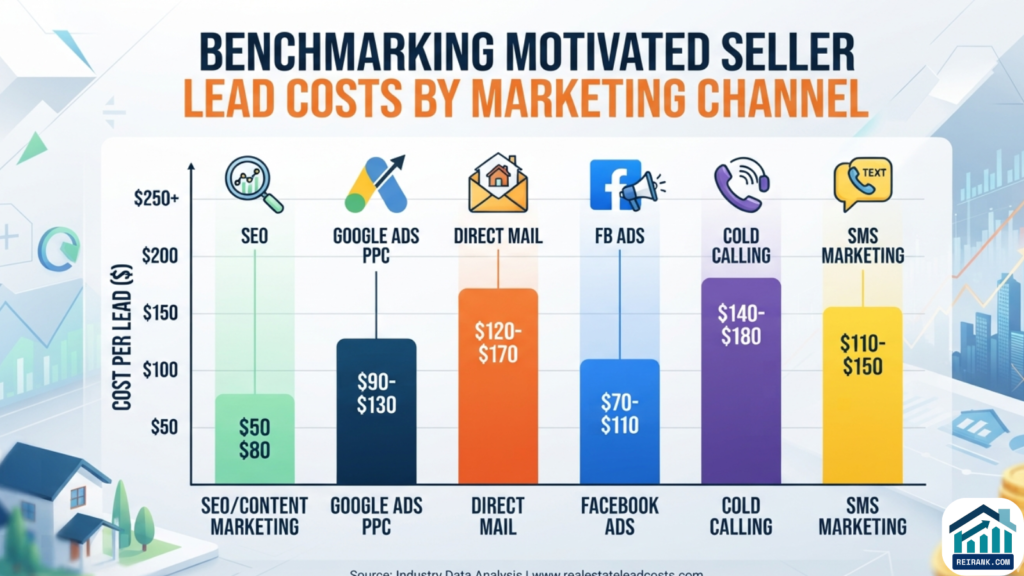
A motivated seller lead isn’t a line on a spreadsheet; it’s a high-intent data point indicating a homeowner ready to trade equity for speed. Successful investors distinguish between low-intent inquiries and high-intent signals. High-intent leads often include verified distress markers like probate, pre-foreclosure, or “tired landlord” status.
Effective lead generation requires understanding that your motivated seller lead cost is directly proportional to the intent level of the channel you choose.
Google PPC remains the gold standard for high-intent acquisition. When a seller types “sell my house fast” into a search bar, they’re actively seeking a solution. This intent commands a premium, especially in highly competitive Tier 1 markets. Conversely, social media marketing operates on interruption.
It generates high volume at a lower cost per lead, but it demands heavy lifting in follow-up. You’ll likely sift through dozens of “tire kickers” before finding a genuine deal. Local SEO serves as your compounding asset.
While it requires an upfront investment in authority, it eventually yields the lowest long-term lead cost by capturing organic traffic without a per-click fee.
Inbound vs. Outbound Lead Cost Comparison
Inbound leads consistently out-convert outbound methods like cold calling or direct mail. Data shows that high-intent organic and search leads convert at rates between 15% and 25%. Outbound methods often struggle to reach 5% conversion. To understand your true performance, you must calculate your blended lead cost.
This is the average cost across all active channels, balancing expensive PPC wins with lower-cost organic inquiries. In 2026, a healthy, motivated seller lead cost in mid-sized Tier 2 markets typically ranges from $150 to $300. Smaller Tier 3 markets may see costs as low as $80, while highly competitive Tier 1 markets can exceed $450 per exclusive lead.
The Premium of Exclusivity
Shared leads are a trap for the unprepared. While these leads are sold for $20 to $100, they’re distributed to multiple investors simultaneously. This creates a race to the bottom that drives up hidden labor costs as your team spends hours battling competitors for a single phone call.
Exclusive leads carry a higher upfront price but eliminate the friction of a bidding war. Lead Exclusivity is the primary driver of conversion speed. By securing exclusive access, you bypass the noise and move directly to the contract phase. Paying more for exclusivity often results in a lower total cost per closed deal.
Factors That Inflate Your Lead Cost and Kill ROI

High costs aren’t a market inevitability; they’re a symptom of technical inefficiency. Your motivated seller lead cost isn’t just a reflection of local competition. It’s often a penalty for poor campaign hygiene. Market Temperature dictates the baseline, but technical waste is what truly kills your
ROI. If you’re bidding on broad-match keywords in 2026, you’re competing with AI-driven search patterns that favor precision over volume. You’re effectively paying for data that doesn’t convert.
The “Google Tax” is a silent profit killer. When your Quality Score drops because your ads don’t perfectly align with user intent, Google charges you more for the same position. You end up paying a premium for inferior traffic.
Mobile performance further compounds this issue. If your site takes more than three seconds to load, your effective lead cost doubles instantly as frustrated sellers bounce back to the search results. Speed is a non-negotiable requirement for maintaining a healthy margin.
Keyword Mismatch and Negative Keyword Neglect
Broad keywords like “Real Estate” attract window shoppers, not distressed sellers. You need a surgical approach to negative keyword management to protect your budget. Identifying “looky-loo” traffic before it clicks is the only way to maintain a competitive advantage.
We eliminate this wasted spend by filtering out irrelevant queries that drain your capital without offering a return. Investors who fail to curate their keyword lists are essentially donating their ad spend to Google. Precision is the only path to a sustainable, motivated seller lead cost.
Conversion Rate Optimization (CRO) Failures
Sending high-intent traffic to a generic homepage is the fastest way to inflate your acquisition costs. A homepage is a brochure; a landing page is a conversion machine.
High-performing Google PPC campaigns require dedicated pages that mirror the specific pain points of the seller. If a lead clicks an ad about probate but lands on a generic “We Buy Houses” page, the disconnect triggers an immediate exit.
We build custom investor websites designed for one purpose: conversion. We prioritize mobile responsiveness and hyper-relevant messaging to ensure every click has the highest possible chance of becoming a signed contract.
Without a robust CRO strategy, you’re just paying for traffic that never converts into revenue. Professional management ensures your technical infrastructure supports your growth rather than hindering it.
Lead Cost vs. Deal Cost: The Profitability Gap
Lead cost is a vanity metric. It distracts from the only number that matters: profit per contract. Calculating your motivated seller lead cost is step one, but stopping there is a strategic failure.
A $20 lead is a liability if it requires forty hours of follow-up to yield nothing. A $200 lead is an asset if it closes within seven days. You must bridge the gap between superficial spending and actual acquisition. High-volume noise is the enemy of high-margin deals.
Cost-Per-Acquisition (CPA) is the total marketing spend divided by the number of signed contracts. Cost-Per-Acquisition is the only metric that dictates market leadership.
If you spend $5,000 to get 50 leads and close one deal, your CPA is $5,000. If you spend the same $5,000 on 10 high-intent leads and close two, you’ve doubled your ROI while cutting your team’s workload in half. Efficiency is your greatest competitive advantage.
Processing low-quality leads isn’t free. It’s a “Labor Tax” on your operations. Every minute your acquisitions manager spends talking to a “tire kicker” is a minute they aren’t closing a motivated seller. High-volume, low-intent strategies create a bottleneck in your sales pipeline.
You’re paying for the privilege of wasting your staff’s time. Opportunity cost is the hidden killer; while you’re chasing weak leads, your competitors are dominating the top search positions and siphoning off the best deals in the market.
The Conversion Ratio Framework
Conversion ratios vary wildly by channel. SEO leads often convert at a 1:10 ratio because the seller is actively searching for you. Facebook leads frequently lag at 1:50 or worse. To find your Maximum Allowable Lead Cost, start with your average deal spread.
If your average profit is $20,000, you can comfortably afford a higher motivated seller lead cost to secure a guaranteed contract. Scale requires mathematical certainty, not hopeful guessing. You must optimize for the deal, not the inquiry.
Quality Over Quantity: The High-Intent Advantage
High intent means less friction. Search-based leads are inherently more valuable because the seller has already identified their problem and is seeking your specific solution. This intent reduces the sales cycle significantly.
Industry data suggests that high-intent leads can reduce the time from initial contact to signed contract by up to 40%. You aren’t just buying data; you’re buying speed.
Dominating top search positions ensures you capture these high-margin opportunities before your competitors even see them. Filtering for intent at the source is the fastest way to scale a lean, profitable operation.
Strategic Optimization: Reducing Lead Cost Without Killing Quality
Passive investors buy leads; dominant investors build assets. Reducing your motivated seller lead cost requires a shift from broad acquisition to surgical precision. You can’t afford to compete on a national stage against aggregators with bottomless budgets. Market dominance starts with hyper-local targeting.
By narrowing your focus to specific zip codes or distressed neighborhoods, you bypass broad competition and speak directly to the local seller’s reality. This focus naturally drives down bid costs while increasing the relevance of your message.
Long-tail keyword dominance is your secondary weapon. While everyone else fights over high-volume terms like “sell my house fast”, you should capture motivated sellers through specific, low-competition queries.
Terms related to local probate laws, specific tax lien deadlines, or neighborhood-specific property issues often carry much lower costs per click.
These queries represent sellers further along in the decision-making process. They aren’t just looking for information; they’re looking for a specific exit strategy.
Dynamic retargeting ensures you don’t pay for the same lead twice. Most visitors won’t convert on their first visit. Instead of letting that initial acquisition cost go to waste, use retargeting ads to follow them across the web. This keeps your brand top-of-mind for a fraction of the initial click cost.
It’s an essential layer of efficiency that turns “lost” traffic into signed contracts. Authority building through SEO further supports this by creating brand recognition. When a seller sees you in the organic results and then sees your ad, your click-through rate (CTR) climbs, which Google rewards with lower pricing.
The SEO-PPC Feedback Loop
PPC buys the data; SEO owns the market. Use your paid campaigns as a laboratory to identify which keywords actually result in signed contracts. Once you’ve identified these high-converting terms, pivot your Local SEO strategy to dominate them organically.
This integrated approach effectively lowers your motivated seller lead cost by increasing the efficiency of every dollar spent. Organic rankings provide the “trust lift” that makes your paid ads perform better. It’s a self-reinforcing cycle of market authority.
Technical Performance as a Cost-Saver
Technical friction is a hidden tax on your ROI. Google’s 2026 algorithms prioritize Core Web Vitals and mobile-first design more than ever. If your site is slow, your Quality Score suffers, and your cost-per-click rises.
You’re literally paying for your site’s poor performance. We eliminate this waste by building “Trust Signals” directly into your landing pages. Professional design, fast load times, and clear social proof increase your conversion rates instantly.
When more visitors convert, your cost per lead drops without you having to change a single bid. High-performance infrastructure is the foundation of a profitable investment operation.
Scale Your Lead Flow and Dominate with REI Rank
Buying unverified lead lists is a gamble with your capital. These lists are often outdated, shared with dozens of competitors, and lack the intent necessary for a high-margin deal.
A monthly retainer for expert management is an investment in a proprietary system. We don’t just hand you data; we build the infrastructure that captures high-intent sellers before they reach the open market.
This shift in strategy is how you stabilize your motivated seller lead cost and build a predictable pipeline. You stop being a lead buyer and start being a market leader.
REI Rank provides specialized digital marketing exclusively for the real estate niche. Our team understands the nuances of distressed property acquisitions.
We integrate Local SEO, Google PPC, and Social Media Marketing into a single, cohesive engine. We don’t just aim for traffic. We aim for market dominance.
Owning the local search results means your brand is the first and only solution a seller sees during their moment of crisis. By controlling the entire search landscape, you secure the highest quality leads at the lowest possible Cost-Per-Acquisition.
Taking the next step requires an honest assessment of your current operations. You must audit your motivated seller lead cost to find where your budget is leaking.
Most investors are shocked to find how much they spend on “looky-loo” traffic and technical errors. We identify these leaks and redirect that capital toward high-intent queries that actually convert. Growth isn’t about spending more; it’s about spending with more precision.
Beyond Lead Generation: A Growth Partnership
We focus on your bottom line. Net profit matters more than lead volume. Our process involves continuous optimization because “set it and forget it” marketing died years ago. We analyze every click to eliminate wasted ad spend.
Our custom Web Development ensures your site isn’t just a brochure, but a high-performance conversion tool tailored for real estate acquisitions. We partner with you to scale operations, not just fill a CRM with noise. Efficiency is the foundation of our partnership.
Start Your Free SEO Audit
You can’t fix what you haven’t measured. A professional marketing consultation identifies the structural leaks in your current digital presence. We find the low-hanging fruit where you’re overpaying for clicks or losing traffic to slow load times.
It’s time to stop guessing and start executing with mathematical certainty. Secure your competitive advantage today and build the predictable lead flow your business requires.
Get Your Free SEO Audit and Stop Wasting Ad Spend
Take Command of Your Acquisition Strategy
The 2026 market doesn’t reward those who simply spend more. It rewards those who spend with superior technical authority. You’ve seen how a highly motivated seller lead cost is often a symptom of technical waste rather than market competition.
Shifting your focus from individual lead prices to a comprehensive Cost-Per-Acquisition model is the only way to build a scalable, high-margin investment firm. High-intent search traffic remains the most valuable asset in your marketing arsenal.
We specialize in SEO and PPC specifically for real estate wholesalers and investors. Our methodology leverages national reach with local search expertise to reduce wasted ad spend through technical precision.
We don’t just generate leads; we build the infrastructure for market dominance. Stop letting inefficient campaigns drain your capital and start capturing the deals your competitors are missing. The path to predictable deal flow starts with a single audit of your current digital footprint.
Dominate your market, get a free SEO audit from REI Rank
Your next high-margin deal is waiting. Take the first step toward a more profitable future today.
Frequently Asked Questions
What is the average motivated seller lead cost in 2026?
Exclusive motivated seller lead costs currently range from $80 to $450 depending on your market tier. Tier 1 metros like Los Angeles or Miami command the highest premiums, often reaching $250 to $450 per lead.
Tier 2 markets like Phoenix typically range from $150 to $300, while Tier 3 or rural markets average between $80 and $180. These figures reflect the high demand for exclusive, high-intent data.
Is SEO or PPC better for generating motivated seller leads?
PPC delivers immediate speed; SEO builds long-term equity. Google PPC is the gold standard for capturing sellers in an active crisis, providing high-intent leads instantly.
SEO requires an upfront investment, but eventually results in the lowest-cost motivated seller lead cost by removing the per-click fee. A dominant strategy integrates both to capture the maximum share of local search traffic.
How many leads does it typically take to close one real estate deal?
New investors typically need 20 to 30 leads to close a single deal. This ratio fluctuates based on your lead source and sales proficiency.
High-intent organic leads often convert at rates between 15% and 25%, while shared portal leads lag significantly at 5% to 10%. Focusing on lead quality over volume is the fastest way to improve this conversion ratio.
Why are my Google Ads leads so expensive compared to Facebook?
You’re paying for intent rather than interruption. Google Ads targets sellers actively searching for a solution, while Facebook targets users based on demographic data.
While Facebook leads have a lower upfront price, they often carry higher hidden labor costs due to lower motivation levels. Google leads are more expensive because they’re closer to a signed contract.
Can I generate motivated seller leads without a website?
You can use call-only ads or social media lead forms, but you’ll pay a massive inefficiency tax. A high-performance website serves as your primary conversion tool and trust builder.
Without a professional landing page, your conversion rates will suffer, and your effective, motivated seller lead cost will climb. A website is a non-negotiable asset for any investor looking to scale.
How do I lower my cost-per-lead without sacrificing quality?
Eliminate technical waste by refining your keyword targeting. Stop bidding on broad-match terms that attract window shoppers and implement aggressive negative keyword lists to protect your budget.
Improving your site’s mobile load speed also boosts your Quality Score, which lowers your cost-per-click. Precision in your technical setup is the only sustainable way to reduce acquisition costs.
What are the best keywords for motivated sellers?
Focus on high-intent phrases that signal a specific problem. Keywords like “sell my house fast,” “stop foreclosure,” and “probate property buyers” outperform generic real estate terms.
Localized long-tail keywords often have lower competition and higher conversion rates. By targeting specific seller pain points, you attract leads that are ready to sign a contract immediately.
Should I buy leads from a lead generation company or run my own ads?
Running your own ads builds a proprietary asset you control. Buying leads often means you’re competing for shared data sold to multiple investors, which drives up your cost-per-deal.
When you manage your own Local SEO and Google PPC, you own the exclusivity and the brand authority. This control ensures a more predictable lead flow and a higher net profit margin.