

Most real estate investor websites have a blog section that is either empty or filled with a handful of generic posts that could have been written for any investor in any city in any state.
These posts get almost no organic traffic, attract almost no motivated sellers, and essentially do nothing for the business. The blog exists because someone said having a blog was good for SEO, but nobody ever explained what to actually put in it or why the content needed to be local to work.
That gap is exactly what this guide addresses. The local blog tips covered here are designed specifically for real estate investors who want their website content to rank in their local market and attract distressed homeowners actively searching for help in their city or neighborhood.
Local-content-motivated seller strategies grounded in the real search behavior of your target audience will consistently outperform generic national content, and understanding why this works is just as important as knowing what to implement.
How Local Blogging Is a Different Strategy from General Content Marketing
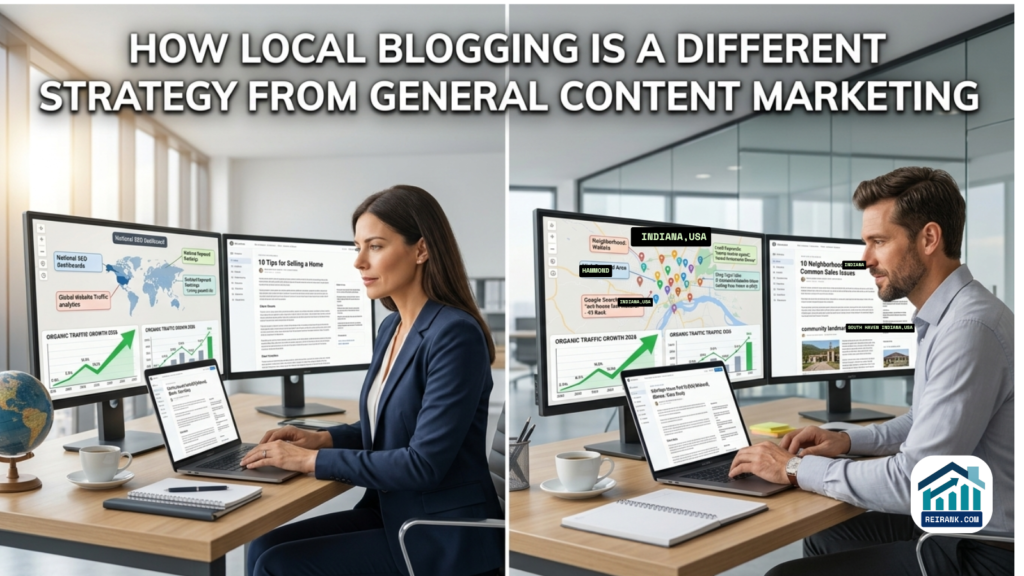
When a homeowner in your market types “what happens if I miss my mortgage payment in [your state]” or “how do I sell an inherited house fast in Indiana” into Google, they are not looking for a general education in real estate.
They are looking for information that is directly relevant to their specific situation and location. Google knows this, which is why its local search algorithms are designed to surface content that demonstrates genuine geographic relevance rather than just topical coverage.

This is the core insight behind local SEO for real estate investors. A blog post about foreclosure processes written specifically for homeowners in your state, referencing the actual timeline and legal framework that applies in that jurisdiction, will consistently outperform a generic national blog post on the same topic for anyone searching from your market.
The same is true for content about specific neighborhoods, local housing market trends, and city-specific seller resources. Each layer of local specificity adds ranking potential that broader content simply cannot match.
The investors who are winning the most organic seller leads through blogging in 2026 are not the ones publishing the most content.
They are the ones publishing the right content, built around the real questions their local motivated sellers are asking, structured to match local search intent rather than just filling a content calendar.
Step by Step: How to Build a Local Blogging Strategy That Attracts Motivated Sellers

The foundation of an effective local-content-motivated seller strategy begins before a single word is written. It starts with understanding what homeowners in your specific market are actually searching for, which is different in meaningful ways from what homeowners in other markets search for.
Begin by identifying the most common distress situations in your target area. Markets with older housing stock often have more sellers facing major repair costs. Areas with seasonal employment or significant economic shifts produce more sellers facing financial hardship.
Cities with high investor activity often have more sellers who have already engaged with investors and have specific questions about how cash offers work compared to what they previously experienced.
Understanding the particular flavor of distress most common in your market shapes the blog topics that will resonate most deeply with local sellers.
Next, use Google’s own features to discover the exact language your local sellers are using when they search. Type the beginning of a relevant seller question into Google and observe the autocomplete suggestions.
Look at the People Also Ask boxes that appear for searches related to selling quickly in your market. These are not hypothetical questions. They are the actual phrases real homeowners in your area are typing, and each one represents a blog topic with proven demand.
From this research, build a content calendar organized around two primary categories. The first is situation-specific local content, such as articles about navigating foreclosure in your specific state, selling an inherited property in your city, or what sellers in specific neighborhoods can realistically expect in the current market.
The second is market-specific educational content, such as regular updates on local housing trends, explanations of how local property tax implications affect a sale, or honest comparisons between selling options available to homeowners in your area.
The Most Effective Local Blog Tips for Real Estate Investor Websites
Writing posts that address specific seller situations in state-specific or city-specific language is the single highest-impact local blogging practice available.
A blog post titled “How Foreclosure Works in [Your State] and What Options You Have Before the Auction” is directly competing for motivated seller searches in your market, while a post titled “How Foreclosure Works” is competing against every real estate website in the country and is unlikely to rank for local searches regardless of its quality.
Covering local market data in your blog posts is another of the most valuable local blog tips for investors.
When you publish a monthly or quarterly update on what is happening with home prices, days on market, and inventory levels in your specific city or county, you create the kind of locally specific, time-sensitive content that search engines favor and that motivated sellers find genuinely useful when they are trying to understand their options.
Including real numbers from local MLS data or public records gives your posts credibility and specificity that purely opinion-based content cannot replicate.
Writing about specific neighborhoods within your market takes local specificity to an even more granular level.
A local blog tips post about selling a house in a specific neighborhood, discussing the property types common there, typical price ranges, how quickly homes sell, and what challenges sellers commonly face in that area, can rank for hyperlocal searches that your competitors are not even attempting to capture.
These neighborhood-level posts also signal to sellers in those communities that you have genuine, firsthand knowledge of their specific area rather than a surface-level familiarity with the broader market.
Publishing content that addresses the emotional dimension of selling under pressure is an aspect of local blog content that many investors underestimate.
A post that opens by acknowledging how stressful it is to face the loss of a home, navigate a family property dispute, or manage a property inherited from a parent who passed away connects with readers in a way that purely transactional content does not.
When local content-motivated seller posts speak to both the practical and emotional reality of a seller’s situation, they build trust faster and more deeply than informational content alone.
Structuring Local Blog Posts for Maximum Search Visibility
Every local blog post you publish should be structured with both readability and search engine comprehension in mind. The title of the post needs to include the specific local reference that makes it geographically relevant, whether that is a city name, a state, or a neighborhood.
A title like “What Inherited Property Owners in [City] Need to Know Before Deciding to Sell” signals exactly who the post is for and where it is relevant, which is information both search engines and potential readers use to decide whether the post is worth their attention.
The opening paragraphs of each post should acknowledge the specific situation the reader is in and immediately establish why local knowledge matters to their decision.
A homeowner in your state dealing with a probate sale needs to know that your post will address the specific laws and timelines that apply to them, not generic national information that may not reflect their legal reality at all.
Subheadings throughout the post should use natural, conversational language that reflects how sellers actually think about their questions rather than formal category labels. “How Long Does Foreclosure Actually Take in [State]” is a more compelling subheading for a distressed homeowner than “Foreclosure Timeline Overview.”
The small difference in phrasing represents a meaningful difference in how immediately relevant the content feels to someone in that specific situation.
Including a clear next step at the end of every local blog post is essential for connecting the trust built through the content to an actual lead generation outcome.
A seller who has just read a thorough, honest explanation of their options in your specific market is primed to take action if you give them a clear, low-pressure invitation to learn more about how your process works or to see what a cash offer on their property might look like.
Common Mistakes That Prevent Local Blog Content from Working
The most common mistake is publishing local content that is local in name only, where the only difference between posts targeting different cities is the place name substituted.
Search engines have become sophisticated enough to recognize this pattern, and this kind of template-based local content rarely ranks well because it lacks the genuine local specificity that makes a post more valuable to a searcher in that location than a generic post would be.
Another frequent mistake is writing posts that are too short to fully address the complexity of the seller questions they aim to address.
A three-hundred-word blog post about foreclosure in your state is not going to rank for that search because it cannot possibly cover the topic with enough depth to satisfy what someone searching that question actually needs to know.
Thorough, genuinely comprehensive posts of 1,000 to 2,000 words, written for local sellers with detailed, consistent information, consistently outperform shorter posts targeting the same queries.
Many investors also make the mistake of publishing blog content irregularly, with long gaps between posts, which signals to search engines that the site is not being actively maintained.
Consistency matters enormously in content marketing for real estate investors because search engines favor sites that demonstrate ongoing publishing activity over those that appear dormant most of the time.
Expert Tips for Local Blog Content That Compounds Over Time
Linking your local blog posts to each other and to your main location landing pages creates an internal linking structure that distributes authority across your site and helps search engines understand the relationship between your content pieces.
A blog post about inherited property in your city should link naturally to your main seller landing page and, perhaps, to a related post on how probate works in your state, creating a web of connected, mutually reinforcing content that builds topical authority across your site.
Updating existing blog posts to keep them current is one of the most underused practices in local SEO for real estate investors. A market update post published eighteen months ago is stale, and a seller reading it may notice that the data does not reflect their current reality.
Revisiting your best-performing posts quarterly to update statistics, add new information, and refresh the content signals to search engines that your site is actively maintained and that your content can be trusted to be accurate.
Asking sellers who contact you through the website what questions they had before reaching out is one of the best sources of future blog topics available.
The concerns that prevented someone from making contact sooner are almost certainly the same concerns that other sellers in similar situations are navigating, which means addressing them in a new blog post creates content with proven demand from a real human source rather than keyword tool estimates.
Real World Application
An investor in a mid-sized market began implementing local blog tips by publishing one locally specific, situation-focused blog post every two weeks for twelve months.
Rather than writing about generic real estate topics, each post addressed a specific seller situation common in the local area, used state-specific legal and procedural information, and included hyperlocal details about the neighborhoods and communities where the investor was most actively buying.
By the end of the twelve months, the blog section of the website was generating roughly 40% of the site’s total organic traffic, with an average conversion rate significantly higher than that of the main landing pages.
The most striking finding was that sellers who arrived through blog content were already familiar with the investor’s process and local market knowledge before the first call, making those conversations substantially easier and faster to convert into actual deals.
The blogging strategy did not replace other marketing activities. It enhanced them by ensuring that any seller who encountered the business through any channel and then searched for the investor online found a substantial body of locally relevant, genuinely helpful content that reinforced every other trust-building impression they had already received.
How Reirank.com Can Help You Build a Local Blog Strategy That Produces Motivated Seller Leads
Developing a local blog strategy that actually ranks for motivated-seller searches in your specific market requires understanding both the search intent of your local audience and the technical requirements for SEO-optimized content that competes effectively in local search results.
Most investors have neither the time nor the specialized knowledge to execute this consistently while also running an active investing operation.
Reirank.com specializes in local SEO for real estate investors, including developing and executing blog content strategies built around the real search behavior of motivated sellers in your specific market.
From keyword research and content planning to writing, optimization, and ongoing publishing management, the goal is to build a local content library that consistently attracts motivated sellers and converts them into inquiries.
Conclusion: local SEO for real estate investors, local content motivated seller
The local blog tips covered in this guide share a common thread. Genuine local specificity, honest and thorough coverage of the real questions your target sellers are asking, and consistent execution over time are what separate investor blogs that generate meaningful organic traffic from those that sit quietly producing nothing.
Local content-motivated seller strategies work because they meet distressed homeowners precisely where they are, in the middle of a stressful, unfamiliar process, with exactly the information they need to understand their situation and feel confident enough to take the next step.
Local SEO for real estate investors built on this foundation of genuinely useful, locally specific content produces leads that arrive more informed, more trusting, and more ready to move forward than leads generated by almost any other organic channel.
If you are ready to build a local blogging strategy that consistently attracts motivated sellers in your market, visit Reirank.com today to book your free consultation and explore how a professionally managed local content strategy can become one of your most reliable and cost-effective lead generation tools.