

Most cash-buying websites are built around a single page that does all the heavy lifting.
A homepage that says “we buy houses” with a phone number and a lead form. A generic about page. Maybe a contact page. That is the entire site.
Then the owner runs Google Ads to that homepage and wonders why their cost per lead is $300. They do SEO for months and wonder why the organic traffic never comes. They assume the market is too competitive or the budget is too low.
Neglecting a crucial fact that City Pages and Situation Pages Generate More Motivated Seller Leads from both SEO and Google Ads.
The real problem is almost always the same: the wrong page is doing the work.
Last week, our city pages and situation pages generated over 15 qualified, motivated seller leads. Not total leads — qualified leads. Homeowners with real properties, real timelines, and genuine motivation to sell.
Those pages produced that result through a combination of organic SEO traffic and Google Ads traffic sent to the right destination. The homepage produced a fraction of that number despite receiving the majority of the traffic.
This post breaks down exactly what city pages and situation pages are, how City Pages and Situation Pages Generate More Motivated Seller Leads, why they work better than a homepage for both SEO and Google Ads, and how to build them correctly to produce consistent, motivated seller leads in any market.
What Are City Pages and Situation Pages?
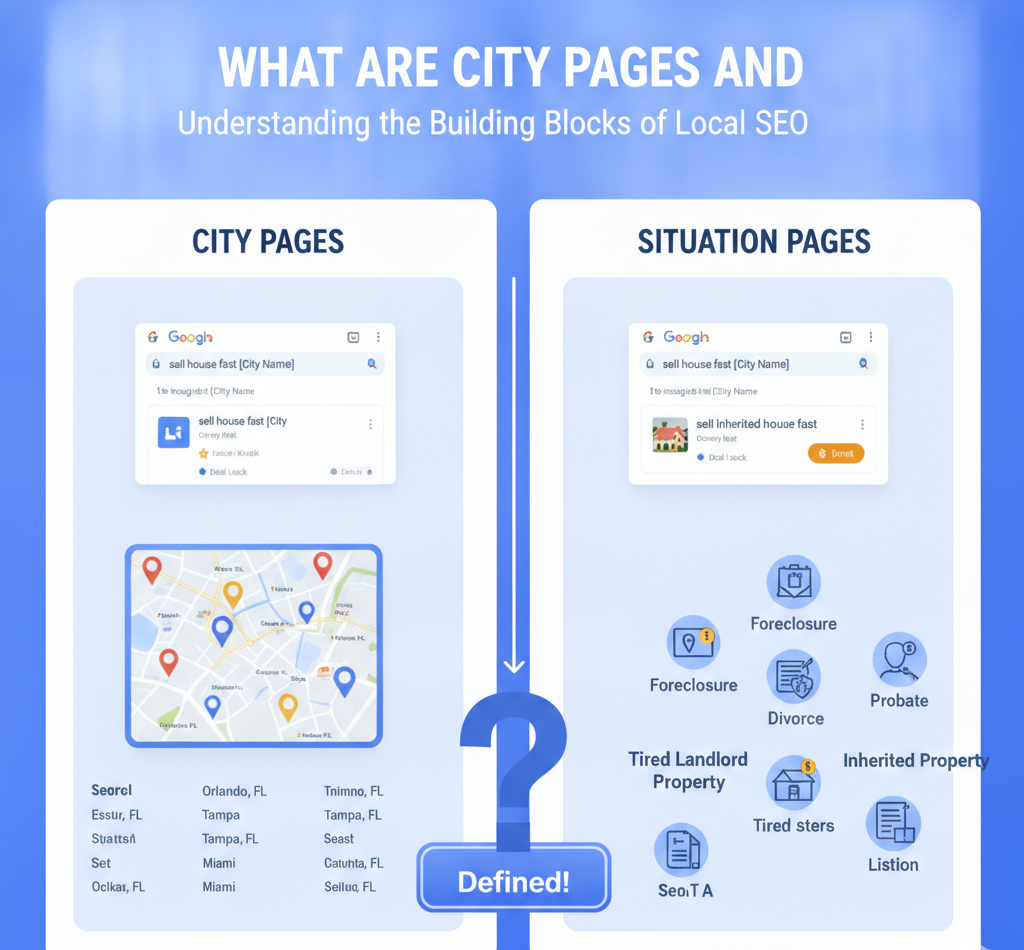
Before getting into strategy, it helps to be clear on definitions.
City pages are dedicated landing pages built around a specific geographic market. Instead of one homepage targeting your entire service area, you build individual pages for each city or county you serve — Gary, Hammond, Merrillville, Portage, Valparaiso, and so on.
Each city page is optimized for the specific search intent of a motivated seller in that location. Someone searching “sell my house fast Gary Indiana” lands on a page built specifically for Gary Indiana sellers — not a generic homepage that could belong to any cash buyer in any state.
Situation pages are dedicated landing pages or long-form content pieces built around the specific circumstances motivating a homeowner to sell. Instead of one generic pitch, you address each situation separately — foreclosure, inherited property, divorce, fire damage, tax liens, code violations, and being behind on payments.
Someone searching “how to sell a house in foreclosure in Indiana” is in a completely different emotional and circumstantial place than someone searching “inherited a house I don’t want.” A situation page speaks directly to that specific person. A homepage speaks to no one in particular.
Together, city pages and situation pages create a content architecture that matches what real motivated sellers are actually searching for — and converts that search intent into leads at a significantly higher rate than any generic page can.
Why City Pages and Situation Pages Work for Google Ads
If you are running Google Ads and sending all your traffic to the homepage, you are paying for relevance you are not delivering.
Google’s Quality Score system measures how closely your keyword, ad copy, and landing page align. When all three align — when the keyword, the ad, and the page all say the same thing to the same person — Quality Score goes up.
When Quality Score goes up, cost per click goes down, and ad position goes up. You pay less for better placement. That is the entire game in Google Ads, and it is won or lost on landing page relevance.
Here is what happens in practice.
Homepage scenario: A searcher in Portage, Indiana, types “sell my house fast Portage Indiana.” Your ad appears. They click and land on a homepage that says “we buy houses in Northwest Indiana.” The page mentions no Portage-specific information. The headline is generic. The content does not reflect their specific search. They leave within 10 seconds.
Google records this as a poor experience. Your Quality Score drops. Your cost per click goes up. Your conversion rate stays low. Your CPL climbs.
City page scenario: The same searcher clicks your ad and lands on a page with the headline “Sell Your House Fast in Portage, Indiana — Cash Offer in 24 Hours.” The page mentions Portage neighborhoods, references Porter County, addresses the situations common to Portage sellers, and has a lead form visible above the fold.
Google records this as a highly relevant experience. Your Quality Score improves. Your cost per click drops. Your conversion rate goes up. Your CPL falls.
We have run this comparison directly in live campaigns. The city page version consistently converts at three to four times the rate of the homepage version, with the same keyword and ad spend.
For situation keywords, the impact is even more significant. A foreclosure keyword sending traffic to a foreclosure situation page — one that answers every question a homeowner in foreclosure is actually asking — converts at dramatically higher rates than a homepage that makes no mention of foreclosure at all.
The math is straightforward. Better relevance equals lower CPL. Lower CPL equals more leads for the same budget. More leads from the same budget equals more deals.
Why City Pages and Situation Pages Work for SEO

Google’s goal has always been the same: surface the most relevant, most trustworthy, most authoritative result for every search query.
A city page built specifically for Valparaiso, Indiana, motivated seller searches is a more relevant result for “sell my house fast Valparaiso Indiana” than a homepage that mentions Valparaiso once in a paragraph alongside 15 other cities.
A situation page built specifically for inherited property sellers in Indiana is a more relevant result for “how to sell an inherited house in Indiana” than a generic about page that mentions inherited homes in passing.
Google ranks specificity. Generic pages rank for generic searches. Generic motivated seller searches produce generic leads — or none at all.
Here is what city pages signal to Google:
A website with dedicated pages for Gary, Hammond, Merrillville, Portage, Valparaiso, and 10 other cities signals to Google that this is a real local business with genuine expertise and a presence in those markets. That local specificity is a primary ranking signal for local search results.
Here is what situation pages signal to Google:
A website with dedicated content on foreclosure, probate, inherited property, divorce, fire damage, and tax liens demonstrates topical authority across the full range of distressed-seller situations. Google rewards topical coverage because it indicates genuine expertise — not surface-level content.
Together, city pages and situation pages build the topical authority and local relevance that Google needs to rank your site confidently for competitive motivated seller keywords.
The 15 Leads Last Week — Where They Actually Came From
Breaking down the source of last week’s results tells the full story about why this page architecture works across both channels simultaneously.
Organic SEO from city pages — 6 leads. These came from homeowners searching city-specific motivated seller terms and finding our optimized city pages ranking on page one. Zero ad spend. Pure organic traffic converting through the page’s lead form.
Organic SEO from situation pages — 4 leads. These came from homeowners searching for situation-specific terms — foreclosure timelines, selling an inherited property, divorce property sales — and finding our situation content. Again, zero ad spend on these pages.
Google Ads traffic sent to city pages — 3 leads. Same geographic keywords as before. The difference was that traffic was directed to a dedicated city page rather than the homepage. The conversion rate jumped significantly.
Google Ads traffic sent to situation pages — 2 leads. Foreclosure and inherited property ad groups are sending traffic to matching situation pages. These produced the lowest CPL of any paid traffic we ran last week.
Homepage — 0 organic leads, lower conversion rate on paid traffic than on every targeted page
The homepage still serves a purpose — it establishes brand credibility and captures direct traffic from people who already know the company name. But as a lead-generation destination for paid- or organic-motivated seller traffic, it consistently underperforms every targeted page it competes against.
How to Build a City Page That Actually Ranks and Converts
There is a significant difference between a city page that produces results and one that just exists. Most cash buyer websites have the latter — pages that swap a city name into a template and call it done.
Google identifies these templated pages quickly and ranks them accordingly — which is to say, it does not rank them at all.
Here is the framework for a city page that works.
Headline (H1): Include the city name and the primary keyword. “Sell Your House Fast in Hammond, Indiana — Cash Offer in 24 Hours” is specific, benefit-driven, and keyword-matched. A homepage headline like “We Buy Houses Fast” is none of those things.
Form or phone number above the fold. The conversion element must be visible without scrolling. Motivated sellers are not browsing — they have a problem, and they are looking for a solution. If they have to scroll to find how to contact you, most of them will not make it that far.
Local language throughout Neighborhood names, zip codes, county references, local market context, and city-specific information that signals genuine local presence. This matters equally to Google evaluating local relevance and to the seller evaluating whether you are a real local buyer.
Trust signals near the top: Number of homes purchased in the area, years in business, average days to close, and reviews from sellers in or near that market. Trust reduces friction. Reduced friction produces more leads.
Situation content mid-page: A section that addresses the common situations motivating sellers in that city — foreclosure, probate, divorce, inherited property, fire damage, and being behind on payments. This serves sellers who arrived on the city page but whose primary concern is their specific situation, and it adds topical depth that Google rewards with stronger rankings.
Minimum 700 to 900 words. Thin pages do not rank in competitive local markets. Google needs content depth to evaluate topical relevance. Sellers need enough information to trust your company before filling out a form. Short pages fail both tests.
Internal links to situation pages. Every city page should link to your relevant situation pages. A seller reading your Gary, Indiana page who is also facing foreclosure should be one click away from your Indiana foreclosure page. This serves the user and builds the internal link architecture that strengthens your entire content network.
How to Build a Situation Page That Converts
Situation pages go deeper than city pages on the specific emotional and circumstantial context of the seller. The goal is not to pitch your service — it is to answer every question the seller has about their situation before presenting your solution as the clearest path forward.
H1 that addresses the situation directly, “Facing Foreclosure in Indiana? Here Are Your Options” or “Inherited a House in Indiana You Don’t Want? Here’s What to Do” — the headline should make the seller feel immediately understood.
Content that answers real questions. For a foreclosure page: How long do I have before the auction? What happens to my credit? Can I sell before the foreclosure date? Will a cash buyer close fast enough? What do I need to do first?
These are the questions a homeowner in foreclosure is actually searching. Answer them directly and completely. Not as a lead-in to your pitch — as genuine information that establishes you as the trusted expert on this situation.
Present your solution in context. After answering the seller’s questions, present a cash sale as the solution that directly addresses their situation. For foreclosure — speed and certainty. For inherited property — simplicity and as-is purchase. For divorce — a fast, neutral sale that avoids prolonged negotiation. The pitch matches the situation.
CTA with situation-appropriate urgency. Foreclosure is time-sensitive. The CTA should reflect that. Inherited property is often emotionally complex. The CTA should be warmer and lower pressure. Match the tone of your call to action to the reader’s emotional state.
Internal links to city pages. A seller reading your Indiana foreclosure page who wants to know if you operate in their city should find a link to that city’s page immediately. Connect your situation pages to your city pages throughout.
How to Connect City Pages and Situation Pages Into a Lead Generation System
The real power of this page architecture comes not from individual pages but from the network they form together.
Every city page links to relevant situation pages. Every situation page links back to relevant city pages. Supporting blog content feeds into both.
Google sees a comprehensive web of locally specific, topically deep, interconnected content that establishes clear authority across the full range of motivated seller searches in your market.
That topical authority is what produces page one rankings. Those rankings are what produce organic leads at zero marginal cost. And that same-page network is what reduces your Google Ads CPL when you route paid traffic to the right destination rather than a generic homepage.
Start here if you are building from scratch:
Build city pages for your top five markets first. Build situation pages for your top four situations — foreclosure, inherited property, divorce, and fire damage. Connect them internally. Submit your updated sitemap to Google Search Console.
Then expand — more cities, more situations, supporting blog content that feeds into your money pages. Every piece you add strengthens the authority of everything already in the network.
This is a compounding system. The more you build, the faster the whole thing grows.
Conclusion: City Pages and Situation Pages Generate More Motivated Seller Leads
If you are running Google Ads to your homepage, you are overpaying for every lead you generate. City and situation pages will reduce your CPL significantly — in most cases by 40 to 60 percent — simply by matching your paid traffic to relevant landing pages.
If you are doing SEO with only a homepage, you are invisible for the local and situation-specific searches your best potential leads are making right now. City and situation pages are how you become visible to all.
Fifteen qualified leads in one week from targeted pages alone. In a competitive market with a domain that is still building authority. The results compound every week as the pages mature and the topical authority grows.
Build the right pages. Build them correctly. The leads will follow.
Frequently Asked Questions
How many city pages do I need? Start with your top three to five markets and build from there. A well-built page for one city will outperform ten thin, templated pages every time. Quality and local specificity matter more than volume.
How long before city and situation pages start ranking? With proper technical setup, a well-optimized city page in a moderately competitive market can appear in search results within 2 to 4 weeks and reach page 1 rankings within 60 to 90 days. Situation pages targeting lower-competition informational keywords often rank faster.
Do I need city pages if I am already running Google Ads? Yes. Your Google Ads CPL is directly affected by the relevance of your landing pages. City pages will reduce your cost per lead on paid traffic immediately — typically within the first two to four weeks after launch.
Can I build these pages myself? Yes, if you have a WordPress site and a basic understanding of on-page SEO. The framework is consistent — local H1, form above the fold, local language, situation content, trust signals, internal links. The challenge is doing it at scale across multiple cities and situations while maintaining quality.
What is the difference between a city page and a regular blog post? A city page is a conversion-focused landing page designed to capture leads. A blog post is a piece of content designed to answer questions and build topical authority.
Both serve different purposes in your SEO strategy, and both are necessary for a complete, motivated seller lead-generation system.
Ready to Build Your Motivated Seller Lead Machine?
REIRank builds city pages, situation pages, and full-funnel SEO systems for real estate investors, wholesalers, and cash-home-buying companies.
If you want to see what this strategy looks like in your specific market, book a free 30-minute strategy call at reirank.com. We will audit your current setup, identify gaps, and show you exactly what a complete city-and-situation page architecture would look like for your markets.
Book a Free Strategy Call — reirank.com
REIRank is a digital marketing agency specializing in motivated seller lead generation for real estate investors through SEO, Google Ads, Meta Ads, and a full-funnel marketing strategy.