

Setting up a Google Ads campaign for motivated seller leads the right way in 2026 is not complicated once you understand the logic behind each decision.
Still, it is unforgiving when those decisions are made carelessly or skipped entirely. Most real estate investors who try Google Ads and conclude that it does not work have not actually tested the channel properly.
What they have tested is a poorly structured campaign with broad keywords, weak ad copy, a slow landing page, and no conversion tracking, and then attributed the disappointing results to the platform rather than the setup.
The investors who generate consistent, qualified motivated seller leads through Google Ads are almost always doing a handful of fundamental things correctly that their less successful competitors are not.
This guide walks through each of those fundamentals in the sequence that produces the best results from the beginning of your campaign rather than after months of expensive learning.
Why Google Ads Campaign Structure Determines Everything
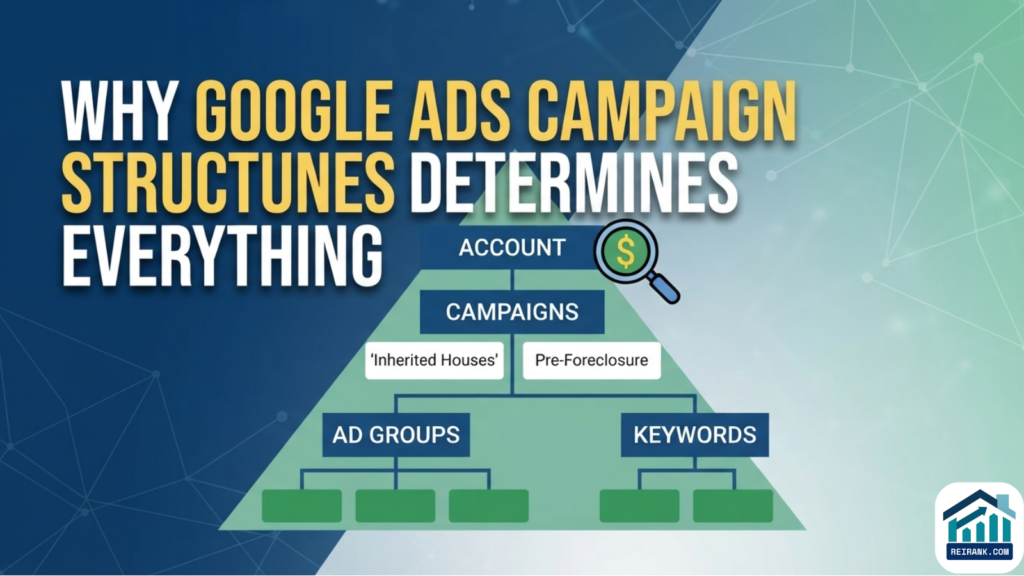
Before touching a single setting in Google Ads, it is worth understanding why campaign structure matters far more than most investors initially appreciate.
The structure of your campaign, how your keywords are organized, which keywords are grouped, and how tightly each group relates to its corresponding ads and landing pages, directly affects your quality score on every keyword you bid on.
Quality score is Google’s rating of the relevance and expected performance of your ads, and it has a direct and significant impact on how much you pay per click and where your ads appear.
A high quality score on a keyword means you pay less per click than a competitor bidding the same amount with a lower quality score, and your ad appears in a better position.
A low quality score means you pay more for worse positioning, which makes your cost per lead higher and your overall campaign economics worse in ways that compound over time.
The foundation of a quality score is relevance, specifically the degree to which your keyword, your ad, and your landing page all align around the same specific intent.
A tightly structured campaign where every keyword in a group shares the same intent, every ad in the group speaks directly to that intent, and the landing page delivers exactly what the ad promises builds quality score naturally and consistently.
A loosely structured campaign where broad keywords, generic ads, and general landing pages are mixed produces the opposite result.
Understanding this dynamic before you start building is what separates a real estate investor PPC setup that becomes more efficient over time from one that burns through budget without improving.
Step-by-Step Way to Set Up a Google Ads Campaign for Motivated Seller Leads

#1: Define Your Campaign Goal and Geographic Targeting
The first practical step in building a Google Ads campaign for motivated seller leads is defining exactly what you want the campaign to accomplish and where you want it to appear. These two decisions shape every subsequent setting in the campaign.
Your goal for a motivated seller campaign is straightforward: you want motivated homeowners in your target market to click your ad, arrive on your landing page, and submit their contact information or call your phone number.
Every campaign setting should be evaluated against whether it supports this specific goal rather than any other metric that might look good in a report but does not contribute directly to lead generation.
Geographic targeting should match your actual buying market precisely. Many investors make the mistake of setting geographic targeting too broadly, either at the state level or across multiple metro areas, when their actual ability to serve sellers is concentrated in specific cities or counties.
Tight geographic targeting ensures that every click you pay for comes from a searcher who is actually within the area where you can close a deal, which directly improves the quality and efficiency of your spend.
Set your location targeting to the specific cities, counties, or radius around your primary market that reflects where you genuinely buy properties.
If you serve a specific city and its surrounding suburbs, set your targeting to match that footprint precisely rather than defaulting to a broader area that includes people you cannot actually serve.
#2: Build Tightly Themed Ad Groups Around Specific Seller Situations
The ad group is the organizational unit within your campaign where keywords, ads, and landing pages connect, and building these groups with tight thematic focus is one of the most important structural decisions in a motivated seller Google Ads strategy.
Each ad group should contain keywords that share the same specific intent and seller situation. A foreclosure-focused ad group contains keywords about selling before foreclosure, stopping foreclosure, and selling quickly when behind on payments.
An inherited property ad group contains keywords about selling an inherited house, what to do with a house left by a deceased parent, and selling a probate property quickly. A general fast sale ad group contains the core “sell my house fast” and “cash home buyers” variations that motivated sellers across all situations commonly use.
Keeping these groups separate rather than combining all seller keywords into a single group allows you to write ads that speak directly to each specific situation, which produces higher click-through rates and better quality scores than generic ads trying to appeal to every situation simultaneously.
For each ad group, plan to build a corresponding landing page that specifically addresses the seller situation the group targets. A foreclosure-focused ad group should send traffic to a foreclosure-specific landing page. An inherited property group should send traffic to an inherited property landing page.
This alignment between the keyword searched, the ad shown, and the landing page content is what produces both high quality scores and high conversion rates.
#3: Select Keywords Using a Mix of Match Types for a motivated seller Google Ads campaign
Keyword selection for a motivated seller Google Ads campaign requires choosing not just which phrases to bid on but which match type to use for each phrase, because match type determines how closely a searcher’s query needs to match your keyword before your ad is eligible to appear.
Broad match allows your ad to appear for searches that Google considers related to your keyword, which can include searches that are only loosely connected to what you actually want to appear for. In the motivated seller space, broad match on a phrase like “sell house” can trigger your ad for searches that have nothing to do with your target audience, wasting significant budget on irrelevant clicks.
Phrase match requires that the searcher’s query contains your keyword phrase in the same order, though additional words can appear before or after it. For a phrase like “sell my house fast,” phrase match would trigger for “sell my house fast in Dallas” or “how to sell my house fast,” which are generally relevant while excluding queries that are not.
Phrase match is the most useful match type for the core of a motivated seller campaign because it balances reach with relevance effectively.
Exact match requires that the searcher’s query precisely matches your keyword with minimal variation. Exact match on your highest-value, highest-converting phrases gives you maximum control over when your ads appear for those specific searches.
Using exact match on your best-performing keywords alongside phrase match on broader variations gives your campaign both precision and coverage.
Negative keywords, which are the phrases you explicitly exclude from triggering your ads, are as important as the keywords you target.
A motivated seller Google Ads strategy without a comprehensive negative keyword list is almost certainly wasting budget on searches from buyers looking for properties, renters looking for apartments, people searching for real estate agent services, and countless other irrelevant queries.
Build your negative keyword list before launching and continue adding to it as your search term reports reveal irrelevant queries triggering your ads.
#4: Write Ads That Match Each Ad Group’s Specific Intent
With your ad groups defined and your keywords selected, the next step is writing responsive search ads for each group that speak directly to the specific seller situation the group targets. Google’s responsive search ad format allows you to provide up to fifteen headlines and four description lines, from which Google automatically tests combinations to identify which perform best.
Write your headlines for each ad group with the specific seller situation in mind rather than using generic motivated seller language across all groups. A foreclosure ad group headline might read “Sell Before Foreclosure Auction” or “Stop Foreclosure, Get Cash Fast.”
An inherited property group headline might read “Inherited a House You Don’t Want” or “Sell an Inherited Home as Is.” The more specifically your headlines speak to the situation the searcher is in, the higher your click-through rate will be and the better your quality score will become over time.
Include your primary keyword phrase in at least two or three of your headline options to signal relevance both to Google’s quality score calculation and to the searcher who scans the ad for confirmation that it matches their search. Include your city name in at least one headline to reinforce local relevance.
And include a specific benefit or promise in at least one headline, such as a timeline, a no-repair guarantee, or a no-obligation offer, that gives the searcher a concrete reason to click your ad over the others on the page.
#5: Build Landing Pages Designed for Conversion of a Google Ads campaign
Every dollar you spend on clicks reaches its destination on your landing page, which means a page that converts poorly makes your entire campaign more expensive regardless of how well everything upstream is performing.
The landing page is where clicks become leads, and it deserves as much attention as every other element of your real estate investor PPC setup.
A motivated seller landing page built to convert paid traffic needs to load in under two seconds on a mobile device, present a clear and benefit-focused headline immediately without requiring any scrolling, place a simple contact form above the fold where it is visible without scrolling on any screen size, and provide enough trust-building evidence through testimonials, a process overview, and local credibility signals to make a stressed homeowner feel comfortable submitting their contact information.
Keep your form short. Asking for a property address and a phone number or email address is enough to qualify the lead and initiate follow-up.
Every additional field you add reduces the number of people who complete the form, which increases your cost per lead for the same traffic volume. Gather additional qualifying information during the follow-up conversation rather than at the form submission stage.
#6: Set Up Conversion Tracking Before Spending Anything
Conversion tracking is what allows Google’s algorithm to learn from your campaign performance and optimize toward the actions that produce motivated seller leads rather than just clicks.
Without conversion tracking properly configured, you are spending budget with no feedback loop, no optimization signal, and no ability to measure your actual cost per lead accurately.
Before launching your campaign, configure conversion tracking in Google Ads for every action that represents a genuine lead, including form submissions, phone calls from ads, and phone calls from your website.
Connect your Google Ads account to Google Analytics 4 and verify that conversion data is flowing correctly between the two platforms.
Once conversion tracking is active and accumulating data, Google’s automated bidding strategies, particularly Target CPA bidding, which optimizes for a specific cost per acquisition, can use that data to automatically adjust bids in ways that improve your campaign efficiency over time.
Without conversion tracking, automated bidding has nothing to optimize toward and may actively harm your campaign performance.
#7: Monitor, Optimize, and Scale your Google Ads campaign
A motivated seller Google Ads strategy is not a set-and-forget system. The first two to four weeks of any new campaign are a data collection phase where the algorithm is learning, and performance is often less efficient than it will become once sufficient conversion data has accumulated.
During this initial phase, review your search term report at least twice per week to identify irrelevant queries that are triggering your ads and add them to your negative keyword list. Monitor your impression share metrics to understand whether your budget is limiting how often your ads appear for your target keywords.
Check your quality scores for each keyword and investigate any that fall below six or seven, as low quality scores indicate an alignment problem between keyword, ad, and landing page that needs to be addressed.
Once you have two to four weeks of performance data, you can begin making optimization decisions based on actual results rather than hypotheses. Pause keywords that are generating clicks but no conversions. Increase bids on keywords that are producing leads at acceptable costs.
Test headline variations in your responsive search ads to improve click-through rates. If your campaign is producing leads at a cost per lead that makes financial sense, increase your budget to scale lead volume proportionally.
How Reirank.com Helps Investors Set Up and Manage Google Ads Campaigns
Building a Google Ads campaign for motivated seller leads that is structured correctly from the beginning requires expertise across keyword strategy, ad copy, landing page optimization, conversion tracking, and ongoing campaign management.
Most real estate investors have the investing expertise but not the paid search expertise, and the gap between a well-built campaign and a poorly built one is directly measurable in wasted budget and missed leads.
Reirank.com builds and manages Google Ads campaigns specifically designed for real estate investors who want to generate motivated seller leads efficiently.
From initial campaign architecture and keyword research through landing page development, conversion tracking setup, and ongoing optimization, every element is built around the goal of generating the highest-quality and highest-volume motivated seller leads from your available budget.
If you are ready to build a Google Ads campaign that is set up correctly from the start, or if you are currently running campaigns that are not producing the results you expected, visit our services page today to explore how Reirank.com can help.
Your free consultation is the starting point for a real estate investor PPC setup built around your specific market, your goals, and your budget.
Conclusion: Google Ads Campaign for Motivated Seller Leads
Setting up a Google Ads campaign for motivated seller leads the right way in 2026 is a systematic process that rewards attention to detail at every stage from campaign structure and keyword selection through ad copy, landing page optimization, and conversion tracking.
The investors who get the best results from this channel are not necessarily those with the largest budgets. They are the ones whose campaigns are built on a foundation of tight structural alignment, relevant creative, and consistent optimization guided by real performance data.
A motivated seller Google Ads strategy built on the steps covered in this guide gives your campaign the best possible foundation for generating genuine, qualified leads at costs that make financial sense for your business.
The real estate investor PPC setup process requires patience in the early weeks as data accumulates and the algorithm learns, but the investors who commit to the process and optimize consistently build paid search systems that become more efficient and more reliable over time.
Visit Reirank.com today to start building a Google Ads campaign for motivated seller leads, structured for long-term performance in your specific market.