

Picture this. You have spent good money sending paid traffic to your website, the clicks are coming in, but the leads are not. Or worse, the leads that do trickle in are weak, unresponsive, and nowhere near as motivated as you had hoped.
If this sounds familiar, the problem is rarely the traffic itself. It is almost always where that traffic lands once it arrives.
This is exactly why landing page optimization for motivated sellers has become one of the most important skills a real estate investor can develop as they head into 2026. A homepage, no matter how polished, is not built to convert a stranger into a lead. A landing page is.
And the difference between a generic page and a properly optimized seller lead landing page can mean the gap between four leads a month and nineteen leads a month from the same traffic and the same budget.
This guide breaks down everything you need to know to build, structure, and refine landing pages that actually turn curious visitors into qualified leads.
Motivated seller inquiries, along with the kind of REI landing page SEO practices that help these pages rank and perform long after they go live.
Why Your Homepage Is Not Enough, and You Need a Landing Page
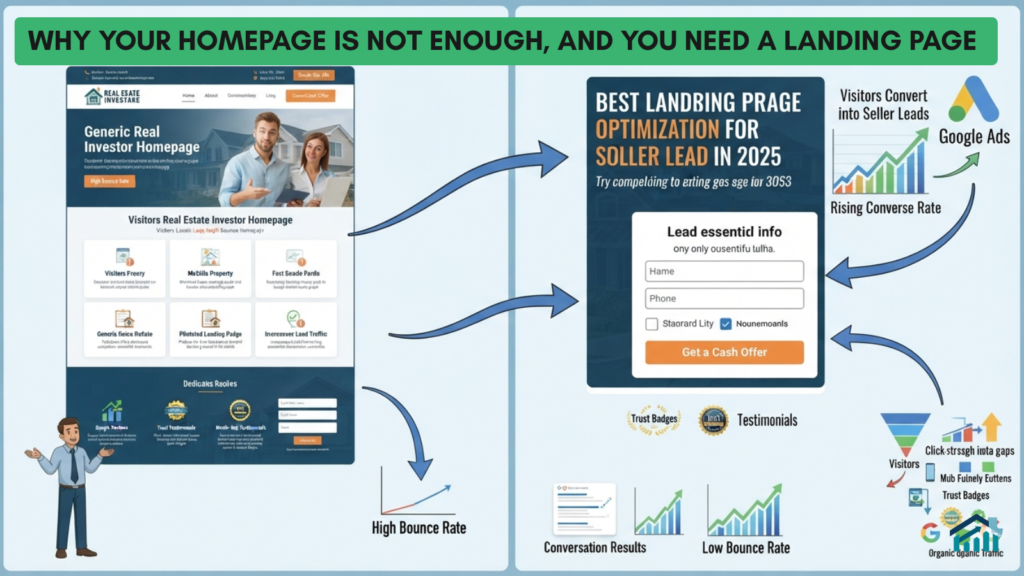
Most investors start their digital marketing journey by sending every visitor, whether from paid ads, organic search, or social media, straight to their homepage.
It feels efficient. One destination for everyone. But homepages are built to serve many purposes at once, and that is exactly the problem.
A homepage includes navigation links, multiple calls to action, general company information, and content designed to serve buyers, sellers, partners, and curious browsers simultaneously.
A landing page works completely differently. It exists to do one thing only: convert a specific visitor into a specific action. A motivated seller arriving from a Google search for “sell my house fast in [city]” does not want to browse your blog, read your company history, or scroll through unrelated service offerings.
They want to know immediately whether you can solve their problem, and they want an easy, obvious way to reach out the moment they decide you can.
The data backs this up clearly. According to First Page Sage’s 2026 benchmarks, the median conversion rate for real estate landing pages sits around 2.6 percent, which means for every hundred people who click through from an ad or search result, roughly ninety-seven leave without taking action.
But pages built with proper landing page optimization for motivated seller traffic in mind are converting at 8, 12, and even 15% or higher using the same traffic sources. That gap is not random. It comes down to structure, clarity, and a relentless focus on what the visitor actually needs to see and do.
The Anatomy of a High-Converting Seller Lead Landing Page

Every effective seller lead landing page follows a similar underlying structure, even though the specific wording and imagery vary from market to market. Understanding this structure is the foundation on which everything else is built.
The first thing a visitor needs to see, before they scroll even an inch, is a headline that immediately matches what brought them to the page in the first place. If someone clicked an ad promising a fast cash offer, the headline on your landing page needs to repeat that exact promise in different words.
A mismatch between what was promised and what the page delivers creates instant doubt, and doubt kills conversions before a visitor even has the chance to learn more about your offer.
Directly beneath that headline belongs a short, specific subheadline that adds one additional layer of clarity, something like a guarantee of speed, simplicity, or no obligation.
This is where you answer the unspoken question every motivated seller is asking themselves the moment they land on your page, which is simply, ” Why should I trust this and why should I keep reading?
From there, the form itself needs to sit as close to the top of the page as possible. Motivated sellers, by definition, are people who want to act, not people who want to read paragraphs of marketing copy before getting to the point.
Putting the address field and a simple form right beneath your opening promise removes friction and signals that you respect the visitor’s time and urgency.
Supporting elements like a short trust-building video, a handful of real testimonials, and a clear explanation of your process can follow further down the page, but none of these elements should ever come before the headline and form.
Everything on a well-optimized seller lead landing page exists to support a single goal: getting the visitor to submit their information.
Why Form Length and Field Choice Matter More Than You Think
One of the most common and costly mistakes investors make is asking for too much information too soon. Every additional field you add to a lead capture form measurably reduces the number of people who complete it.
A long form with name, email, phone number, property condition, timeline, and reason for selling might seem to produce better-qualified leads, but in practice, it often produces far fewer leads overall, since many visitors abandon the form before reaching the submit button.
The smarter approach for motivated seller landing pages is to start with the absolute minimum information needed to begin a conversation, typically just the property address and a phone number or email.
Once that initial information is captured, you can gather additional qualifying details through a phone call, a text message sequence, or a short follow-up form.
This approach respects the urgency sellers feel and gets them into your pipeline before they have a chance to second-guess themselves and click away.
If you are running paid traffic and want to balance lead volume against lead quality, a multi-step form can be a useful middle ground.
Rather than presenting every field at once, a multi-step form asks one or two questions per screen, which feels less overwhelming and tends to produce stronger completion rates than a single long form, while still allowing you to gather more qualifying detail than a bare-bones one-field form would capture.
The Power of Speed to Lead
Here is a statistic that should change how you think about everything downstream of your landing page. A lead that does not receive a response within five minutes of submitting a form is roughly nine times less likely to convert into an actual conversation, let alone a closed deal. This single fact makes your follow-up system just as important as the landing page itself.
No amount of landing page optimization for motivated seller traffic will matter if a seller fills out your form and then waits hours, or worse, days, to hear back from you.
By that point, the urgency that drove them to seek help in the first place has often shifted toward a competitor that responded faster.
Connecting your landing page form directly to an automated text message or email sequence that fires the moment a lead comes in, paired with a real human follow-up as quickly as possible, dramatically increases the percentage of leads that turn into actual conversations.
Building Pages for Specific Seller Situations Instead of One Generic Page
A mistake that quietly limits the performance of countless investor websites is relying on a single, broad landing page meant to capture every type of motivated seller.
A homeowner facing foreclosure, a person who just inherited a property they do not want, and a landlord dealing with a difficult tenant are all technically motivated sellers, but they are thinking about completely different problems and need to see completely different messaging.
Building separate, dedicated landing pages for each major seller situation in your market allows you to speak directly to that specific person’s circumstances rather than offering generic, one-size-fits-all language that resonates with no one in particular.
A page built specifically around inherited property can speak to the confusion and emotional weight of dealing with a parent’s home from out of state.
A page built around foreclosure can speak directly to the urgency of the timeline and the relief of stopping the process before it goes further. Industry guidance commonly recommends creating at least six separate landing pages for a real estate business, each tailored to a distinct lead type, rather than relying on a single generic page to do all the work.
This same logic extends to geography. If you serve multiple cities or counties, building individual landing pages for each major market, rather than one combined regional page, allows you to speak with local specificity and dramatically improves your ability to rank for location-based searches, which brings us to the technical side of REI landing page SEO.
REI Landing Page SEO: Making Sure Your Pages Get Found
A beautifully designed landing page that never gets discovered by search engines is only useful for paid traffic.
To capture the full value of your effort, your landing pages also need to be built with REI landing page SEO principles in mind, so that motivated sellers searching organically can find them without you having to pay for every single click.
This starts with your headline and page title. Including your primary keyword, something like “sell my house fast in [city],” naturally within your H1 heading, helps search engines understand exactly what the page is about, while still reading as something a real human being would actually want to read.
Forcing in a keyword in a way that feels robotic or repetitive does more harm than good, both for readability and for how search engines evaluate content quality.
Page speed is another factor that affects both your search rankings and your conversion rate simultaneously. A slow-loading landing page frustrates visitors enough that many will leave before the page even finishes loading, and search engines factor loading speed directly into how pages are ranked.
Compressing images, avoiding unnecessary scripts, and choosing a fast, reliable hosting platform are not optional technical details. They are foundational to both your SEO performance and your conversion rate.
Mobile responsiveness deserves equal attention, since well over half of all real estate-related searches now happen on mobile devices.
A landing page that looks great on a desktop monitor but breaks apart or becomes difficult to navigate on a phone screen will lose a significant share of the motivated sellers who matter most, since so many of them are searching and reaching out from their phones in moments of urgency.
Finally, avoid the trap of stuffing your landing page with unrelated content in an attempt to rank for as many keywords as possible. A focused page that thoroughly addresses one specific situation, written in clear, natural language, consistently outperforms a bloated page trying to be everything to everyone, both in search rankings and in actual conversion once a visitor arrives.
Placement of Trust Signals and Social Proof in the Right Places
Trust is the single biggest barrier standing between a motivated seller and a completed form submission.
Selling a home, especially under financial or emotional pressure, is one of the biggest decisions a person will make, and a stranger asking for their personal information online naturally triggers hesitation. Addressing that hesitation directly on your landing page is essential.
Placement of trust elements matters as much as their presence. A strong testimonial or a visible star rating positioned directly above or beside your form does far more to reduce hesitation at the exact moment of decision than the same testimonial buried at the bottom of a long page that most visitors never scroll to.
A short, genuine video introduction from you or your team, even just thirty to forty-five seconds long, can meaningfully increase trust by putting a real human face behind the offer rather than leaving the visitor to wonder exactly who they would be working with.
Clear, honest language about your process also builds trust in ways that polished marketing copy cannot replicate. Briefly explaining what happens after someone submits the form, when they can expect a call, what the next steps look like, and that there is no obligation to accept any offer removes uncertainty and makes submitting the form feel far less risky.
Testing and Refining Your Pages Over Time: Landing page optimization for motivated seller traffic
Landing page optimization for motivated seller traffic is not something you complete once and then leave untouched. The investors who consistently generate the strongest results treat their pages as living assets that improve gradually through ongoing testing rather than static pages built once and forgotten.
A simple, sustainable approach is to test one element at a time rather than redesigning an entire page at once. Changing your headline while keeping everything else the same lets you clearly see whether that single change improved or hurt your conversion rate.
Once you find a stronger headline, move on to testing your call-to-action button language, then your form length, and finally your supporting imagery. Small, methodical improvements compound significantly over months and years, often producing far greater gains than a single dramatic redesign ever could.
Conclusion: Landing Page Optimization for Motivated Seller
Optimizing your landing pages for motivated seller leads is not about chasing trends or copying whatever your competitor’s website looks like this month. It comes down to a few consistent, proven principles. Match your headline to the promise that brought the visitor to your page.
Keep your form short and place it near the top. Respond to every lead within minutes, not hours. Build separate pages for distinct seller situations and markets rather than relying on a single generic page.
And make sure every page is technically sound, fast, mobile-friendly, and structured in a way that search engines can understand and reward.
The investors who commit to this kind of focused, ongoing optimization are the ones turning the same advertising budget and organic traffic into significantly more leads, more conversations, and ultimately more closed deals than competitors who send visitors to a generic homepage and hope for the best.
If building and refining high-converting, search-optimized landing pages feels like more than you have time to manage on top of running your investing business, you do not have to figure it out alone.
Reirank.com specializes in helping real estate investors build landing pages designed specifically to convert motivated seller traffic while also performing well in organic search.
Visit Reirank.com today to take advantage of a free consultation, where we will walk through your current website and landing pages, identify exactly where leads are being lost, and show you a clear path toward turning more of your traffic into real, qualified, motivated seller leads.