

Building a real estate investor website that converts is not the same thing as building a website that looks good, and that distinction is where most investors go wrong the first time they invest in their digital presence.
A website can be professionally designed, visually polished, and technically functional without ever generating a meaningful volume of motivated seller leads, because the elements that make a website attractive to look at and the elements that make it persuade a stressed homeowner to submit their contact information are not the same and do not always overlap.
This guide walks through every aspect of building a high-converting investor website, from the foundational decisions about platform and structure through the specific on-page elements that separate websites generating consistent inbound leads from those sitting quietly in the background producing almost nothing.
Why Most Investor Websites Fail to Convert
Before getting into what a converting investor website looks like, it helps to understand why so many of them fail to convert even when they are receiving reasonable traffic.
The most common failure pattern is a website built around what the investor wants to communicate rather than what the motivated seller needs to find.
An investor who fills their homepage with company history, years of experience, number of deals closed, and service area coverage is leading with information that serves their own credibility concerns rather than the seller’s immediate need for reassurance that this business can solve their specific problem quickly and simply.
A seller who lands on a page like that in a moment of genuine stress or urgency scans it, finds nothing that speaks directly to their situation, and clicks away within seconds.
Investor website conversion optimization starts with understanding the psychology of the visitor you are trying to convert. A motivated seller is not browsing casually.
They are searching for a solution to a specific problem, often under time pressure, often with significant anxiety about making the right decision, and often comparing multiple websites simultaneously.
What they need to see the moment they arrive on your page is not a company profile. It is evidence that you understand their situation and a clear, simple path to getting the help they are looking for.
Choose the Right Platform to Build a Real Estate Investor Website That Converts
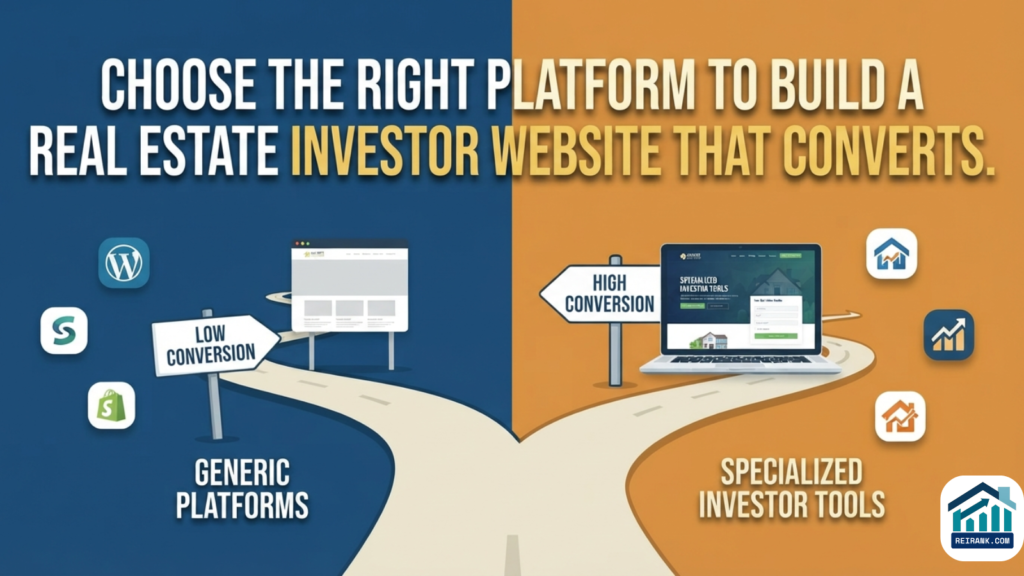
The platform you choose for your investor website determines the ceiling on your site’s performance in several important ways, including page load speed, SEO flexibility, mobile responsiveness, and your ability to make changes quickly based on performance data.
For real estate investors who want a website built and optimized specifically for motivated seller lead generation without managing a complex technical setup, dedicated investor website platforms like Reirank and Carrot are worth serious consideration.
These platforms are built around the specific conversion and SEO requirements of investor websites, and they handle many of the technical optimization decisions that would otherwise require developer involvement or significant technical knowledge to get right.
For investors who want more design flexibility and full control over every element of their site, WordPress with a lightweight, performance-optimized theme is the most capable option.
The trade-off is that WordPress requires more active management, more attention to plugin selection and update management, and more deliberate technical optimization to achieve the page speed performance that conversion and SEO both require.
Whatever platform you choose, the non-negotiable requirements are fast mobile load times, genuine mobile responsiveness rather than just a site that technically works on mobile, and the ability to create dedicated landing pages for specific seller situations without being constrained by a rigid template structure.
Homepage Structure: What Goes Where and Why
The homepage of a motivated seller website design is the most visited page on the site, and the one where first impressions are formed and conversion decisions are most frequently made.
Every element of your homepage should be arranged in a deliberate sequence that moves a visitor from arrival through trust building to action in the shortest and smoothest possible path.
The very first element a visitor sees without scrolling, the section of the homepage that loads within their initial viewport, should contain four things:
#1.A headline that immediately and specifically names the seller’s situation or desired outcome.
#2. A short supporting statement that adds one key benefit or reassurance.
#3. A simple contact form or clear call to action button.
#4. And a trust signal of some kind, whether that is a Google review star rating, several homes purchased, or a brief seller testimonial.
Nothing else belongs in this above-the-fold section. Navigation menus should be clean and minimal. Decorative elements should not compete visually with the headline and call to action.
The entire purpose of this first screen is to communicate in under five seconds that the visitor has arrived in the right place and that taking the next step is simple and low risk.
Below the fold, the sequence that consistently performs best in investor website conversion optimization moves through a brief process explanation and social proof in the form of multiple testimonials or case studies.
A deeper dive into the benefits of working with you versus traditional alternatives, answers to the most common seller questions, and a repeated call to action that gives visitors who have read further down the page an easy path to contact without having to scroll back to the top.
The Contact Form: Choose the Right Contact Form for Building a Real Estate Investor Website That Converts

The contact form is where a website visitor becomes a lead, which makes it the single most important functional element on your entire website.
Every decision about your form, including where it appears, how many fields it contains, what those fields ask, and how it looks on a mobile screen, has a direct measurable impact on your conversion rate.
Keep your initial form as short as possible. Asking for a property address and either a phone number or email address gives you everything you need to follow up effectively.
Every additional field you add to the form reduces the number of people who complete it, and the reduction in completions is rarely offset by the improvement in lead quality that additional information might seem to promise.
Gather additional qualifying details during your follow-up conversation rather than at the form submission stage, when the seller is still deciding whether to trust you enough to share their contact information.
Place your contact form above the fold on your homepage and every dedicated landing page on your site. Visitors who arrive with genuine intent to take action often look for the form immediately on arrival, and burying it below multiple sections of content means some portion of your most motivated visitors never find it before leaving.
Repeat the form or a call to action button at the bottom of longer pages to capture visitors who scroll through your content before deciding to take action.
Make every phone number on your site a clickable link using the tel: HTML attribute. This is a one-minute technical change that allows mobile visitors to initiate a call by tapping your phone number rather than manually dialing it, and it meaningfully improves mobile conversion rates for visitors who prefer speaking to someone rather than filling out a form.
Local Trust Signals That Convert Seller Visitors
Motivated sellers are not just evaluating whether you can solve their problem. They are evaluating whether you are trustworthy enough to solve it.
In the context of what is usually a large financial transaction handled under stressful circumstances, trust is the primary barrier between a visitor who finds your website and a lead who submits their information.
The trust signals that convert motivated sellers most effectively are specific, local, and verifiable. A generic statement that you are a trustworthy local investor does nothing.
A visible Google review rating with a count of genuine reviews from past sellers, displayed prominently near your call to action, does a great deal.
Specific testimonials that mention the seller’s situation, their location, and what the experience was actually like give future sellers a concrete example of what working with you looks like that abstract credibility claims cannot provide. Local trust signals that indicate genuine community presence also matter significantly.
Membership badges from local real estate associations, Better Business Bureau accreditation if applicable, and specific local market knowledge demonstrated through your content all contribute to the sense that you are an established, locally accountable business rather than an anonymous online operation.
Including a professional photo of yourself and your team, if applicable, on your About page and potentially on your homepage builds personal connection and humanity that converts visitors who want to know who they are dealing with before sharing their contact information.
A business whose owners are visible and identifiable feels safer to a hesitant seller than one that presents no human face.
Mobile Optimization: Mobile optimization for a motivated seller website design is Non-Negotiable
A significant majority of motivated seller searches happen on mobile devices, often during evenings and weekends when stress about a property situation has time to translate into active searching behavior.
A website that functions adequately on desktop but delivers a slow, cluttered, or difficult-to-navigate experience on a phone is not just missing a technical standard. It is actively losing a large share of its most motivated visitors before they ever read your headline or find your contact form.
Mobile optimization for a motivated seller website design covers several distinct areas that all need to work together. Page load speed on mobile connections is the most critical factor, since visitors on slower mobile connections will leave a page that takes more than two to three seconds to become interactive.
Google’s PageSpeed Insights tool shows you exactly how your site performs on mobile and provides specific recommendations for the changes most likely to improve load time.
Text size and button sizing on mobile screens affect whether visitors can read and interact with your page without zooming or struggling with tiny tap targets.
Paragraphs that look fine on a desktop screen can become uncomfortably small on a phone, and contact form fields or submit buttons that are too small to tap accurately create friction that reduces conversions.
Testing your website on actual mobile devices across different screen sizes, rather than relying only on desktop browser emulation, is the only reliable way to identify these issues before they cost you leads.
Dedicated Landing Pages for Each Seller Situation
A single homepage is rarely sufficient to capture the full range of motivated seller traffic available in your market, because different seller situations require different messaging and attract different search queries.
Sellers facing foreclosure are thinking about different concerns and using different language than sellers managing inherited properties, sellers dealing with divorce, or sellers whose properties need major repairs.
Building dedicated landing pages for each major seller situation you serve allows you to speak directly and specifically to each audience rather than using generic language that tries to appeal to everyone and resonates deeply with no one.
A dedicated foreclosure landing page can use foreclosure-specific language in its headline, address foreclosure-specific concerns in its content, and answer the foreclosure-specific questions that sellers in that situation are most likely to have before making contact.
Each dedicated landing page also represents an additional organic ranking opportunity for the situation-specific search terms that motivated sellers in each category use when looking for help.
A foreclosure landing page optimized for “[state] foreclosure help sell my house” captures searches that your general homepage will never rank for, effectively multiplying the organic search visibility of your overall website without requiring any increase in your advertising budget.
Page Speed as a Conversion and SEO Factor on a Motivated Seller Website Design
Page speed deserves its own focused attention because it affects both your conversion rate and your search rankings simultaneously, making it one of the highest-leverage technical improvements available to any investor website.
On the conversion side, research consistently shows that every additional second of load time reduces the percentage of visitors who stay on a page and take action. For motivated sellers searching on mobile connections with genuine urgency, a slow page does not just inconvenience them.
It creates enough friction that a meaningful portion of them click the back button before your page has finished loading and click on a competitor’s result instead.
On the SEO side, Google’s Core Web Vitals framework explicitly incorporates page speed and loading experience metrics as ranking factors, meaning a slow website is being penalized in search results relative to faster competitors even when all other ranking factors are equal.
Investing in page speed improvements yields returns in both conversion rate and organic rankings, making it one of the clearest double-benefit optimizations available.
The most impactful speed improvements for most investor websites involve compressing and properly formatting images before uploading them, minimizing the number of third-party scripts loading on each page.
Choosing a hosting provider with server response times under two hundred milliseconds, and using a content delivery network to serve your site from servers geographically close to your target market.
Content Strategy for Conversion and SEO Together
The content on your investor website serves two purposes simultaneously when done correctly: it satisfies the informational needs of motivated sellers who want to understand their options before making contact, and it signals relevance and authority to search engines evaluating whether your pages deserve to rank for specific seller queries.
Content that achieves both purposes is specific, honest, locally grounded, and genuinely useful to the person reading it.
A page about buying houses in a specific city should contain real information about the local market, the types of situations common among sellers in that area, what the buying process typically looks like in that specific context, and honest answers to the questions sellers in that market most commonly ask.
Content that is thin, generic, or clearly written primarily for keyword placement rather than genuine usefulness fails both purposes.
It does not build trust with sellers who can immediately recognize the difference between content written to help them and content written to rank, and it increasingly fails to rank well as search engines in 2026 apply more sophisticated quality assessments to content relevance and genuine usefulness.
How Reirank.com Builds Investor Websites Designed to Convert
Building a real estate investor website that converts motivated sellers into leads requires getting dozens of decisions right simultaneously, from platform selection and page structure through content quality, mobile performance, local trust signals, and dedicated landing page architecture.
Most investors who build their own websites get some of these decisions right and miss others, and the gaps are what prevent a well-intentioned website from generating the lead volume it is capable of producing.
Reirank.com builds real estate investor websites designed from the ground up for motivated seller conversion, combining the technical performance standards that search engines reward with the trust-building content and conversion-optimized structure that stressed homeowners respond to.
From initial site architecture and platform setup through content development, local SEO integration, and ongoing optimization based on conversion data, every element is built around the goal of turning your website into your most reliable and cost-effective lead generation asset.
If your current investor website is attracting some traffic but failing to convert it into the motivated seller leads your business needs, or if you are building your first investor website and want to get the foundation right from the beginning, visit our services page today to explore how Reirank.com can help.
Your free consultation is the starting point for a website strategy tailored to your specific market, seller audience, and business goals.
Conclusion: Real Estate Investor Website That Converts
A real estate investor website that converts is not the result of good design alone, or good SEO alone, or a well-written headline alone.
It is the result of all of these elements working together in a structure that reflects a genuine understanding of how motivated sellers think, what they need to see to feel safe enough to take action, and how search engines evaluate the relevance and trustworthiness of the pages they surface for the searches that bring those sellers to your site.
The decisions covered in this guide, from platform choice and homepage structure through contact form design, mobile optimization, local trust signals, include dedicated landing pages.
And content strategy, collectively determine whether your website becomes a consistent source of motivated seller leads or an ongoing source of frustration for an investor wondering why their digital marketing investment is not producing results.
Getting these decisions right from the beginning, or correcting them systematically if your existing site is underperforming, is what separates investor website conversion optimization that produces real deal flow from a digital presence that looks professional but delivers little. Visit Reirank.com today to start building the investor website your business deserves.