

Most real estate investor websites follow the same predictable pattern. There is a homepage with a headline about buying houses fast, a contact form, maybe a how-it-works page, and a testimonials section if the investor has been thoughtful enough to add one.
That is a reasonable start, but it leaves a significant amount of organic search traffic on the table. The investors quietly dominating their local markets in search results have figured out something most of their competitors have not.
They have built dedicated seller resource pages that Google rewards with consistent rankings and that motivated sellers genuinely find useful.
If you want to create a seller resource page that ranks on Google and keeps driving inbound leads month after month without requiring you to run paid ads constantly, this guide is for you.
We are going to walk through exactly what a Seller Resource Page is, how to create a Seller Resource Page That Ranks on Google, why it works so well for real estate investor websites, and the step-by-step approach to building one that performs well for both search engines and the human beings reading it.
What Is a Seller Resource Page and Why Does It Matter
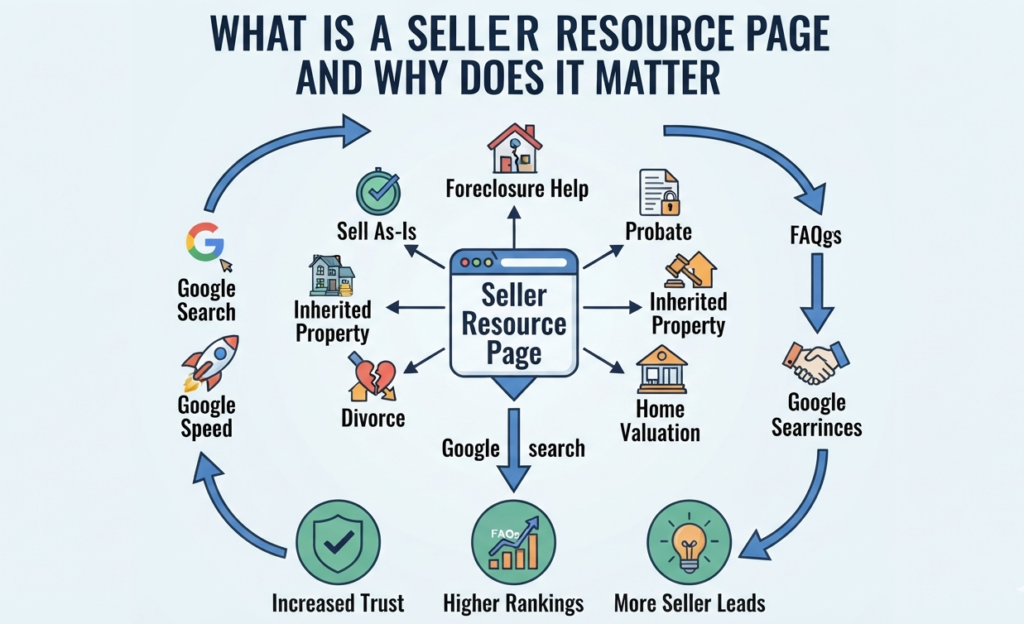
A seller resource page is a dedicated section of your investor website that provides genuinely helpful information for homeowners considering selling.
Rather than serving as a sales page that pushes sellers to contact you immediately, a resource page positions you as a trusted authority by providing sellers with the information they need to make an informed decision.
The irony is that this approach, which feels less salesy, actually converts at a higher rate because it builds real trust before any conversation happens.
The reason seller resource page SEO works so well is rooted in how Google evaluates content. Google’s primary goal is to deliver the most useful, trustworthy, and relevant results to each searcher.
When a motivated seller types something like “what happens if I sell my house as-is,” “how does selling to a cash buyer work,” or “what do I need to do before selling an inherited property,” Google is looking for pages that answer those questions comprehensively and honestly.
A well-built investor resource page does exactly that, and in doing so, it earns rankings that a basic homepage never could. Beyond the SEO benefits, a seller resource page serves a critical role in your conversion funnel.
Sellers who find you through informational searches are often earlier in their decision-making process than someone who searches directly for “sell my house fast.” They are researching options, weighing their choices, and looking for someone they can trust.
When your resource page provides clear, honest, and helpful answers during that research phase, you position yourself as the obvious choice when they are ready to take action.
That is how an investor resource page becomes a long-term lead generation asset rather than just another page on your website.
The Strategic Foundation: Understanding What Sellers Are Actually Searching For
Before you write a single word of your seller resource page, you need to understand what your target sellers are typing into Google. This is where most investors get it wrong.
They write about what they think sellers want to know rather than what sellers are actually asking. The difference between those two things can mean the difference between a page that ranks and one that sits in obscurity.
Motivated sellers tend to search in patterns that reflect their emotional state and their situation. Someone facing foreclosure searches for things like “how to stop foreclosure,” “what happens when you miss mortgage payments,” and “sell house before foreclosure.”
Someone dealing with an inherited property searches for “how to sell an inherited house,” “do I need probate to sell a house,” and “selling a house you inherited, tax implications.”
Someone going through a divorce searches for “how to sell house during divorce,” “can I sell my house without my spouse’s permission,” and “fastest way to sell house in divorce.”
When you understand these search patterns, you can structure your investor resource page around the actual questions real sellers are asking rather than the questions you assume they have.
This alignment between searcher intent and page content is one of the most fundamental principles of seller resource page SEO, and getting it right from the start saves you months of effort trying to rank for the wrong things.
Free tools like Google’s own autocomplete feature, the “People Also Ask” boxes that appear in search results, and platforms like Answer the Public can give you a rich understanding of what your target sellers are searching for without requiring any paid subscriptions.
Structuring Your Seller Resource Page for Maximum SEO Impact

The structure of your investor resource page is just as important as the content itself. Google’s crawlers evaluate how well-organized and comprehensive a page is, and human visitors make split-second judgments about whether a page looks trustworthy and worth reading. Getting the structure right serves both audiences simultaneously.
Your page should open with a clear, welcoming introduction that speaks directly to the seller, acknowledging that selling a house is a significant decision and that this page exists to help them understand all their options.
This is important because it signals to both Google and the reader that the page is genuinely helpful rather than purely promotional.
Following the introduction, organize your content into clearly defined sections, each addressing a different aspect of the selling process or a different seller situation.
You might have sections covering what to expect when selling to a cash investor, how the process works from first contact to closing, what kinds of situations you most commonly help sellers with, frequently asked questions organized by topic, and a glossary of common real estate terms explained in plain language.
Each of these sections adds depth to your page and gives Google more content to evaluate for relevance across a wide range of seller search queries.
Internal links within your resource page are another structural element that both helps sellers navigate and strengthens your overall site architecture.
When your resource page links to deeper pages on your site that address specific topics in more detail, like a dedicated page about your foreclosure assistance process or a page explaining how you handle inherited properties, you create a web of interconnected content that search engines reward and that keeps sellers engaged longer on your site.
Writing Content That Serves Both Google and Your Sellers
When you sit down to actually write the content for your seller resource page, the most important mindset shift is to think of yourself as a trusted advisor rather than a marketer.
The goal is not to sell in every sentence but to genuinely educate and inform, trusting that the trust you build through honest information will do the selling for you over time.
Concrete, specific information performs better than vague generalities for both SEO and seller trust. Rather than saying “we can close quickly,” say “in most cases, we can close in as little as seven to fourteen days, though some situations involving title issues or estate matters may take a bit longer.”
Rather than saying “we buy houses in any condition,” explain what that actually means in practice, describing the kinds of repairs and issues you routinely handle without requiring the seller to fix anything.
The reading level of your resource page content matters more than most investors realize. Motivated sellers come from all educational backgrounds, and many are dealing with stressful situations that make complex language even harder to process.
Writing clearly, avoiding jargon, and explaining any technical terms you do use in plain language make your page more accessible, more readable, and ultimately more likely to convert the sellers who find it.
Length is another important factor when creating a seller resource page that consistently ranks. Comprehensive resource pages that genuinely cover a topic in depth tend to outrank thin pages that barely scratch the surface.
This does not mean padding your content with unnecessary words, but it does mean being thorough enough that a seller could read your page and come away with a genuinely better understanding of their situation and options than they had before they arrived.
Pages that accomplish this tend to earn longer average time on page, lower bounce rates, and more return visits, all of which send positive signals to search engines.
Local SEO Elements That Make Your Seller Resource Page Rank in Your Market
One of the most powerful aspects of building a strong investor resource page is the opportunity to combine the authority of genuinely helpful content with the specificity of local SEO.
A generic resource page on selling houses is competing against national brands and major real estate platforms with enormous domain authority.
A resource page about selling houses specifically in your city or region is competing against a much smaller pool of local competitors, and when done well, it can rank very strongly indeed.
Weaving your location naturally into your resource page content is the foundation of this approach. If you serve the Houston market, your resource page should reference
Houston neighborhoods mention local property tax considerations specific to Texas, discuss local market conditions, and address situations common among Houston homeowners.
This level of local specificity tells Google that your page is particularly relevant to sellers searching for or about your market, and it tells sellers that you genuinely understand the environment they operate in rather than offering generic national advice.
Beyond the written content, your seller resource page benefits from being embedded in a strong local SEO structure that includes your Google Business Profile, consistent NAP citations across local directories, and links from locally relevant websites.
Seller resource page SEO at the local level is a combination of on-page relevance and off-page authority, and both elements need attention for the page to reach its full ranking potential.
Adding Multimedia Elements to Increase Engagement and Dwell Time
Written content is the foundation of a strong investor resource page, but multimedia elements can significantly enhance the page’s performance for both sellers and search engines.
Video content is particularly valuable because it keeps visitors on your page longer, which signals to Google that the page is delivering value, and because it communicates your personality and trustworthiness in a way that text alone cannot.
A short video introduction where you speak directly to sellers, introduce yourself, and give them a preview of what the page covers is a simple addition that can meaningfully increase the amount of time visitors spend on your resource page.
If you have video testimonials from past sellers, embedding them on your resource page adds social proof right in the context where sellers are making their initial evaluation of whether to trust you.
Infographics or simple visual explainers that illustrate your process, show a timeline of what happens between first contact and closing, or compare the experience of selling to an investor versus listing with an agent can make complex information easier to absorb and more memorable.
These visuals also create opportunities for other websites to link to your resource page when they share the graphics, which builds high-quality backlinks that strengthen your page’s authority over time.
Technical SEO Details That Determine Whether Your Page Actually Ranks
You can write the most helpful, comprehensive, and beautifully structured investor resource page in your market and still fail to rank if the technical foundations of the page are not in order. Technical SEO is the layer beneath your content that determines whether Google can effectively crawl, index, and evaluate your page.
Your page title should include your primary keyword naturally and ideally your location, something like “Seller Resource Guide for Houston Homeowners – Everything You Need to Know.”
Your meta description should summarize the page’s value in a way that compels sellers to click when they see your result in search, touch on the main topics covered, and end with an encouraging note about what they will gain by reading.
Page loading speed is a ranking factor that disproportionately affects resource pages because they tend to have more content and potentially more multimedia elements than simpler pages.
Compress your images before uploading them, use a caching plugin if your site runs on WordPress, and test your page speed regularly with Google’s free PageSpeed Insights tool to catch and fix issues before they undermine your rankings.
Mobile optimization is non-negotiable for a resource page because a significant portion of motivated sellers will find and read your content on their phones, often in emotionally charged moments when they are looking for answers quickly.
Your page needs to be easy to navigate, read, and interact with on a small screen, with text large enough to read comfortably, sections that are easy to scroll through, and contact options that are easy to tap.
Schema markup, particularly FAQ schema for any question-and-answer sections on your resource page, can help your content appear in enhanced search results that take up more space on the page and attract more clicks.
Adding this structured data is a technical step that your web developer or an SEO plugin can handle, and it can make a meaningful difference in how visible your resource page appears in search results.
Keeping Your Seller Resource Page Fresh and Authoritative Over Time
One of the biggest mistakes investors make after successfully building a resource page that starts ranking is treating it as a finished product rather than a living document.
Google consistently rewards pages that are kept current and updated regularly, and sellers who visit your page benefit from information that reflects the current market environment rather than conditions from several years ago.
Make a habit of reviewing your seller resource page at least every three to six months and updating any statistics, market references, or process details that may have changed.
When new situations arise in your investing business that sellers commonly ask about, add a section to address those questions. When local market conditions shift significantly, update your content to reflect the new reality.
Monitoring your page’s performance in Google Search Console provides a continuous stream of data on which search queries bring visitors to your resource page, which of those queries drive the most clicks, and where there might be gaps between what sellers are searching for and what your page currently covers.
This data is invaluable for guiding your ongoing content updates and ensuring that your seller resource page continues to rank for an expanding set of relevant searches over time.
Turning Seller Resource Page Visitors Into Actual Leads
All of the SEO work in the world only matters if your resource page eventually converts its visitors into leads that you can follow up with. The key to doing this without undermining the trust that your resource page builds is to make your contact opportunities feel like natural next steps rather than aggressive sales pitches.
Place a simple, friendly call-to-action section at the end of your resource page that acknowledges the seller has learned a lot and invites them to take the next step if they are ready.
Something as simple as “If you have read through this guide and you think working with a cash investor might be the right option for your situation, we would love to have a no-obligation conversation” is less off-putting than a hard sales push and often converts at a higher rate because it respects the seller’s autonomy.
Offering a free resource download, like a simple checklist of what to expect when selling to a cash investor or a guide to evaluating cash offers, in exchange for the seller’s email address, is another conversion mechanism that works well on resource pages because it provides immediate additional value while giving you a way to follow up.
Sellers who are not ready to call today may be ready in three weeks, and having their email address means you can stay in front of them during that decision-making period.
The Long-Term Payoff of a Well-Built Seller Resource Page
Building a truly excellent investor resource page takes more effort than slapping together a basic website, but the return on that investment compounds over time in a way that almost no other marketing channel can match.
A well-built resource page can continue to attract and convert motivated seller leads for years after it was first published, becoming more authoritative and valuable with each passing month as it accumulates more backlinks, engagement signals, and search history.
The investors who build and consistently nurture these pages are the ones who eventually find themselves with a pipeline of inbound leads that significantly reduces their dependence on paid advertising, cold calling, and direct mail.
That kind of organic lead generation is not only less expensive in the long run but also tends to attract sellers who are further along in their decision-making and more serious about finding a solution. When you create a seller resource page that ranks, you are not just building a webpage.
You are building a piece of digital infrastructure that works for you continuously, and when you pair it with strong seller resource page SEO practices and a commitment to keeping it current and comprehensive, it becomes one of the most valuable assets in your entire real estate investing business.
Get Expert Help to Create a Seller Resource Page That Ranks
Understanding the strategy is a great starting point, but building and optimizing an investor resource page that actually ranks in a competitive local market requires expertise, time, and ongoing attention that most real estate investors simply do not have available when they are also running a full investing operation.
That is exactly what the team at REIRank.com is here to help you with. We offer a free consultancy call to review your current website, assess your local market competition, and walk you through exactly what a high-performing seller resource page would look like for your specific market and investment strategy.
Beyond the consultation, we offer a full suite of real estate investor digital marketing services, including complete resource page creation and optimization, local SEO management, content strategy, and lead generation campaign management.
Visit REIRank.com today to book your free consultation and take the first step toward building an online presence that consistently attracts and converts motivated sellers in your market.