

There is a version of this situation that plays out constantly across the real estate investor market. An investor builds a website, adds some content, maybe even hires someone to help with SEO, and then waits for the organic leads to arrive.
Months pass. The phone stays quiet. The website sits there looking professional but generating almost nothing. And the frustrating part is that it is rarely obvious why.
The answer, in most of these cases, is that the website has underlying SEO problems that are quietly suppressing its ability to rank, and nobody has taken the time to systematically find and fix SEO problems on investor websites the way a professional audit would reveal them.
Issues that are invisible to the casual observer, such as broken links, duplicate content, slow load times, missing metadata, and inconsistent local signals, can collectively prevent even a well-built website from ever reaching the first page of search results.
This guide walks through exactly the best ways to find and fix SEO Problems on Investor Websites, how to identify these issues like a professional, what they mean for your rankings, and how to address each one in a way that builds lasting improvements rather than temporary patches.
Why SEO Problems Are So Common on Investor Websites
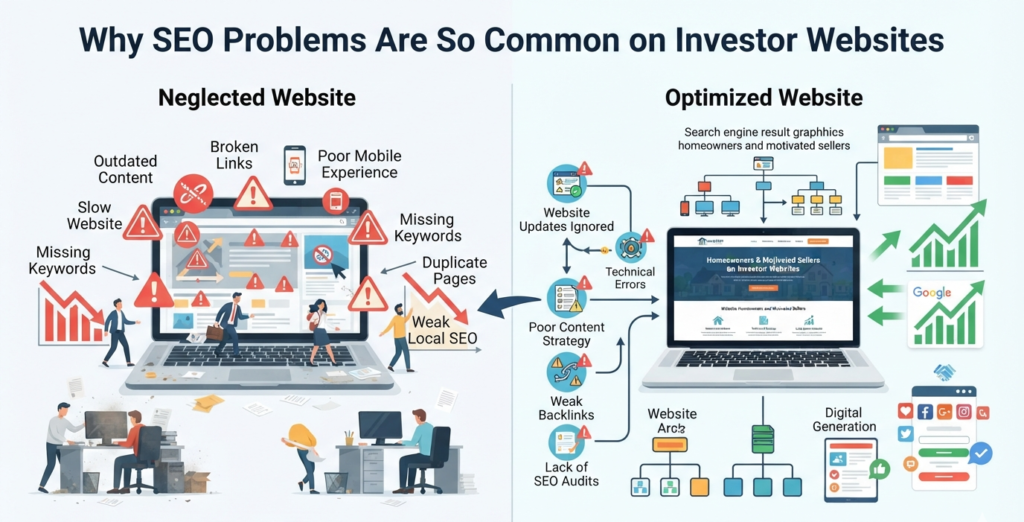
Real estate investor websites have a specific set of characteristics that make them particularly vulnerable to certain categories of SEO problems. Many are built on templates designed for speed rather than long-term SEO performance, which means technical issues are baked in from the start.
Others evolve as investors add pages, change phone numbers, update service areas, and modify content without understanding the downstream SEO effects of those changes.
The motivated seller market is also hyperlocal, creating unique complexity. A single investor might need to rank across dozens of neighborhoods, cities, and counties, each requiring locally specific content and local signals that are easy to implement inconsistently.
When those local signals conflict or when the technical infrastructure of the site cannot support the volume of location-based content being added, ranking performance suffers in ways that are not immediately obvious from looking at the site on the surface.
Understanding how to conduct a local SEO audit for real estate investor businesses is the first step toward identifying these patterns and correcting them methodically rather than guessing at what might be holding the website back.
Starting with a Technical SEO Audit
The foundation of any serious effort to find and fix SEO problems on investor websites is a thorough technical audit. Technical SEO covers the structural elements of a website that determine whether search engines can crawl it efficiently, index its pages correctly, and evaluate its content accurately.
Problems at this level affect every other aspect of SEO performance, which is why fixing technical issues before working on content or local optimization is always the right sequence.
Google Search Console is the most important free tool available for beginning this process. After verifying your website with Search Console, navigate to the Coverage report, which shows you exactly which pages Google has successfully indexed, which ones it has discovered but not indexed, and which ones are excluded for various reasons.
Pages that are not indexed cannot rank, so any pages showing errors or exclusions in this report need to be investigated and corrected before anything else.
The Page Experience section of Search Console gives you real-world data on how your site performs on Core Web Vitals, the set of loading speed, interactivity, and visual stability metrics that Google uses as ranking factors.
Pages flagged as Poor or Needs Improvement in this report are actively being penalized in search rankings, and resolving these issues often produces visible improvements in ranking position within a few weeks of the fixes being implemented.
Crawl errors, including broken internal links, missing pages that still receive links from other parts of your site, and redirect chains that make search engines work harder to find your content, are another major category of technical problems that a Search Console audit reveals.
Every broken link on your investor website represents a dead end for both visitors and search engines, and a significant number of broken links signals to Google that the site is not being actively maintained.
Diagnosing On-Page SEO Issues

Once technical problems are addressed, the next category to evaluate in any investor website SEO fix process is on-page SEO, the elements within each page that signal what the page is about and why it deserves to rank for specific search terms.
Duplicate content is one of the most common and damaging on-page problems on investor websites, particularly those that use templates to create multiple city or neighborhood pages.
When the majority of the content on these pages is identical except for the location name being swapped, Google struggles to determine which version is most relevant and often simply declines to rank any of them prominently.
Every location page on your investor website needs meaningfully unique content that speaks to the specific characteristics, challenges, and seller situations in that particular area.
Missing or generic title tags and meta descriptions represent another widespread issue. The title tag is what appears as the clickable headline in search results, and a strong, keyword-relevant title directly influences both your ranking potential for that keyword and the click-through rate from people who see your listing.
Many investor websites either use the same generic title across multiple pages or leave pages with titles that were auto-generated by their CMS without ever being reviewed or optimized.
Heading structure problems, where pages use multiple H1 tags or have no logical heading hierarchy at all, make it harder for search engines to understand the organization and relative importance of content on each page.
A properly structured page has a single H1 that includes the page’s primary keyword, followed by H2 and H3 subheadings that organize supporting content logically.
Auditing heading structure across your key pages is a quick fix that produces real improvements in search engine comprehension.
Thin content is a persistent problem on investor websites where pages exist primarily as location placeholders rather than genuinely useful resources.
Google’s quality assessments heavily penalize pages that offer very little substantive value to visitors, and a landing page with three short paragraphs about buying houses in a specific city is almost certainly too thin to rank competitively for that location.
Expanding these pages with locally specific, genuinely useful content about selling situations common in that area, what the process looks like, and why sellers in that market benefit from a cash offer is one of the highest-impact investor website SEO fix activities available.
Addressing Local SEO Problems Specifically
For real estate investors, local SEO issues represent some of the most impactful problems to find and fix because so much of your target audience is performing local, location-specific searches.
A thorough local SEO audit that real estate investor businesses need goes well beyond on-page optimization to examine the full ecosystem of local signals that determine your visibility in map results and local pack rankings.
NAP consistency, the exact match of your business name, address, and phone number across your website and every directory listing where your business appears, is the cornerstone of local SEO trust.
Any inconsistency in these details across Google Business Profile, Yelp, Yellow Pages, local chamber directories, and other citation sources creates conflicting signals that reduce Google’s confidence in your business information.
A local citation audit using tools like BrightLocal or Whitespark can identify every instance where your business information appears online and flag discrepancies that need correction.
Your Google Business Profile deserves specific attention in any investor website SEO fix process. An incomplete or inconsistently maintained profile is a significant missed opportunity, since Google Business Profile directly powers local pack results for the high-intent searches that bring in motivated sellers.
Review your profile for complete and accurate business categories, a comprehensive service area that matches your actual target markets, a thorough business description that incorporates relevant keywords naturally, regular posts that demonstrate active business engagement, and a current collection of genuine customer reviews.
Review volume and recency are factors that many investors overlook when diagnosing local SEO underperformance. Google’s local ranking algorithm treats review activity as a signal of ongoing business legitimacy and quality, and a profile with reviews that are all from more than a year ago sends a weaker signal than one with a steady stream of recent feedback.
Building a systematic post-closing review request process addresses this gap over time.
Common Mistakes in Diagnosing SEO Problems
One of the most frequent mistakes investors make when trying to identify SEO issues is focusing exclusively on content quality while ignoring technical problems that prevent even excellent content from ranking.
A beautifully written page targeting a high-intent seller keyword will still underperform if it loads in seven seconds on a mobile device, if it has been inadvertently set to noindex, or if it has no internal links pointing to it from other pages on the site.
Conversely, some investors focus entirely on technical fixes while neglecting the content quality issues that are keeping their pages from competing even when they are technically sound. Both dimensions matter, and a comprehensive audit addresses them in sequence rather than treating them as alternatives.
Another common mistake is treating SEO problems as a one-time fix rather than an ongoing maintenance activity. New technical issues emerge as websites are updated, new content is added, and CMS plugins are modified. Local citation inconsistencies develop over time as business information changes.
Review profiles stagnate without active management. An effective SEO maintenance routine reviews the most important signals on a regular schedule rather than assuming that problems fixed once will never reappear.
Expert Tips for Getting the Most from Your SEO Audit
Prioritize your audit findings by impact rather than addressing issues in the order you discover them. A missing title tag on your highest-traffic landing page has more immediate significance than a broken link on a blog post from two years ago.
Building a prioritized list of findings and working through it systematically, starting with the issues most likely to produce measurable ranking improvements, is a more effective use of your time than trying to fix everything simultaneously.
Use Google Analytics alongside Search Console to understand not just which pages are ranking, but which pages are ranking and converting. A page that draws reasonable organic traffic but generates very few leads has a different kind of problem than a page that is simply not ranking.
Diagnosing the conversion issue on a ranking page, which is often related to the page’s layout, call to action, or relevance of its content to the visitor’s actual intent, requires a different set of tools than diagnosing a ranking problem.
When correcting thin or duplicate content issues across multiple location pages, resist the temptation to simply add more generic filler text to reach a word count target. The quality and local specificity of the additional content matter far more than its length.
A shorter page with genuinely useful, locally relevant information about selling situations in a specific neighborhood consistently outperforms a longer page padded with content that could apply equally to any location.
Real World Application
An investor operating across a three-county market had been struggling with stagnant organic rankings despite consistent content publishing. A thorough audit revealed three primary categories of problems working against the site simultaneously.
First, eleven city-specific landing pages had identical title tags except for the city name, with no other distinctions between them. Second, the Google Business Profile listed the wrong primary category, which had been set to general real estate rather than the more specific home-buying investor category. Third, 43 local directory listings contained inconsistent phone number formatting, creating conflicting NAP signals across the citation landscape.
Addressing these three categories of problems in sequence, starting with the technical and local signal corrections before moving to the content differentiation work on the city pages, produced visible improvements in local pack rankings for several target markets within about six weeks.
The investor website SEO fix in this case did not require any new content to be created or any changes to the site’s overall structure. Correcting existing problems that had been silently suppressing performance was sufficient to produce meaningful gains.
How Reirank.com Can Help You Find and Fix SEO Problems on Your Investor Website
Knowing where to look for SEO problems and having the tools and expertise to diagnose and fix them efficiently are two different challenges. Many investors understand enough about SEO to know that something is wrong but not enough to pinpoint exactly what, let alone prioritize a remediation plan that addresses the highest-impact issues first.
Reirank.com provides comprehensive SEO audits specifically designed for real estate investor websites, covering technical performance, on-page optimization, local SEO signal consistency, and competitive analysis within your specific market.
Rather than producing a generic report of every possible issue, the focus is on identifying the specific problems most likely to be holding your website back and building a clear, prioritized plan for addressing them.
Conclusion: Best Ways to Find and Fix SEO Problems on Investor Websites
The ability to systematically find and fix SEO problems on investor websites is one of the most practically valuable skills in real estate digital marketing, because even a well-intentioned SEO strategy built on a foundation of unaddressed technical and local problems will consistently underperform.
The investors generating the most organic motivated seller leads in 2026 are not always the ones with the most content or the biggest marketing budgets.
They are often the ones who took the time to audit their websites properly, identify the issues that were suppressing their performance, and fix them methodically.
Whether you conduct a local SEO audit for real estate investor businesses on your own using free tools like Search Console, or work with a specialist to diagnose and resolve investor website SEO fix priorities more efficiently, the important thing is to start the process rather than continuing to publish new content on top of a foundation of unresolved problems.
If you are ready to find out exactly what is holding your investor website back and build a clear path to stronger organic performance, visit Reirank.com today to book your free consultation and explore the full range of real estate investor digital marketing services available to help you build the organic lead generation presence your business deserves.