

Most real estate investor websites lose traffic not because their content is weak, but because their pages are isolated from each other. A property listing has no path to the financing page.
A market guide never connects to the lead capture form. Search engines crawl these sites and see a collection of disconnected pages instead of a structured, authoritative resource.
This is where an internal linking strategy for real estate investor websites in 2026 becomes essential. Internal links are not a minor technical detail.
They tell Google which pages matter most, how your content relates to them, and why a visitor should keep exploring instead of leaving after one page.
For investors competing in crowded local markets, this structural advantage often separates the sites that rank from the ones that get buried on page three.
This article breaks down exactly the top Internal Linking Strategy for Real Estate Investor Websites, how to build an internal linking framework that improves rankings, increases time on site, and turns casual visitors into qualified leads.
Why Internal Linking Matters for Real Estate Investor Sites
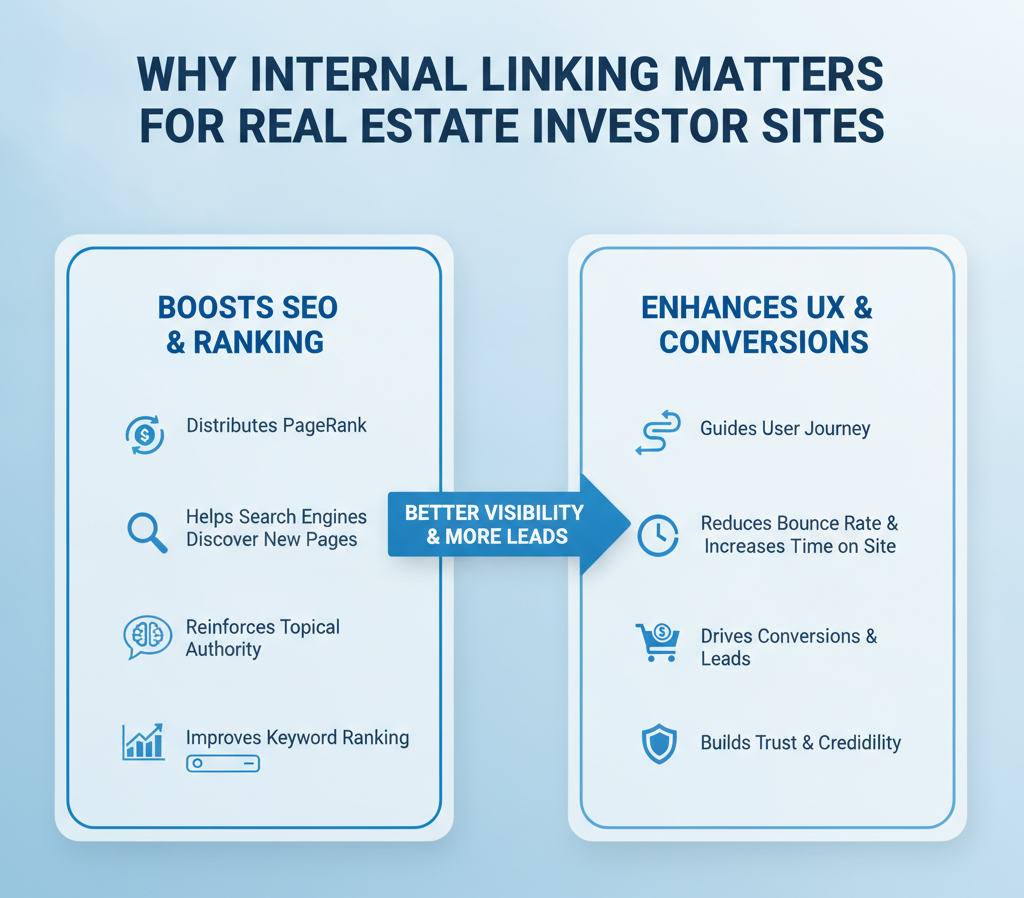
Real estate investing websites usually fall into a few content categories: property listings, neighborhood or market guides, investment education content, and lead generation pages like “sell my house fast” or “we buy houses in cash.” Without a deliberate linking structure, these categories operate in silos.
SEO internal links solve this by creating clear pathways between related content. When done correctly, they accomplish three things at once.
First, they distribute authority. A backlink to your homepage does more good for your entire site when that authority flows through internal links to your money pages, such as a specific city’s “sell your house” landing page.
Second, they improve crawl efficiency. Search engines have limited resources to crawl any given site.
A logical link structure helps Google find and index your most valuable pages faster, especially new listings or time-sensitive market content.
Third, they guide user behavior. A visitor reading about cash offers for inherited properties is a strong candidate to also read about the probate selling process or local closing timelines.
Good internal linking nudges them toward the next logical step instead of hoping they find it on their own.
For investor websites specifically, this matters more than in many other industries because the buyer journey is often long and research-heavy.
Sellers comparing options, agents looking for partnerships, and other investors researching markets all behave differently, and your linking structure should account for that.
Core Concepts Behind a Strong Internal Linking Strategy
#1. Topic Clusters and Pillar Pages
The most effective approach for linking investor pages on a website is the topic cluster model. This means building one comprehensive pillar page around a broad theme, such as “How to Sell an Inherited House in Indiana,” and then linking it to and from supporting pages that cover narrower subtopics like probate timelines, tax implications, or repair costs before selling.
This structure signals topical depth to search engines. Instead of one thin page trying to rank for everything, you have a network of interconnected pages that collectively demonstrate authority on the subject.
#2. Anchor Text That Reflects Intent
Anchor text is the clickable phrase used in a link, and it carries real SEO weight. Generic anchors like “click here” or “learn more” waste an opportunity.
Descriptive anchors such as “sell your house fast in Phoenix” or “how cash home buyers calculate offers” tell both users and search engines what to expect on the linked page.
The key is variation. Repeating the same anchor text across dozens of links can look manipulative to search engines. Mix exact match phrases with natural variations and related terms.
#3. Link Depth and Site Architecture
Link depth refers to how many clicks it takes to reach a page from the homepage. Pages buried five or six clicks deep rarely get crawled often or rank well, regardless of content quality.
A well-planned site architecture keeps your most important pages, such as city-specific landing pages or your main lead capture form, within two or three clicks of the homepage.
#4. Contextual Links Versus Navigational Links
Navigational links in menus and footers are necessary but carry less SEO value than contextual links placed within the body of your content.
A link inside a blog post that naturally connects to a related service page passes more relevance signal because it sits within meaningful, on-topic content.
Step-by-Step Guidance for Building Your Linking Structure

#1: Audit your existing content and pages. Before adding new links, map what you already have. List every page on your site, categorize it by type (listing, blog, service, location page), and note its current internal link count using a crawling tool like Screaming Frog or Sitebulb.
#2: Identify your priority pages. These are typically your lead generation pages, high-value city or neighborhood pages, and core service pages. These should receive the most internal links pointing toward them.
#3: Build pillar and cluster relationships. For each major topic, identify one pillar page and three to eight supporting pages. Link supporting pages back to the pillar, and link the pillar out to each supporting page in a relevant section.
#4: Add contextual links within body content. Go through existing blog posts and guides. Wherever a topic is mentioned that has a dedicated page elsewhere on your site, add a natural link. Avoid forcing links where they do not fit the sentence.
#5: Optimize anchor text variety. Review your planned anchors to ensure you are not repeating identical phrases excessively. Aim for a mix of branded, descriptive, and partial match anchors.
#6: Fix orphan pages. Orphan pages have no internal links pointing to them at all. Use your crawl audit to find these and connect them to at least two to three relevant pages.
Step 7: Monitor and adjust quarterly. Internal linking is not a one-time task. As you publish new content or update market data, revisit your linking map every quarter to keep it current.
10 Advantages of a Strong Internal Linking Strategy for Real Estate Investor Websites in 2026
A well-planned internal linking strategy is one of the most underrated tools a real estate investor can use to grow organic traffic and convert more motivated sellers. Here is why it matters so much heading into 2026.
#1. It helps search engines understand your site structure. When your pages logically link to each other, Google can crawl your entire website more efficiently and understand how your content relates.
This makes it easier for search engines to index every page correctly, including newer neighborhood pages or blog posts that might otherwise get overlooked.
#2. It distributes authority across your most important pages. Every time one page links to another, some of that page’s ranking strength passes along.
Linking from a high authority page, like your homepage or a well-performing blog post, to a key landing page, such as your sell my house fast page in a specific city, gives that page a meaningful ranking boost.
#3. It keeps motivated sellers engaged longer. A seller who lands on a blog post about avoiding foreclosure is far more likely to stay on your site if that post links naturally to your main offer page or a related resource.
The longer someone stays engaged with your content, the more trust you build before they ever pick up the phone.
#4. It reduces your bounce rate. Visitors who have an easy path to related content are less likely to leave your site immediately. A lower bounce rate sends a positive signal to search engines and often translates directly into more inquiries and form submissions.
#5. It guides visitors toward conversion points. Internal links are not just for search engines. They are also a roadmap for human visitors.
Strategic links from informational content toward your contact form, your cash offer page, or your seller FAQ keep visitors moving toward the action you actually want them to take.
#6. It strengthens topical authority for your local market. When you link your city-specific pages, neighborhood guides, and situation-based content together, you build a cluster of related pages that signals deep local expertise to Google.
This kind of topical depth is increasingly important as search engines reward sites that demonstrate real, comprehensive knowledge of a subject rather than isolated, disconnected pages.
#7. It helps newer pages rank faster. A brand new blog post or landing page often struggles to gain visibility on its own. Linking to it from established, already indexed pages gives it a faster path to being crawled, indexed, and considered for rankings.
#8. It supports a better user experience overall. Sellers searching for help are often stressed and want clear next steps. Thoughtful internal links that anticipate their questions, such as linking a probate sale article to a guide on how the cash offer process works, create a smoother, more helpful journey through your site.
#9. It future-proofs your site for AI-powered search. As AI search tools increasingly map relationships between pages to understand context and authority, a well-connected internal linking structure makes it easier for these tools to recognize your site as a trustworthy, comprehensive resource on real estate investing topics.
#10. It maximizes the value of every piece of content you create. Instead of letting blog posts and landing pages sit in isolation, internal linking turns your entire website into an interconnected system where every new page adds value to your existing content and every existing page helps support new content.
Over time, this compounding effect is one of the most cost-effective ways to grow organic visibility without constantly creating new pages from scratch.
Common Mistakes Investors Make With Internal Linking
Many investor websites repeat the same handful of errors.
Overloading the footer with every page on the site dilutes link equity and tells search engines nothing about content relationships.
A cleaner footer with curated, high-priority links performs better than one stuffed with fifty links.
Another frequent mistake is linking only from the homepage to subpages, with no reciprocal or lateral linking between related content.
This creates a flat structure instead of a true network, limiting the topical signals search engines rely on.
Some investors also neglect older content entirely. A blog post from two years ago that still ranks decently often goes unlinked from newer pages, missing an easy opportunity to pass authority forward.
Lastly, using identical anchor text for every internal link is a habit that can look unnatural and may dilute relevance rather than reinforce it. Variation matters as much as the link itself.
How Reirank.com Can Help With This Strategy
Building and maintaining an internal linking structure manually across dozens or hundreds of pages becomes difficult to manage over time, especially for investors juggling multiple markets and content types. This is the kind of work Reirank.com is built to support.
Reirank.com focuses specifically on real estate investor websites and helps identify which pages need more internal link equity, where orphan pages exist, and how to structure pillar and cluster relationships based on actual search intent data for the real estate niche.
Rather than guessing which anchor text variations to use or which pages deserve priority linking, investors can use the platform’s analysis to make those decisions based on real performance data tied to their specific market and content type.
For investor websites managing location pages across several cities, this kind of structured guidance helps ensure that linking decisions stay consistent and aligned with what actually moves rankings in this industry, rather than relying on generic SEO advice that does not account for how investor sites are searched and used.
Conclusion: Internal Linking Strategy for Real Estate Investor Websites
An effective internal linking strategy for real estate investor websites in 2026 is not about adding as many links as possible. It is about building a deliberate structure where every page supports another, authority flows toward the content that matters most, and visitors are guided naturally toward the action you want them to take.
Investors who treat website linking investor pages as an ongoing process, rather than a one-time setup, consistently see stronger crawl efficiency, better rankings for competitive local terms, and more engaged visitors who explore beyond a single page.
The technical side matters, but so does the judgment behind it: knowing which pages deserve priority, which topics belong together, and how to keep the structure current as the site grows.
Start with an honest audit of your current site, identify the gaps, and build outward from there. The sites that get this right in 2026 will be the ones that turn organic traffic into real, qualified opportunities.