

Picture a homeowner standing in their kitchen, frustrated, holding a stack of bills, and they say out loud to their phone, “Who buys houses fast near me?” No typing. No browsing. Just a question, spoken naturally, the way they would ask a friend for help.
That moment right there is exactly why every real estate investor needs to understand how to optimize voice search for real estate investors in 2026. Voice is not a futuristic gimmick anymore.
It is how a huge and growing share of motivated sellers are actually searching for help, and the investors who show up in those spoken answers are the ones getting the call.
This guide walks you through exactly how voice search works, how to best Optimize Voice Search for Real Estate Investors, why it matters so much for your investing business right now, and the practical, beginner-friendly steps you can take today to start winning that traffic. Let’s get into it.
Why Voice Search Deserves Your Attention Right Now
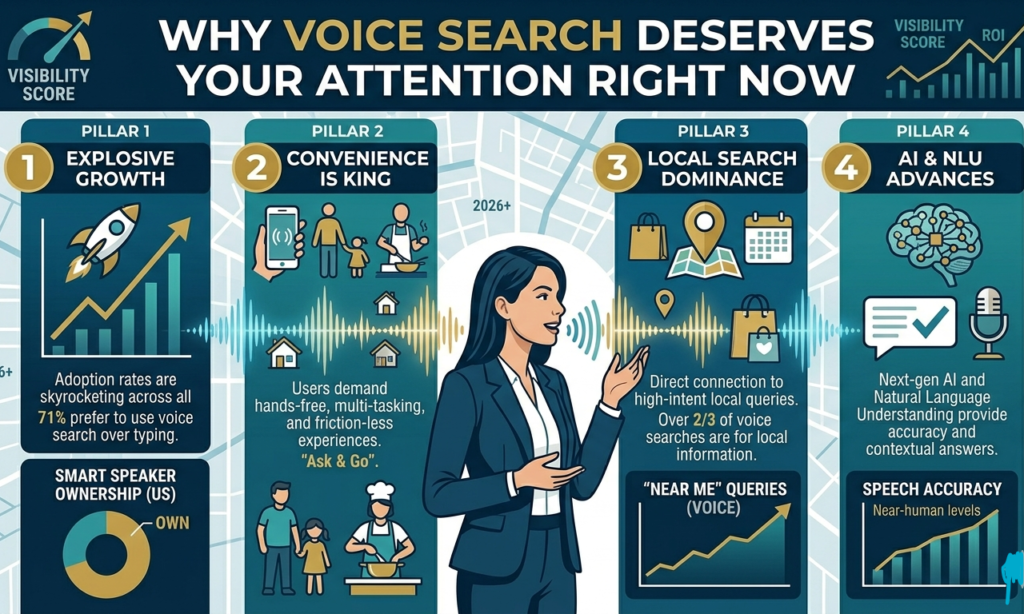
Let’s start with the numbers, because they tell a story that is hard to ignore. <cite index=”8-1″>Roughly 32% of consumers now use voice daily to perform searches they would normally type, and approximately 27% of people use voice search on their mobile devices.</cite> That is not a niche behavior anymore.
That is a meaningful chunk of the people searching for solutions to their property problems, including the motivated sellers you are trying to reach.
Here is what makes this especially relevant for real estate investors. <cite index=”14-1″>Voice traffic tends to be more valuable because users take immediate action after a voice search, whether that means calling a business or visiting in person, which gives voice search a higher conversion potential than typed search in many cases.
</cite> Think about what that means in practical terms. Someone who speaks a question out loud about selling their house fast is not casually browsing. They are close to making a decision, and they want an answer right now.
<cite index=”8-1″>Voice queries typically demonstrate higher intent clarity. When someone takes the time to ask a complete question out loud, they are usually further along in their decision-making process.</cite> That single fact should change how seriously you take a voice search strategy.
These are not cold browsers. These are warm, motivated people asking for help in the moment they need it most.
ALSO READ: The Best CRM Systems for Real Estate Investors: What to Look For
How Voice Search Is Fundamentally Different from Typing
Before diving into tactics, you need to understand one key shift, because it changes everything about how you approach your content from this point forward.
<cite index=”8-1″>Typed search queries are typically two to three words long, something like “sell house fast.” Voice queries average four to seven words and take the form of complete questions, like “how do I sell my house fast without making repairs.”</cite> That difference is not small.
It means the keywords you have been optimizing for, the short, clipped phrases that work well for typed search, are not the same phrases that voice search rewards.
<cite index=”8-1″>People type like they are communicating with a machine, abbreviated and keyword-focused. They speak like they are talking to a human assistant, in a way that is natural, conversational, and often informal.</cite> Your content needs to reflect that shift if you want to optimize voice search REI effectively.
This is the single biggest mindset change required to win in this space, and most real estate investor websites have not made it yet.
<cite index=”14-1″>A voice user might ask, “Which real estate company has the best real estate deals in my city?” rather than typing “best real estate agency.”</cite> The investor whose website speaks that same natural, conversational language is the one whose content gets pulled into the answer.
Building Your Keywords Around Real Questions

The first practical step in any voice search strategy is to completely rethink how you approach keyword research. <cite index=”6-1″>To effectively leverage voice search, you need to rebuild your keyword strategy from the ground up, starting with keyword research that focuses on phrases reflecting how people naturally speak.</cite>
Instead of building your content around short phrases like “we buy houses” or “cash home buyers,” start thinking in full questions.
What does a motivated seller actually ask out loud when they are dealing with a property they need to get rid of? Questions like “how do I sell my house fast without paying a realtor,” “what happens if I inherit a house I do not want,” or “can I sell my house if it needs major repairs” are the kinds of natural, spoken phrases that voice search strategy should be built around.
A simple but effective way to generate this list is to think like the person asking the question rather than the business answering it. Sit down and write out every question a stressed, motivated seller might actually say out loud to a friend or family member about their situation.
Those questions become the foundation of your content plan. Free tools like Google’s “People Also Ask” feature and Answer The Public can help you discover additional question-based phrases that real people are searching for in your specific market.
<cite index=”11-1″>Structuring content around who, what, how, and the best way to queries is essential for voice search engine optimization.</cite> This is exactly the kind of framework real estate investors should be applying to every new piece of content they create going forward.
Building an FAQ Section That Actually Wins Voice Search
If there is one single piece of content that delivers the most direct return for a voice search strategy, it is a well-built FAQ section. <cite index=”6-1″>An effective way to capture voice search traffic is by creating a comprehensive FAQ section on your website that addresses common questions potential sellers might ask, formatted as a question and answer.</cite>
The reason this works so well comes down to how voice assistants actually generate their answers. When someone asks Siri, Alexa, or Google Assistant a question, the assistant is typically pulling its spoken response from a featured snippet or a structured answer somewhere on the web.
<cite index=”15-1″>Voice assistants almost always read from featured snippets or AI-generated answers, which means content built to directly and concisely answer a specific question is what gets selected and read aloud.</cite>
For your investor website, this means building out a thorough FAQ page, or FAQ sections within your key landing pages, that directly answer the most common questions motivated sellers ask.
Questions like how the cash offer process works, how quickly you can close, whether the seller needs to make any repairs, and what fees are involved should all be addressed in clear, complete sentences that could be read aloud as a standalone answer.
<cite index=”6-1″>This format not only aids in optimizing for voice search but also establishes your authority as a knowledgeable resource in the real estate market.</cite> It works double duty, building trust with human readers while giving voice assistants exactly the kind of structured, quotable content they are looking for.
Why Local SEO and Voice Search Are Inseparable
Here is something every real estate investor absolutely needs to understand about voice search in 2026. <cite index=”15-1″>With most voice queries carrying local intent, Google Business Profile completeness, hyper-local content, NAP consistency, and review velocity now directly affect voice rankings.
Local SEO used to be treated as a side project for a lot of businesses, but in 2026, it has become the central project.</cite>
Think back to the example at the start of this article. “Who buys houses fast near me?” is a fundamentally local question, and voice assistants know it.
<cite index=”14-1″>Many voice searches are location-based, similar to searching for the best digital marketing agency near me, and optimizing your Google Business Profile and local keywords can significantly improve local search visibility for these kinds of queries.</cite>
This means your voice search strategy and your local SEO strategy are essentially the same project, executed together. Make sure your Google Business Profile is filled out with accurate hours, an up-to-date phone number, your specific service areas, and recent photos.
<cite index=”14-1″>Businesses can fine-tune the content of their Google Business Profile, local pages, and even their keywords to make a meaningful impact on the visibility of their Google voice search results.</cite>
Beyond your Business Profile, building out hyperlocal content for every neighborhood and city you serve gives voice assistants more material to pull from when answering location-specific questions in your market.
A motivated seller in a specific suburb asking a voice assistant about cash buyers in their area is far more likely to get an answer that includes your business if you have dedicated, locally specific content covering that exact area.
The Critical Role of Structured Data and Schema
Voice assistants do not read your whole webpage and try to interpret it the way a human would. They rely heavily on structured data to understand precisely what your content means and how to extract a clean, accurate spoken answer from it. <cite index=”6-1″>Structured data helps search engines understand your content better, which is crucial for voice search.</cite>
This is where schema markup becomes essential to any serious voice search strategy. <cite index=”8-1″>Key tactics for real estate include optimizing for neighborhood and property-specific queries, creating detailed neighborhood guides, implementing real estate schema markup, and optimizing for location-specific queries while ensuring property listings are mobile-optimized with clear contact information.</cite>
For real estate investors, this means making sure your website has the Local Business schema correctly implemented so voice assistants can confidently identify your business name, location, and contact details.
The FAQ schema, applied to the question and answer content discussed earlier, gives voice assistants a clean, structured format to pull spoken answers from.
The combination of genuinely helpful, conversational content and the correct structured data behind it is what gives your website the best chance of being the source a voice assistant reads from out loud.
Speed and Mobile Performance Are Non-Negotiable
Here is a fact that surprises a lot of investors when they first hear it. <cite index=”15-1″>Pages that rank for voice search load roughly 52% faster on average than pages that do not rank for voice. Core Web Vitals, mobile-first design, structured data, and HTTPS are minimum requirements now, not differentiators.</cite>
This connects directly back to everything covered in mobile SEO strategy, but it deserves specific attention here because voice search assistants are overwhelmingly used on mobile devices and smart speakers, both of which depend on fast, clean, technically sound websites to source their answers.
If your real estate investor website is slow, cluttered, or poorly optimized for mobile, you are effectively disqualified from being a meaningful source for voice search answers, no matter how well your content addresses the right questions.
Practical steps here include compressing your images, choosing fast and reliable hosting, minimizing unnecessary plugins and scripts, and regularly testing your site speed using free tools like Google PageSpeed Insights. None of this is glamorous work, but it forms the technical backbone that everything else in your voice search strategy depends on.
The Blurring Line Between Voice Search and AI Assistants
One of the most important shifts to understand as you optimize voice search for real estate investors in 2026 is that voice search and conversational AI have effectively merged into a single category of behavior. <cite index=”15-1″>When someone asks Siri a question, they are using voice search.
When they ask ChatGPT or Claude a question, they are using a conversational AI. From the user’s perspective, these experiences are increasingly similar, and your content needs to work for both.</cite>
<cite index=”15-1″>ChatGPT now serves more than 800 million weekly users, and Gemini has surpassed 750 million monthly users, with Google AI Overviews showing up on at least 16% of all search results pages and becoming a primary place where voice assistants pull their answers from.
</cite> This means a motivated seller might just as easily ask ChatGPT or Google’s AI Overview about their selling options as they might ask Siri out loud, and the content strategies that win in both scenarios are essentially identical.
<cite index=”7-1″>Buyers and sellers are increasingly asking full questions through tools like Google’s AI Overviews, ChatGPT, and voice search, which all reward direct, structured answers, creating what is called zero-click behavior, where the searcher finds their answer without ever clicking through to a website.
</cite> While that might sound discouraging at first, since fewer clicks could mean fewer visits to your site, <cite index=”7-1″>it actually means the investor who shows up directly inside the answer itself is the one who wins, even without a click, because their name and business become the trusted source the searcher remembers.</cite>
Building Brand Mentions That AI Systems Trust
Since AI-powered answer engines and voice assistants increasingly draw from a wide range of sources to determine which businesses are credible and worth citing, building your presence across multiple platforms matters more than ever.
<cite index=”10-1″>As more people mention and search your name across the web, you create the trust signals that AI systems use to determine which professionals are credible in a given market.</cite>
For real estate investors, this means showing up consistently in local press mentions, community organization websites, investor association directories, and review platforms, not just your own website.
<cite index=”7-1″>Beyond websites, AI tools also rely on brand mentions across platforms, making consistent publishing and repurposing essential, with the strategy summed up simply as record once, then repurpose everywhere.</cite>
Practically speaking, this means that a single piece of content you create, whether that is a blog post answering a common seller question or a short video explaining your buying process, should be repurposed across your website, your social media, and any guest content opportunities you can find.
The more places your expertise and your name appear consistently across the web, the stronger the trust signal becomes for both traditional search engines and the AI systems powering voice search.
Practical Steps for optimizing voice search for real estate investors to Start Today
If all of this feels like a lot to take in, here is the simplified path to start optimizing voice search for real estate investors without getting overwhelmed.
Begin by rewriting your keyword approach to focus on full, natural questions rather than short phrases. Build out a genuinely thorough FAQ section on your website that directly answers the questions motivated sellers actually ask, written in clear, complete sentences.
Make sure your Google Business Profile is fully optimized and that your local content covers every neighborhood and city you serve, since local intent drives the majority of voice queries.
Implement schema markup, particularly Local Business and FAQ schema, so that voice assistants and AI systems have clean, structured data to pull from. Check your site speed and mobile performance, fixing any technical issues that might be holding your pages back from being considered trustworthy, fast sources.
And finally, work on building your brand presence beyond your own website through local press, directories, and consistent content repurposing, since that broader visibility feeds directly into how confidently AI systems cite your business.
Conclusion: Optimize Voice Search for Real Estate Investors
The way people search for help is changing, and the investors who optimize voice search for real estate investors now are positioning themselves to capture some of the most motivated, highest-intent leads available anywhere in digital marketing.
Voice search rewards natural language, genuine answers to real questions, strong local relevance, and clean technical performance, and none of those things require a massive budget to implement correctly.
A solid voice search strategy is not a separate project from your existing SEO and local marketing efforts.
It builds directly on top of them, rewarding the same fundamentals, helpful content, local trust, and technical health, while adding a layer of conversational thinking that makes your website ready for how people are actually speaking to their devices today.
Start with your FAQ content, tighten up your local presence, and make sure the technical foundation of your site can support it all. The motivated seller standing in their kitchen asking their phone for help right now deserves to hear your business as the answer.
Ready to Capture the Motivated Sellers Asking for Help Right Now?
If reading this made you realize your investor website is not built to capture the voice and AI-driven searches happening in your market every single day, you are not alone, and you do not have to figure this out by trial and error.
That is exactly the gap REI RANK helps real estate investors close.
At Reirank.com, we build complete REI digital marketing and lead generation systems designed for how sellers and buyers actually search today, covering everything from voice and AI search optimization to local SEO, schema implementation, content strategy, and Google Business Profile management.
We make sure your business is positioned to be the answer when a motivated seller asks their phone, their smart speaker, or ChatGPT for help.
You should not be losing high-intent leads simply because your website was built for yesterday’s search habits.
Visit our services page today to see exactly how we help investors like you show up, get cited, and get the call when it matters most. Get started with our free consultation today.