

List stacking for motivated sellers is one of the most talked-about strategies in real estate investing, and for good reason. Instead of mailing or calling every homeowner on a single list, you layer several lists and focus on properties that appear on more than one.
A house that shows up on a pre-foreclosure list, a probate list, and an absentee owner list at the same time tells a very different story from a house that appears on only one. That overlap is where many investors find their best deals.
But list stacking is only one way to find motivated sellers. More investors are now comparing do-it-yourself stacking with buying pre-qualified leads, sellers who have already been contacted, screened, and confirmed as interested in selling. Each approach has real strengths, real costs, and a place in a healthy acquisition strategy.
In this guide, we’ll explain how list stacking for motivated sellers works, look at the three most popular list types (pre-foreclosure, probate, and absentee owners), and compare stacked lists with pre-qualified leads so you can decide which approach, or which combination, fits your budget, your team, and your goals.
What Is List Stacking for Motivated Sellers?
At its core, list stacking for motivated sellers combines several distress-based property lists and identifies records that appear on two or more of them.
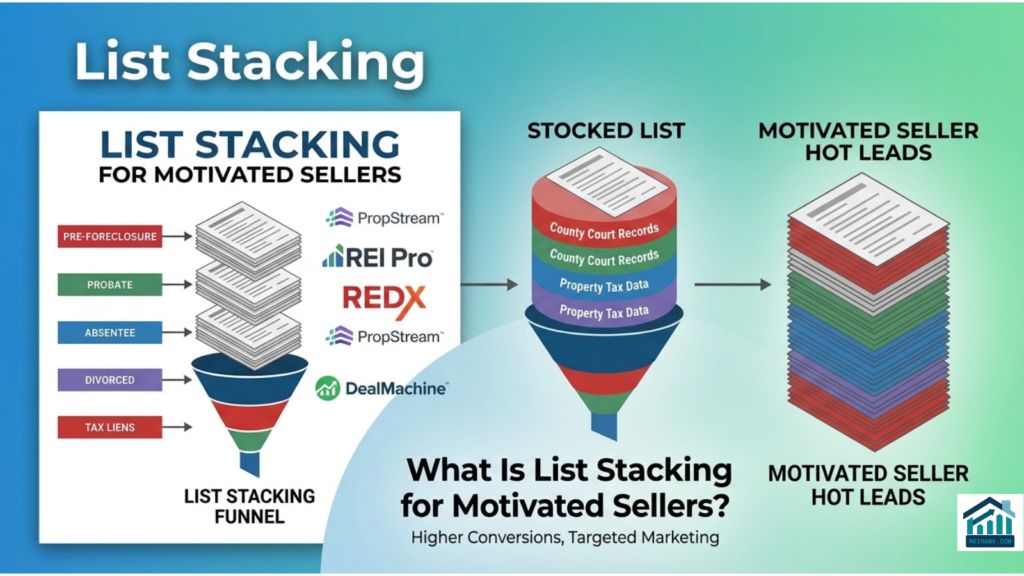
Each list represents a different kind of pressure an owner might be under. When those pressures overlap on the same property, the owner’s likelihood of selling rises sharply.
Think of each list as a filter. An absentee-owner list on its own is huge and fairly general, because many landlords are happy with their rentals and have no plans to sell. A list of tax-delinquent properties is smaller, but some of those owners will simply pay the bill.
When you find an absentee owner who is also behind on taxes and whose property has a code violation, you’ve narrowed a broad market down to a small group of owners who may be facing several problems at once. Those homeowners are most likely to welcome a fast, as-is cash offer.
The goal of stacking isn’t to build a bigger list. It’s to build a smarter one. By putting your marketing dollars behind the properties with the most overlapping signals, you reduce waste and increase the odds that each call, text, or letter reaches someone ready to talk.
How Real Estate List Stacking Works in Practice
The process usually begins with pulling several lists for the same market. Investors get this data from county records, list providers, or property data platforms.
Common starting lists include pre-foreclosure filings, probate cases, absentee owners, tax delinquencies, code violations, vacant properties, expired listings, evictions, and high-equity owners.
Once the lists are gathered, they’re merged into one master spreadsheet or CRM. Because the same property may be formatted differently from one list to the next, the system cleans and standardizes addresses so it can recognize true matches. From there, each property gets a count of how many lists it appears on.
A property on one list gets a score of one, a property on three lists gets a score of three, and so on. Some investors go further and weight certain lists more heavily, so a pre-foreclosure filing, for example, counts for more than an absentee status.
The highest-scoring properties go to the top of the marketing queue. Those records are then skip traced to find phone numbers and email addresses, scrubbed against Do Not Call lists, and pushed into direct mail, cold calling, or text campaigns. Lower-scoring records may still be marketed, but less often or through cheaper channels.
Done well, list stacking for motivated sellers gives you a prioritized, data-driven outreach plan. Done poorly, with outdated data, messy addresses, or no follow-up system, it can become a lot of spreadsheet work with little to show for it.
Pre-Foreclosure Lists: Urgent but Crowded

Pre-foreclosure lists contain homeowners who have received a formal notice that their lender has started the foreclosure process. Depending on the state, this may be a notice of default, a lis pendens filing, or a similar public record.
These owners are behind on their mortgage payments and face a clear deadline, which is why pre-foreclosure is often seen as one of the most motivated list types.
The biggest strength of a pre-foreclosure list is urgency. These homeowners have a ticking clock. If they don’t catch up on payments, refinance, sell, or reach an agreement with the lender, they may lose the property and much of their equity.
For an investor who can close quickly, that urgency creates a real opportunity to help a family avoid foreclosure while securing a fair deal.
The weaknesses are just as real. Because pre-foreclosure filings are public and easy to find, these homeowners are often flooded with letters, calls, and even door knocks from investors, agents, and loan modification companies. Many become overwhelmed or defensive.
Others have little or no equity, making a traditional investor purchase difficult without a short sale. Some catch up on payments or get a loan modification and lose motivation.
Pre-foreclosure leads also require extra care because some states have specific rules governing how you can approach homeowners in foreclosure.
In a stacking strategy, pre-foreclosure works best as a strong signal when combined with other factors. A pre-foreclosure property that is also vacant or owned by an absentee landlord often signals a more serious, and more solvable, problem.
Probate Lists: High Motivation, Sensitive Timing
Probate lists come from court records of estates settled after a property owner dies. When an owner passes away, their home often goes through probate before it can be sold, and the executor or heirs become the decision-makers.
Probate properties can be some of the market’s most promising leads. Many heirs live out of the area, have their own homes, and have no interest in maintaining, renting, or renovating an inherited house.
The property may be dated or need repairs, and splitting the proceeds among several family members is often easier with a quick, simple cash sale. For many families, an investor who can buy as-is and handle the details is a real relief.
Probate also has challenges. Timelines can be long because the estate may need court approval before a sale can close. You’ll often be talking with grieving family members, which calls for patience, empathy, and a soft approach.
Finding the right person takes extra research, since the executor may not live at the property and contact information can be hard to track down. Several heirs may disagree about whether or when to sell.
Probate data fits well into list stacking for motivated sellers because it pairs naturally with other signals. A probate property that is also vacant, tax-delinquent, or carrying code violations usually points to an estate that needs a quick, practical solution.
Absentee Owner Lists: Broad Reach, Lower Intent
Absentee owner lists include properties where the owner’s mailing address differs from the property address. In other words, the owner doesn’t live there. This group includes landlords, out-of-state owners, heirs, and owners who moved but never sold.
The main advantage of absentee lists is their size and variety. They give you a wide pool of potential sellers, and many absentee owners have strong equity because they’ve held the property for years.
Out-of-state landlords in particular may be tired of managing tenants and repairs from a distance, and some will jump at the chance to sell without the hassle.
The downside is that absentee status alone says very little about motivation. Many landlords are perfectly happy collecting rent and have no plans to sell.
Marketing to an entire absentee list can be expensive, and response rates are often lower than for more distressed lists. Without additional filters, you may spend a lot to reach owners who simply aren’t interested.
That’s why absentee lists are a natural base layer for stacking. Add filters like tax delinquency, code violations, vacancy, eviction history, or long ownership, and a broad absentee list quickly becomes a focused group of owners who may be ready to let go.
What Happens When You Stack These Lists Together
The real power of list stacking for motivated sellers shows up when these lists overlap. Consider a hypothetical property that appears on all three: it’s in probate, the estate has fallen behind on the mortgage and received a pre-foreclosure notice, and the heirs live in another state, so the property is absentee-owned.
That combination often points to a family under time pressure, dealing with a house they don’t want, from a distance, while trying to protect whatever equity remains.
A seller in that situation is usually far more receptive than one who appears on just one list. Stacking lets you find these high-pressure situations early and reach out with a clear, helpful solution.
Stacking still has limits. Even with several overlapping signals, you’re working from public data, not from a conversation. You still don’t know whether the owner wants to sell, what they expect to be paid, or the property’s condition.
Data can be outdated, skip-trace results can be wrong, and some owners with every warning sign will still say no. Stacking improves your odds, but it doesn’t confirm intent. That’s where pre-qualified leads come in.
What Are Pre-Qualified Motivated Seller Leads?
Pre-qualified leads are homeowners who have already been contacted and screened before they reach you. Instead of handing you a list of potentially motivated people, a pre-qualification process confirms the homeowner is open to selling and gathers key details about their situation.
A strong pre-qualification process usually confirms you’re speaking with the owner or an authorized decision-maker and explores the four core areas of seller motivation: why they want to sell, how soon they need to sell, the property’s condition, and the price they’re hoping for.
Many providers record these conversations or write detailed notes, so you can review the seller’s situation before your first call.
The key difference is that list stacking identifies owners who might want to sell, while pre-qualified leads identify owners who have said they’re willing to talk about selling. One is a well-researched guess. The other is a confirmed conversation starter.
List Stacking vs. Pre-Qualified Leads: A Side-by-Side Comparison
When you compare list stacking for motivated sellers with pre-qualified leads, the differences come down to cost, time, control, and conversion.
#1. Cost structure is the first difference. List stacking has a lower cost per record because you’re buying data rather than conversations. But you’ll also pay for skip tracing, data cleaning, dialer or texting software, direct mail, and the labor to run your campaigns.
Pre-qualified leads cost more per lead, but much of that outreach work is already done, so the cost per real conversation can be competitive, or even lower, once you factor in everything stacking requires.
#2. Time and labor are the second difference. List stacking is hands-on. Someone has to pull lists, merge and clean data, run skip tracing, manage campaigns, and make or supervise hundreds of calls to find a handful of interested sellers.
#3. Pre-qualified leads shift much of that work away from your team, freeing your acquisitions staff to negotiate instead of prospect.
#4. Control and scale are the third difference. List stacking gives you full control over your market, your criteria, and your volume. You can go deep into a specific ZIP code, target a certain property type, and build a long-term pipeline of owners you’ll follow up with for months or years.
Pre-qualified leads depend on your provider’s reach and delivery volume, though a good provider can target your preferred markets and criteria.
#5. Speed to conversation is the fourth difference. With list stacking, it can take weeks of marketing before an owner responds. With pre-qualified leads, the conversation can happen the moment the lead arrives.
#6. Conversion potential is the final difference. Stacked lists produce fewer interested sellers per record, but because you control the pipeline and follow up over time, they can build a steady, long-term flow of deals.
Pre-qualified leads typically turn into appointments and contracts at a much higher rate per lead, because the seller has already raised their hand.
Which Approach Is Right for You?
The right choice depends on where your business is today. If you have a strong team, tight systems, time to invest, and a patient long-term mindset, list stacking for motivated sellers can be a powerful, cost-efficient engine for deal flow.
It rewards investors who enjoy data, follow up consistently, and are willing to market to the same owners multiple times.
If your time is limited, you’re just starting, or your team negotiates better than it prospects, pre-qualified leads may offer a faster path to closed deals. They also work well for investors who want predictable results without building a full in-house marketing operation.
For many growing investors, the best answer is a hybrid. Pre-qualified leads provide immediate, ready-to-talk sellers that keep revenue coming in, while list stacking runs in the background to build a longer-term pipeline. Over time, you’ll see which source delivers the best return in your market and can shift your budget accordingly.
A Note on Compliance
Whichever approach you choose, compliance matters. Cold calling and texting homeowners from stacked lists means following the Telephone Consumer Protection Act, the National Do Not Call Registry, and any state-specific rules, including rules that may apply to homeowners in foreclosure.
Always scrub your data, honor opt-out requests, and talk to a qualified attorney about your specific outreach methods. When you buy pre-qualified leads, ask your provider how they handle consent and compliance so you understand the full picture.
Skip the Guesswork With Pre-Qualified Leads from reirank
List stacking for motivated sellers can uncover great opportunities, but it takes time, tools, and a lot of dials. If you’d rather spend your energy closing deals than digging through spreadsheets, our pre-qualified lead service delivers homeowners who have already been contacted, screened, and confirmed as open to selling, complete with the notes and details your team needs.
Explore Our Pre-Qualified Motivated Seller Lead Service to see how ready-to-talk sellers can be delivered straight to your CRM.
Not sure whether list stacking, pre-qualified leads, or a combination of both is right for your market? Schedule a free, no-obligation consultation with our team. We’ll review your goals, target areas, budget, and current lead flow, then recommend a strategy built around your business.
Want to see how other investors have grown their deal flow? Our case studies show how wholesalers and investors have used our pre-qualified leads, on their own and alongside their own marketing, to close more deals in competitive markets.
Frequently Asked Questions
What is list stacking for motivated sellers?
List stacking for motivated sellers is a real estate marketing strategy where investors combine several distress-based lists, such as pre-foreclosure, probate, absentee owner, tax-delinquent, and code violation lists, and prioritize the properties that appear on more than one. The more lists a property appears on, the more likely the owner is under pressure and open to selling.
Which list is best for finding motivated sellers?
No single list is best in every market. Pre-foreclosure lists offer strong urgency but are often crowded with competitors. Probate lists can produce highly motivated sellers but need patience and sensitivity.
Absentee owner lists offer broad reach but lower intent on their own. Most investors get the best results by stacking these lists instead of relying on one.
How many lists should I stack?
Many investors start with three to five lists, then add or remove lists based on results. The key is choosing lists that represent different types of distress, so overlaps are meaningful. Stacking too many loosely related lists can create noise rather than insight.
Are pre-qualified leads better than list stacking?
Neither is better in every situation. Pre-qualified leads usually convert at a higher rate per lead and save your team significant time, while list stacking offers lower cost per record, more control, and a long-term pipeline. Many investors use both together.
Why do pre-qualified leads cost more than stacked lists?
Pre-qualified leads cost more because the provider has already done the outreach, conversations, and screening. You’re paying for a confirmed, interested seller rather than raw data.
When you add up skip tracing, marketing, software, and labor, the true cost of a stacked-list conversation is often higher than it first appears.
Can I use list stacking and pre-qualified leads at the same time?
Yes, and many successful investors do. Pre-qualified leads provide steady, ready-to-talk sellers now, while list stacking builds a pipeline of future opportunities. Tracking results from both sources helps you shift your budget toward whatever performs best in your market.
Conclusion: List Stacking for Motivated Sellers
List stacking for motivated sellers is a smart, data-driven way to find homeowners facing overlapping pressures. Pre-foreclosure lists create urgency, probate lists bring highly motivated heirs, and absentee owner lists offer broad reach and plenty of equity.
When you stack them together, you move beyond guesswork and focus your marketing on the properties most likely to lead to a deal.
Still, stacking can only point you toward owners who might sell. Pre-qualified leads take the next step by confirming that the seller is ready to talk and giving you the details you need to make a strong offer.
The investors who grow fastest often use both: stacking to build a long-term pipeline, and pre-qualified leads to keep deals flowing today.
Ready to spend less time prospecting and more time closing? Get started with our pre-qualified lead service or book your free consultation today