
If you’re a real estate investor looking to generate motivated seller leads on demand, PPC for real estate investors is one of the most powerful tools in your marketing arsenal. Unlike SEO, which takes months to build, pay-per-click advertising puts your offer in front of motivated sellers today, the moment they search “sell my house fast” or “cash home buyer near me.”
This guide breaks down everything you need to know to build a real estate investor PPC strategy that actually produces deals, from keyword targeting and ad copy to budgets, landing pages, and common pitfalls to avoid.
What Is PPC for Real Estate Investors?
PPC (pay-per-click) is a form of digital advertising where you pay only when someone clicks your ad. For real estate investors and cash home buyers, PPC typically runs on:
- Google Ads — captures sellers actively searching for a solution
- Microsoft/Bing Ads — lower competition, lower cost-per-click, and reaches an older demographic that often owns paid-off homes
- Facebook and Instagram Ads — interruption-based; reach sellers who aren’t actively searching but match your target audience profile
- YouTube Ads — brand awareness and retargeting for longer-term nurture
The most effective PPC channel for real estate investors is Google Ads, specifically the Search network. When a distressed homeowner types “sell my house fast in [city]” into Google, they have high intent — they’re actively looking for your solution. A well-built Google Ads campaign for cash home buyers captures that intent and converts it into leads.
Why Real Estate Investors Need a PPC Strategy
Most wholesalers and cash buyers rely on one or two lead sources — direct mail, driving for dollars, or cold calling. The problem with these channels is inconsistency. When your mail piece timing is off, or your list gets stale, the leads dry up.
A real estate investor’s PPC strategy solves this. It creates a predictable, scalable, always-on lead generation system where your phone rings because sellers come to you — not because you chase them down.
Here’s what makes PPC uniquely powerful for real estate investors:
- High intent leads — sellers searching Google are ready to act
- Full control over spend — pause, scale, or adjust anytime
- Hyper-local targeting — target specific zip codes, cities, or counties
- Speed — campaigns can go live and generate leads within 24–48 hours
- Measurable ROI — track every click, call, and form submission back to ad spend
Google Ads for Motivated Seller Leads: How It Works
Google Ads for motivated seller leads operates on a keyword auction system. You bid on search terms, your ad shows when someone searches those terms, and you pay only when they click.
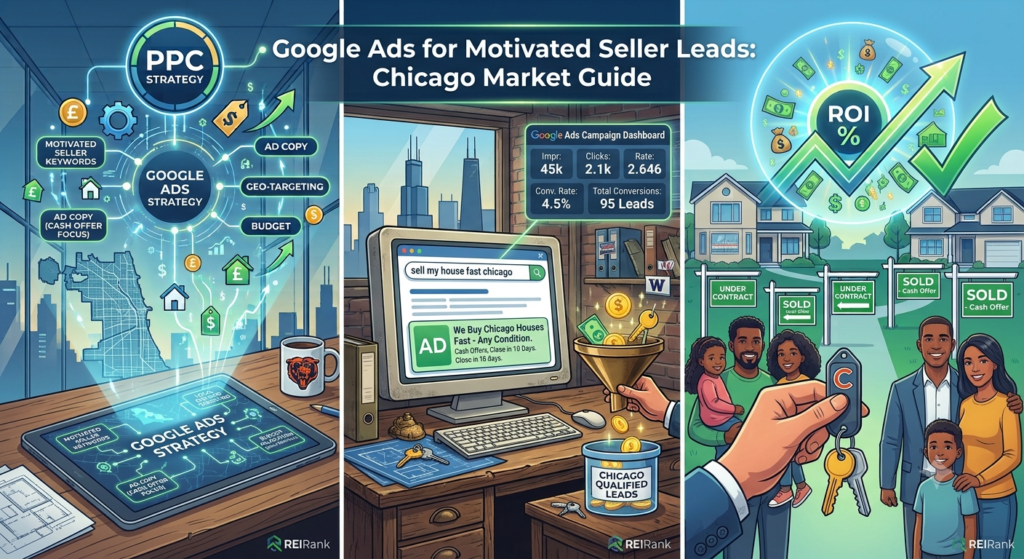
Step 1 — Keyword Research
The foundation of any successful PPC campaign for real estate investors is choosing the right keywords. Focus on high-intent, transactional keywords that signal the seller is ready to move:
High-converting keyword categories:
- “Sell fast” intent: sell my house fast, sell house quickly, need to sell my house now
- “Cash offer” intent: cash home buyers near me, sell house for cash, cash offer for my house
- “We buy houses” branded: we buy houses [city], cash home buyers [city], buy my house cash
- Problem-based: sell house in foreclosure, sell inherited house, sell house during divorce, sell fire-damaged house
- Location-specific: sell my house fast [city] [state], cash home buyers [zip code]
Negative keywords to add immediately:
- real estate agent, realtor, MLS, Zillow, Redfin, rent, apartment, jobs, license, course, how to flip
Step 2 — Campaign Structure
Organize your Google Ads account into tightly themed ad groups:
| Campaign | Ad Group Examples |
|---|---|
| Motivated Sellers | Sell House Fast, Cash Offer, Sell As-Is |
| Location Targeting | [City 1], [City 2], [City 3] |
| Problem-Based | Foreclosure, Inherited Property, Divorce Sale |
| Competitor | [Competitor brand] alternatives |
Keep each ad group to 5–15 closely related keywords. The tighter the theme, the higher your Quality Score — and the lower your cost per click.
Step 3 — Ad Copy That Converts
Your ad copy needs to speak directly to the seller’s pain point and make the next step obvious. Here’s the formula that works:
Headline 1: Lead with the benefit → “Get a Fair Cash Offer Today” Headline 2: Address objection → “No Repairs, No Fees, No Agents” Headline 3: Add urgency or location → “We Close in 7 Days — [City]” Description: Reinforce the value, address one more objection, and end with a CTA → “We buy houses as-is in any condition. Local buyers, fast closings, zero hassle. Get your free offer in 24 hours.”
Always test at least 2–3 ad variations per ad group. Let the data tell you which messaging resonates. After 2–3 weeks, pause the loser and create a new challenger.
Step 4 — Landing Page Optimization
Your landing page is where your PPC budget either pays off or gets wasted. Sending Google Ads traffic to your homepage is one of the most common and costly mistakes real estate investors make.
Your landing page for pay-per-click for cash home buyers must:
- Match the ad’s message exactly (message match = higher Quality Score and conversions)
- Have one clear goal: get the seller to fill out a form or call
- Load in under 3 seconds on mobile — most sellers are on their phones
- Include a short form (name, property address, phone number — that’s it)
- Show social proof — testimonials, number of homes purchased, years in business
- Feature a prominent phone number — many sellers want to call, not fill out forms
Step 5 — Call Tracking
Every real estate investor’s PPC campaign must have call tracking set up. Use a tool like CallRail or Google’s native call tracking to:
- Know which keywords and ads are driving phone calls
- Record calls to improve your sales process
- Calculate your true cost-per-lead by channel
Without call tracking, you’re flying blind. You might be generating calls from your PPC campaign, but attributing them to direct traffic.
Facebook Ads for Real Estate Investors
While Google captures active searchers, Facebook Ads lets you reach sellers before they start searching. This is called interruption marketing — your ad appears in their feed and plants the idea of selling.
Facebook works best for real estate investors when you:
- Target by homeownership + life events — Facebook lets you target people who are recently divorced, recently widowed, or have just changed jobs (all common motivated seller triggers)
- Use video ads — a 30–60 second video of you explaining how the process works- dramatically outperforms static image ads for credibility
- Run retargeting campaigns — people who visited your website but didn’t fill out a form are your warmest audience; show them a follow-up ad with a testimonial or a softer CTA
- Keep your audience hyper-local — target by zip code or a radius around your target market
Facebook leads are typically lower-intent than Google leads but cost less per lead. Many investors run both — Google for warm, ready-to-act sellers, and Facebook for building a pipeline of sellers who will be ready in 30–90 days.

PPC Budget for Real Estate Investors: What to Expect
Budget is the #1 question from investors starting their first PPC campaign. Here’s a realistic framework:
| Market Size | Recommended Monthly Budget | Expected Leads/Month | Estimated CPL |
|---|---|---|---|
| Small market (rural/mid-size city) | $1,500–$2,500 | 8–15 | $150–$250 |
| Medium market (metro suburb) | $2,500–$5,000 | 12–25 | $150–$300 |
| Large market (major metro) | $5,000–$10,000+ | 20–40 | $200–$400 |
Cost-per-lead (CPL) benchmarks: For real estate investor PPC, a CPL of $150–$350 is typical for Google Ads. Some highly competitive markets like South Florida or DFW can push $500+ per lead. One closed deal at $10,000–$30,000 profit makes even a $400 CPL an excellent investment.
Important: Start with a budget you can sustain for at least 60–90 days. PPC campaigns need data to optimize. Spending $500 for two weeks and giving up is the most common and costly mistake.
Common PPC Mistakes Real Estate Investors Make
#1. Sending traffic to the homepage: Your homepage is designed to do many things. Your landing page should do one thing: capture the lead.
#2. Not using negative keywords: Without a negative keyword list, your ads show for irrelevant searches like “real estate agent jobs” or “how to become a house flipper.” This burns the budget fast.
#3. Bidding on too many keywords at launch: Start with 20–30 tightly focused keywords. Let data guide expansion. Spreading your budget thin across 200 keywords means no individual keyword gets enough data to optimize.
#4. Ignoring Quality Score: It affects your cost per click and ad position. A higher Quality Score means you pay less for the same (or better) placement. Improve it by keeping ad groups tightly themed, writing relevant ad copy, and building fast landing pages.
#5. Giving up too early: Google Ads campaigns need 60–90 days and at least 30–50 conversions before the algorithm can truly optimize. Expect the first month to be more expensive — it’s a learning period.
#6. Not tracking phone calls: If you’re not tracking calls, you’re likely under-reporting conversions and under-investing in your best-performing keywords.
Frequently Asked Questions
What is the best PPC platform for real estate investors? Google Ads Search campaigns are the highest-converting platform for cash home buyer leads because you’re reaching sellers with active intent. Facebook Ads work well for retargeting and building a pipeline.
How much should a real estate investor spend on PPC? A starting budget of $1,500–$3,000/month is realistic for small to medium markets. Expect to refine over 60–90 days before seeing consistent results.
What keywords should real estate investors target with PPC? Focus on high-intent phrases like “sell my house fast [city],” “cash home buyers [city],” “we buy houses [city],” and problem-based terms like “sell house in foreclosure” and “sell inherited property.”
Is PPC better than direct mail for real estate investors? Both have a place. PPC generates faster, higher-intent leads with trackable ROI. Direct mail can reach off-market sellers who aren’t searching online. Many top investors run both simultaneously.
How do I track ROI from my real estate investor PPC campaigns? Use call tracking (CallRail or Google), set up conversion tracking in Google Ads for form submissions, and track leads through to closed deals in your CRM. Calculate ROI as: (Revenue from PPC leads) ÷ (Total PPC spend including management fees).
Can I run PPC myself, or do I need an agency? You can learn the basics, but it has a steep learning curve. A poorly managed campaign can waste thousands of dollars in a matter of weeks. Many investors find that hiring a specialist agency — especially one focused on real estate investor marketing — pays for itself in avoided waste and better results.
Conclusion: PPC for Real Estate Investors: The Complete Strategy Guide
A well-executed PPC strategy for real estate investors is one of the fastest ways to build a consistent, predictable pipeline of motivated seller leads. It requires upfront investment, disciplined optimization, and patience through the learning curve — but when it clicks, it becomes your most reliable lead source.
Whether you’re just starting your first Google Ads for motivated seller leads campaign or looking to improve an existing one, the fundamentals don’t change: the right keywords, compelling ad copy, a fast-converting landing page, and relentless data-driven optimization.
REIRank specializes in digital marketing for real estate investors and wholesalers. From PPC management to SEO and landing page optimization, we build lead-generation systems that deliver real results. Get in touch today.