

Ask most real estate investors how they generate leads online, and they will talk about their website, their Google Business Profile, maybe their social media presence.
Very few of them will mention link building. And that gap, that blind spot in how most investors think about their digital marketing, is quietly one of the biggest competitive advantages available to the investors who do understand it.
In 2026, the ways real estate investors build local links have never been more clearly defined, more accessible, or more impactful for the investors willing to put in the work.
A backlink, at its most basic, is simply a link from another website that points to your website.
Every time a local news outlet writes an article and links to your site as an expert source, every time a community organization lists you as a sponsor and links back to your homepage, every time a local business partner mentions you on their website with a clickable link, you earn a backlink.
And to Google’s algorithm, each of those links functions as a vote of confidence that your website is authoritative, relevant, and trustworthy enough to be recommended by another source.
The more credible those votes are, the more Google trusts your site, and the higher it ranks in local search results.
For real estate investors specifically, backlinks from investor websites represent an enormous untapped opportunity.
Understanding how to build them strategically is one of the most powerful ways to grow your organic lead generation, and this guide will walk you through exactly how to do it in a way that is practical, sustainable, and built for the competitive search landscape of 2026.
ALSO READ: The 10 Best Keyword Research Tips for REI Websites
Why Local Links Matter More Than National Ones
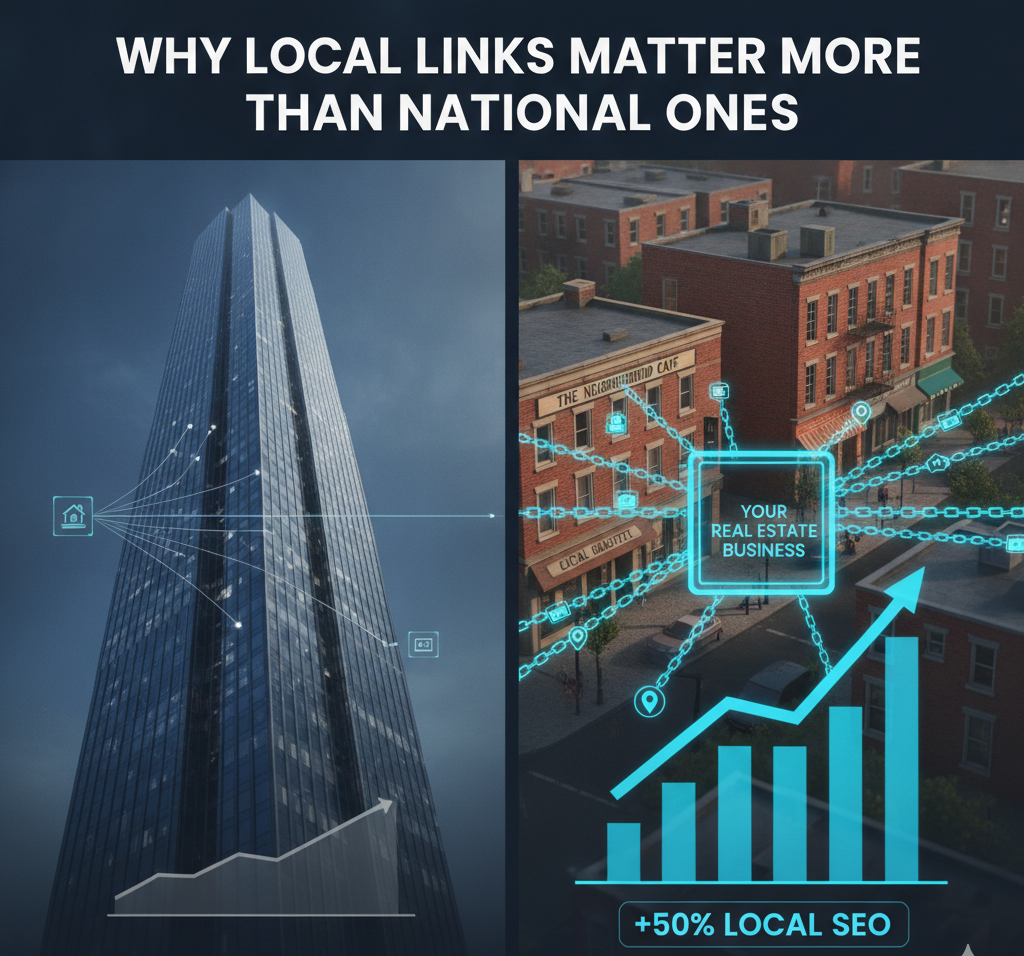
Before getting into the specific strategies, it is worth taking a moment to understand a principle that shapes everything else in local SEO link strategy for real estate investors:
When it comes to ranking for local search terms, a link from a local source is almost always more valuable than a link from a larger, more authoritative national source.
Think about what this means in practice. A link from your city’s local newspaper website, which might have a domain authority score in the 40s or 50s, can do more for your ability to rank for “sell my house fast in [your city]” than a link from a large national real estate blog with a domain authority of 70 or 80.
The reason is that Google’s local ranking algorithm places significant weight on geographic relevance.
When a locally trusted source links to your website, it sends a signal that your business is genuinely embedded in that community, and that signal carries specific weight for local search queries that a national link simply cannot replicate in the same way.
This is actually good news for real estate investors, because it means the competition for the most impactful links is not between you and massive national corporations.
It is between you and the other local investors and cash buyers in your market, most of whom are not thinking about link building at all.
Building a strong local link profile gives you an advantage that is genuinely difficult for national portals like Zillow or Realtor.com to counter, because they cannot walk into a chamber of commerce breakfast, sponsor a local charity 5K, or build the personal relationships with local business owners that generate the most valuable local links available.
Starting with the Foundational Links Most Investors Overlook
When building investor website backlinks from scratch or auditing what you already have, the most efficient place to start is with the easiest, highest-authority links available, many of which most investors have simply never claimed.
These are the links within professional associations, industry organizations, and business credential platforms that are often overlooked precisely because they seem too obvious.
If you are a licensed real estate professional, your state’s realtor association almost certainly maintains a member directory, and that directory typically includes a link to each member’s website.
Getting your profile filled out with your current website URL is a quick win that delivers a link from a high-authority domain in your industry. The same logic applies to the National Association of Realtors, local MLS provider profiles, and any other professional associations you belong to.
These profiles take relatively little time to claim and optimize, and they produce links from exactly the kinds of credible, industry-relevant sources that Google trusts.
Beyond professional associations, the Better Business Bureau and your local chamber of commerce are essential early links in any local SEO link strategy for real estate investors.
Chamber memberships typically cost a few hundred dollars per year, and they include a listing in a member directory that links back to your website from a locally trusted, authoritative source.
The Better Business Bureau offers accreditation that comes with a link from an extremely high-authority domain.
These are not glamorous or creative link-building tactics, but they are the kind of reliable, high-quality local signals that form the bedrock of a strong local search presence.
The Power of Community Sponsorships
One of the most underused local link-building strategies for real estate investors is community sponsorship.
When a local charity, youth sports team, school fundraiser, community 5K run, or neighborhood event publishes a sponsor page on their website and links to your business as a sponsor, you earn a link that is almost impossible to replicate through any other means.
These links carry genuine local relevance; they come from trusted community organizations and tend to stay live for extended periods without any ongoing effort on your part.
The process of earning sponsorship links is straightforward.
You identify community organizations and events in your target market, reach out to them about sponsorship opportunities, make a contribution at whatever level makes sense for your budget, and ensure, as part of the arrangement, that your business name is listed on their website with a link back to your investor website.
For most local organizations, even a modest contribution is enough to secure a visible sponsor listing, and many are genuinely grateful for community investment from local businesses.
From a pure link-building standpoint, the targeting matters here. Sponsoring organizations whose websites have some degree of domain authority, even a modest amount, is preferable to sponsoring organizations whose online presence is minimal.
That said, even small community organizations with modest websites can generate genuine local relevance signals that contribute meaningfully to your overall link profile.
And beyond the SEO value, the community goodwill and name recognition that come from visible sponsorship can generate direct inquiries from homeowners who see your name associated with organizations they trust.
Building Links Through Local Business Partnerships

Real estate investors operate at the intersection of a wide range of local industries, and that natural overlap creates abundant opportunities for local link building REI through genuine business partnerships.
Mortgage brokers, title companies, real estate attorneys, property managers, home inspectors, contractors, moving companies, landscapers, and dozens of other local businesses all interact regularly with the same homeowners, sellers, and buyers that you serve.
Building reciprocal referral relationships with these businesses often naturally results in website mentions and links.
The most effective approach is to think about local link building not as a transactional exercise but as an extension of your existing networking and relationship-building activities.
When you develop a genuine working relationship with a mortgage broker who sends you referrals, it is natural to mention each other’s services on your respective websites.
When you partner with a contractor who handles rehab work on your properties, a mention on their website and a corresponding mention on yours create value for both businesses while generating a relevant, local backlink signal.
What makes partnership links particularly valuable is their contextual relevance. A link from a local home inspector’s website to your real estate investor website sits within a context that Google understands to be directly related to your industry and your geographic market.
This combination of topical relevance and local geographic context is exactly what the local ranking algorithm is designed to reward, and it is the kind of signal that purely technical SEO tactics cannot easily manufacture.
Getting Into Local Media and News Publications
If there is a single link-building strategy that produces the most significant and sustained impact on real estate investor website rankings, it is earning editorial mentions and backlinks from local news sources, local business journals, and regional media outlets.
A single link from your city’s newspaper website or local business publication can deliver more ranking authority than dozens of directory listings combined. And in 2026, the door to this kind of coverage is more accessible than most investors realize.
Local journalists and editors are constantly searching for expert sources when they need to write about housing markets, foreclosure trends, neighborhood development, home values, or any of the dozens of real estate-adjacent topics that regularly make the local news.
As a real estate investor with direct market experience, you have exactly the kind of ground-level insight and professional expertise that journalists need but often struggle to find.
Being available, responsive, and genuinely helpful when journalists reach out to you is one of the most effective long-term strategies for earning consistent press coverage and the investor website backlinks that come with it.
Platforms like Qwoted, Featured, and SourceBottle connect journalists with expert sources. When a journalist is working on a story about the local housing market or real estate trends, they post a query on these platforms asking for expert commentary.
Monitoring these platforms and responding quickly with thoughtful, specific, data-grounded insights when a relevant query appears puts you in front of journalists at exactly the moment they need someone like you.
A successful pitch leads to a quote in a published article, typically accompanied by a credit that links back to your website, creating an editorial backlink from a credible local media source.
For this approach to work consistently, your responses to journalists’ queries need to offer something genuinely useful, a specific observation, a relevant data point, or a professional insight that goes beyond generic commentary.
Journalists have little patience for vague platitudes, but they respond well to sources who demonstrate real market knowledge and give them a usable quote that illuminates their story.
Over time, becoming a go-to expert source for local real estate stories can lead to a steady stream of media mentions that build both your link profile and your professional reputation.
Content That Attracts Links Naturally
One of the most sustainable long-term components of a local link-building REI strategy is creating content on your website that is genuinely useful enough to attract links without requiring active outreach for each one.
When you publish a comprehensive neighborhood guide, a detailed analysis of your local real estate market, or a resource page that answers questions homeowners and sellers in your area regularly search for, you create assets that other websites in your community may reference and link to organically.
The types of content that tend to attract natural links in the real estate investor space include thorough neighborhood profiles that document market conditions, property types, local amenities, and investment potential; local market reports that compile and analyze recent sales data, price trends, and inventory levels.
Guides for homeowners facing specific situations like foreclosure, probate, divorce, or inherited property, and FAQ pages that comprehensively address the questions motivated sellers most commonly have before deciding to work with an investor.
What distinguishes content that earns links from content that does not is the depth and specificity of the information it provides. A two-paragraph neighborhood overview will not earn links because it offers nothing not found elsewhere.
A 2,000-word guide that covers a neighborhood’s history, current market dynamics, typical property challenges, and investment landscape provides other writers, bloggers, journalists, and community organizations with a reference they can use, which helps drive organic link acquisition over time.
Leveraging Real Estate Investor Associations and Meetups
Local real estate investor associations and real estate investing meetup groups exist in virtually every major market, and they represent a frequently overlooked opportunity for building both investor website backlinks and community authority.
Most of these organizations maintain websites with member directories, event sponsor listings, and resource pages linking to the websites of active members and contributors.
Joining your local real estate investor association and taking an active role, whether that means speaking at meetings, volunteering to help organize events, contributing educational content to the organization’s newsletter or blog, or simply maintaining a complete and current member profile, naturally produces opportunities for website links.
When your name appears as a speaker at an association event, that event listing often links to your website. When you contribute an article to the association’s blog, your author bio typically includes a link back to your site.
These institutional links from established local organizations carry meaningful authority and strong topical relevance for real estate investor searches.
Meetup groups organized through platforms like Meetup.com also create link opportunities when organizers build supplementary websites for their groups and include resource sections or member spotlights.
Getting involved at the organizing level of a local investing meetup can result in links from every promotional page associated with the group, as well as from the websites of other members and businesses who participate in the community.
The combination of genuine community involvement and strategic awareness of the link opportunities it creates is one of the most efficient ways real estate investors can build local authority over time.
Government and Educational Institution Links
Among the most powerful investor website backlinks available are those from government websites and educational institutions, typically identified by their .gov and .edu domain extensions.
These links carry exceptional authority in Google’s eyes because they come from sources that the algorithm has learned to consider inherently trustworthy.
While they are harder to earn than most other types of links, the effort is disproportionately rewarded in terms of their impact on search rankings.
For real estate investors, the most accessible pathway to government and educational links typically runs through local economic development initiatives.
Many city and county economic development offices maintain pages dedicated to local businesses, community investment programs, and neighborhood revitalization efforts.
If your investing activity involves buying distressed properties and renovating them, you may qualify to be featured as a contributor to neighborhood improvement efforts, which can result in a link from a municipal or county website.
Reaching out to your city’s economic development office to introduce yourself and your work is a worthwhile effort, even if the results are not immediate.
Local community colleges and universities sometimes maintain resource pages for students studying business, finance, or real estate.
Reaching out to instructors or program coordinators to offer yourself as a guest speaker, a case study contributor, or a practical resource can occasionally lead to a link on an institutional website.
While these opportunities require patience and persistence, a single .edu or .gov link can have a meaningful impact on your site’s overall authority and local ranking performance.
Avoiding the Link Building Mistakes That Hurt Rankings
Understanding how real estate investors build local links effectively also requires recognizing the approaches that can cause harm, because not all links are beneficial, and some can actively damage your search rankings.
Google’s algorithm has become sophisticated enough to recognize link profiles that were manufactured through shortcuts rather than built through genuine relationships and valuable content.
Buying links from services that promise large quantities of backlinks at low prices is one of the fastest ways to earn a Google penalty that can suppress your site’s rankings for months or years.
These services typically use private blog networks, link farms, or other manipulative tactics that Google’s systems are designed to detect and penalize.
The promise of 50 high-authority backlinks for a small fee should be understood as a warning sign rather than a bargain, because the cost of recovering from a penalty far exceeds any short-term ranking improvement such links might temporarily provide.
Reciprocal linking schemes, where two websites agree to link to each other purely for SEO purposes without any editorial rationale, are also recognized by Google’s algorithm and discounted.
Genuine partnership links between complementary local businesses are natural and valuable, but artificial arrangements that exist solely for link exchange purposes tend to produce little real benefit and carry the risk of negative algorithmic treatment.
The principle underlying all effective link building in 2026 is that links should reflect genuine relationships, earned authority, and real community connections rather than manufactured signals.
Tracking Your Link Building Progress
Building local links without tracking your progress is a bit like running a direct mail campaign without knowing which mailers generated calls.
Understanding which links you have earned, which strategies are producing results, and how your overall link profile is growing over time is essential for making informed decisions about where to focus your effort and investment.
Tools like Ahrefs, Moz, and SEMrush all offer backlink monitoring features that allow you to see every link pointing to your website, assess the authority of the linking domains, and track changes to your link profile over time.
Google Search Console, which is free, also provides a basic overview of which sites are linking to yours.
Making a habit of reviewing your link profile monthly, identifying new links earned, and flagging any potentially problematic links that may have appeared keeps you informed and in control of one of the most important factors in your local search rankings.
Setting realistic expectations for link-building results is also important. Unlike paid advertising, which can drive traffic to your website immediately, link building is a long-game strategy whose results compound over time.
A high-quality local link from a trusted source might contribute to ranking improvements over several weeks or months rather than overnight.
Investors who commit to consistent link-building over six months to a year typically see meaningful, sustained improvements in their organic search visibility, while those who treat it as a one-time project tend to see limited, temporary results.
Conclusion: Ways Real Estate Investors Build Local Links
The ways real estate investors build local links in 2026 span a wide range of activities, from claiming association profiles and chamber memberships to earning editorial mentions in the local press, sponsoring community events, building genuine local business partnerships, and creating content that attracts natural links over time.
None of these strategies produces results overnight, and none of them works in isolation.
The investors who see the most dramatic improvements in their organic search presence tend to be those who approach link building as a systematic, ongoing part of their business development rather than a technical SEO exercise they do once and forget.
What makes the local SEO link strategy for real estate investors so powerful is that it builds something competitors cannot easily copy in the short term.
A network of genuine local relationships, a reputation as a trusted community business, a history of press mentions and expert citations, and a track record of community involvement all produce links that are deeply authentic and highly durable.
These are not the kinds of links you can purchase or manufacture; they are earned through real business activity, and they reflect the genuine presence in your market that makes Google confident putting your website in front of motivated sellers at exactly the right moment.
Start with the easiest wins, work systematically outward into community involvement and media relationships, create content worth linking to, and give the process time to compound.
The investors doing this right now are building a local search presence that will continue generating leads long after their competitors are still mailing postcards and wondering why the phones are not ringing.