

If you have a real estate investor website and you are wondering why it is not showing up on Google the way you expect, schema markup might be the missing piece. Most investors focus on writing content and building links, which is great.
But there is a layer underneath all of that that search engines actually read to understand what your site is about. That layer is schema markup.
This guide breaks it all down for you. What schema markup is, Best Schema Markup for Real Estate Investor Websites, why it matters specifically for real estate investor websites, how to implement it, and what to expect from your efforts.
Whether you are just getting started with SEO for real estate investors or you have been at it for a while and want to sharpen your competitive edge, this is the guide for you.
What Is Schema Markup and Why Should Real Estate Investors Care
Schema markup is a type of structured data code that you add to your website to help search engines better understand your content. Think of it as a translator between your website and Google.
Without it, Google reads your page and tries to figure out what you do. With it, you are literally telling Google, “Hey, this is a real estate investor website. These are the properties we buy. This is how to contact us.”
Google uses this structured data to generate rich results in search, which are those eye-catching listings that include star ratings, addresses, FAQs, and other details right there on the search results page. Rich results get more clicks.
More clicks mean more leads. For a real estate investor, more leads mean more deals.
The good news is that most of your competitors are not using real estate schema markup properly. That gives you a real window to stand out.
The Connection Between Schema Markup and SEO for Real Estate Investors
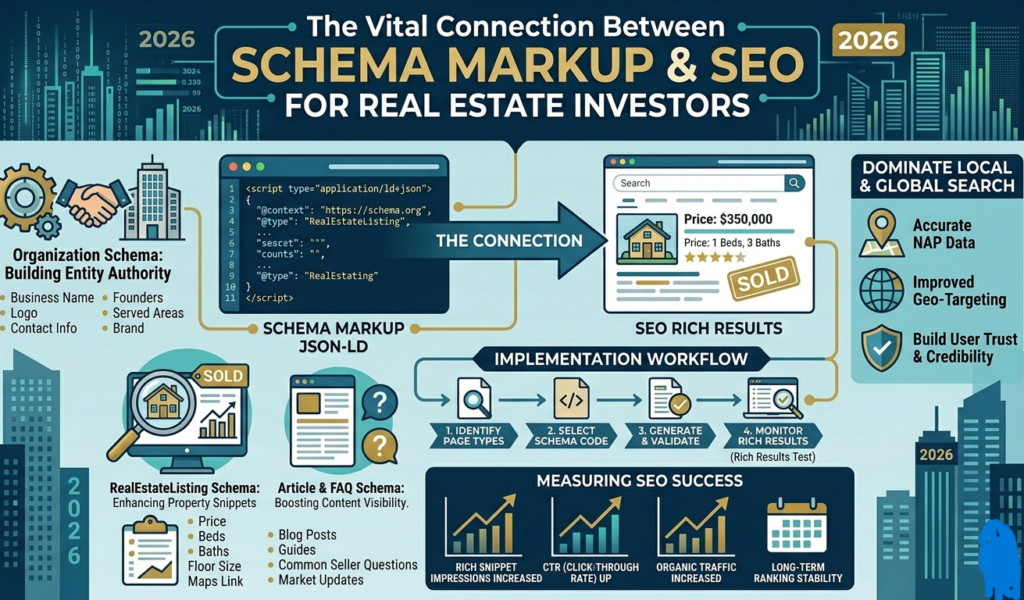
Here is something that trips a lot of investors up. They think SEO is just about keywords and blog posts. And while content definitely matters, search engines have evolved.
Google does not just read your words anymore. It reads signals. Schema markup is one of the strongest signals you can send.
When you implement real estate schema markup correctly, you are doing several things at once. You are helping Google categorize your site accurately.
You are making it easier for your pages to show up as rich snippets. You are also building trust with search engines by being transparent about who you are and what you do.
This is especially important because the real estate space is competitive online. When you are targeting sellers in specific cities or neighborhoods, every ranking advantage counts. Schema markup gives you that advantage without requiring you to write a single extra word of content.
Understanding the Real Estate SEO Timeline
Before we get into the specifics of implementation, you need to understand the real estate SEO timeline. This is crucial because many investors become frustrated and give up before their efforts start to work.
SEO for real estate investors is not instant. Schema markup is not a magic button that puts you on page one overnight. Typically, after implementing structured data, you can start seeing crawl improvements within a few weeks.
Rich snippet eligibility can take one to three months, depending on how often Google crawls your site. Ranking improvements from the combined SEO effect can take three to six months or more.
The real estate SEO timeline varies based on how competitive your local market is, how authoritative your domain is, and how much other SEO work you have done alongside schema implementation.
But here is the thing. Every day you wait is a day your competitors could be getting ahead. Start now, and you will be glad you did in six months.
Types of Schema Markup That Matter for Real Estate Investor Websites

Not all schemas are created equal. There are hundreds of schema types out there, but only a handful are genuinely useful for real estate investor websites. Here are the ones you should focus on.
#1. LocalBusiness Schema
This is the foundation. If you are an investor operating in a specific city or region, the LocalBusiness schema tells Google exactly where you are, what you do, your hours, your phone number, and your service areas.
This is especially powerful for local SEO because it strengthens your visibility in map packs and local search results.
A well-structured LocalBusiness schema for a real estate investor might include your business name, address, phone number, website URL, geographic area served, opening hours, and a brief description of your services.
Getting this right means Google can confidently show your business to motivated sellers searching for cash home buyers in your area.
#2. Real Estate Listing Schema
If your investor website features properties you are selling or that you have bought, the Real Estate Listing schema helps Google understand those listings. You can include details like the property address, price, number of bedrooms and bathrooms, listing status, and images.
This type of real estate schema markup is particularly useful if you wholesale properties or list your inventory online. When implemented correctly, it can make your listings eligible to appear directly in search results with rich details that attract clicks.
#3. FAQPage Schema
One of the most underused schema types for investors. Think about the questions motivated sellers type into Google.
Things like “how to sell my house fast,” “what do cash home buyers pay,” or “how does selling to an investor work.” If you have FAQ sections on your website that answer these questions, adding the FAQPage schema can prompt Google to display those answers as expandable rich results right on the search page.
This dramatically increases your visibility. Your result takes up more space on the page. It builds trust because you look authoritative. And it gets clicks even when you are not ranking number one.
#4. Organization Schema
This schema type establishes your business identity across the web. It connects your website to your Google Business Profile, your social media accounts, and other online mentions of your brand.
For real estate investors, having a strong Organization schema helps Google understand that you are a legitimate, established business rather than a random website.
It also contributes to the knowledge panel, the business card-style box that sometimes appears on the right side of Google search results. Getting a knowledge panel is a signal that Google trusts you, and trust is the currency of SEO.
#5. Review Schema
Social proof is everything in real estate investing. Motivated sellers want to know that other people have worked with you and had a good experience. Review schema allows you to mark up testimonials and reviews on your website so that star ratings can appear in search results.
Even a modest number of positive reviews displayed as stars in your search listing can significantly boost your click-through rate. And in a business where trust is everything, that visibility matters.
How to Implement Schema Markup on Your Investor Website
Now for the practical part. There are a few ways to add schema markup to your website, and the right method depends on your technical comfort level and your website platform.
#1. Using Google Tag Manager
Google Tag Manager is a tool that lets you add code to your website without editing the underlying files directly. You can create a new tag, paste your schema JSON-LD code into it, and set it to fire on the pages you want.
This is great for investors who use WordPress or similar platforms and want a bit more control without hiring a developer.
#2. Adding JSON-LD Directly to Your Pages
JSON-LD is the format Google recommends for schema markup. It is a small block of code that lives in the head section of your HTML. If you are comfortable with your website’s backend, you can paste this code directly.
Plugins like RankMath or Yoast SEO for WordPress can also automatically generate basic schema, which is a solid starting point.
#3. Using a WordPress Plugin
If your investor website runs on WordPress, schema plugins make the process much simpler. RankMath, in particular, has solid schema options, including Local Business and FAQ schema built right in.
You fill in your business details, and the plugin handles the code. It is not perfect for highly customized needs, but for most investors, it works well enough to get started.
A Simple Local Business Schema Example for Real Estate Investors
Here is what a basic Local Business schema might look like for a real estate investor website. You would paste this into the head section of your homepage.
{
  "@context": "https://schema.org",
  "@type": "LocalBusiness",
  "name": "Fast Cash Home Buyers",
  "url": "https://www.yourwebsite.com",
  "telephone": "+1-555-000-0000",
  "address": {
    "@type": "PostalAddress",
    "streetAddress": "123 Investor Lane",
    "addressLocality": "Houston",
    "addressRegion": "TX",
    "postalCode": "77001",
    "addressCountry": "US"
  },
  "areaServed": ["Houston", "Dallas", "Austin"],
  "description": "We buy houses fast for cash in Texas. No repairs needed, no agent fees.",
  "openingHours": "Mo-Fr 09:00-18:00"
}
This is a simplified example. You can expand it with your logo, social profiles, and additional service areas. The key is accuracy. Make sure everything matches what is on your Google Business Profile.
Common Mistakes Real Estate Investors Make With Schema Markup
Knowing what not to do is just as important as knowing what to do. Here are the most common mistakes that undermine the effectiveness of real estate schema markup.
#1. The first is inconsistency. If your schema indicates your business is located at one address but your Google Business Profile lists a different one, search engines get confused. Keep everything consistent across all platforms.
#2. The second is marking up content that is not actually on the page. Google explicitly warns against this. If your schema claims you have five-star reviews, but there are no reviews visible on your page, that is a violation that can get your rich snippets removed.
#3. The third is forgetting to test. Google offers a free Rich Results Test tool where you can paste your URL or code and see exactly what Google reads. Always test after implementing any schema changes.
#4. The fourth is to implement a schema once and never update it, as your business changes. Your service areas expand. Your hours shift. Keep your schema current.
How Schema Markup Fits Into Your Broader SEO Strategy
Schema markup does not work in isolation. It is one component of a comprehensive SEO for real estate investors strategy. Think of your SEO efforts as a house. Content is the walls.
Backlinks are the foundation. Schema markup is the electrical system. You can have great walls and a solid foundation, but without an electrical system, the house does not function properly.
When you pair strong schema implementation with keyword-targeted content, local citations, Google Business Profile optimization, and quality backlinks, you create a compounding SEO effect. Each element reinforces the others.
And over the real estate SEO timeline, that compounding effect is what separates investors who show up on page one from those buried on page five.
Tracking the Impact of Your Schema Markup
Once you have implemented real estate schema markup, you want to track whether it is working. The best tools for this are Google Search Console and Google’s Rich Results Test.
In Google Search Console, navigate to the Enhancements section. If your schema is being read correctly, you will see reports for the different schema types you have implemented. You will also be able to see any errors or warnings that are preventing your rich results from appearing.
Over time, keep an eye on your click-through rate in the Performance section of Search Console. If your impressions are steady but your click-through rate improves after adding schema, that is a strong sign that the rich snippets are working.
What to Realistically Expect in 2026
The SEO landscape in 2026 is more competitive than ever. Google continues to prioritize structured, trustworthy, well-organized content. Schema markup has become less of a bonus and more of a baseline expectation for websites that want to compete seriously.
For real estate investor websites specifically, local competition is growing. More investors are building websites. More are investing in content. The ones who win are the ones who pay attention to the technical details that others ignore. Schema markup is one of those details.
If you implement everything covered in this guide, you are doing more than most of your competitors. And in SEO, consistency eventually pays off.
Conclusion: Schema Markup for Real Estate Investor Websites
Schema markup is not complicated once you understand what it does and why it matters. It is simply a way of communicating more clearly with search engines so they can reward you with better visibility.
For real estate investors, that visibility translates directly into motivated-seller leads, more inbound calls, and, ultimately, more deals closed.
The real estate SEO timeline requires patience, but implementing real estate schema markup correctly from the start puts you in the best possible position to see results faster.
Start with the Local Business schema on your homepage. Add the FAQ Page schema to your most common questions. Test everything with Google’s Rich Results Test.
And keep your information consistent across every platform. Do those things, and you are already ahead of most investors competing for the same sellers.
Ready to Turn Your Website Into a Lead Generation Machine?
Understanding schema markup is a great first step, but implementing a full SEO and digital marketing strategy takes time, expertise, and consistency. That is where most real estate investors get stuck.
You are great at finding deals and closing transactions. But spending hours on website optimization, structured data, and content strategy takes you away from what you do best.
That is exactly why we built our REI digital marketing and lead generation services.
We handle everything from schema markup implementation and local SEO to Google Business Profile optimization, motivated seller content strategies, and paid lead generation, all designed specifically for real estate investors like you.
If you are tired of watching competitors show up on page one while your website sits in the dark, it is time to change that.
Visit our services page today and discover how we can build you a steady pipeline of motivated seller leads so you can focus on closing deals.