

In 2026, 90% of motivated seller clicks never make it past the top three results in the Google Map Pack. If your brand isn’t appearing in those prime spots, you’re essentially invisible to the highest-intent leads in your market.
Mastering local search for real estate investors is no longer an optional marketing tactic; it’s the baseline for survival in a landscape dominated by national aggregators and rising ad costs.
You’ve likely felt the sting of wasted ad spend on low-intent clicks or the frustration of inconsistent lead flow from traditional outbound methods. It’s time to stop fighting for scraps and start dictating the terms of your local market growth.
You recognize that a strong digital presence is vital, but the old rules of SEO have shifted. We’ll show you how to leverage the latest 2026 mechanics to capture sellers at their peak moment of intent.
You’ll learn the exact strategy to reduce your cost-per-lead while building a high-authority brand that sellers trust instinctively. From maintaining the critical 30-day freshness factor on your Google Business Profile to deploying hyper-local video content that converts, this breakdown provides the roadmap to total geographic dominance.
Let’s move beyond visibility and start securing the market leadership your business demands.
Key Takeaways
- Identify why local search for real estate investors is the critical infrastructure for turning high-intent search traffic into high-ROI acquisitions.
- Master the specific Google Business Profile optimizations and Service Area settings required to dominate the Map Pack without a physical storefront.
- Compare the immediate scaling potential of Local Services Ads against the long-term equity and authority of organic SEO.
- Deploy high-conversion local landing pages and mobile-first designs to capture motivated sellers during high-stress search moments.
- Adopt a lead-first marketing philosophy that prioritizes actual closings over vanity metrics to secure sustainable market leadership.
The Strategic Power of Local Search for Real Estate Investors
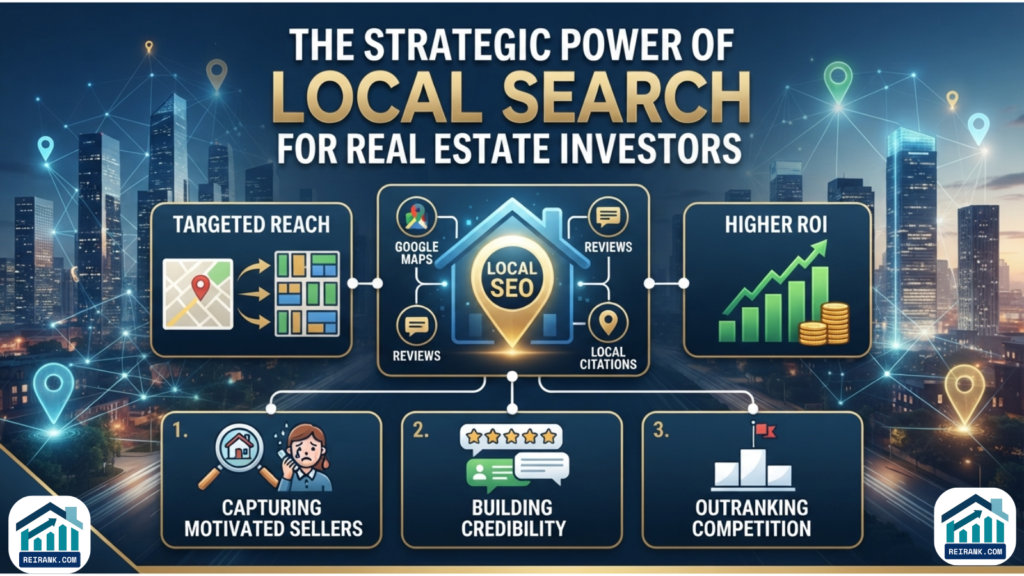
Local search for real estate investors isn’t just a digital business card. It’s the heavy-duty infrastructure that connects distressed sellers with local buyers in real time.
While most wholesalers still rely on manual labor like “driving for dollars” or hit-or-miss networking, market leaders use digital automation. They build a system that captures leads while they sleep.
This shift from passive to tactical is what separates the top 1% from the rest of the pack. You aren’t just looking for traffic; you’re building a lead-capture engine that works 24/7.
At its core, Local search engine optimization (Local SEO) is about geographic dominance. It ensures your brand is the first thing a homeowner sees when they face a crisis. In 2026, Google will have fundamentally changed the game. The algorithm now prioritizes hyper-local relevance over national brand authority.
A massive national company can no longer hide behind its budget to bury a well-optimized local investor. If you own the local search space, you own the market. Keywords with local intent, such as “sell my house fast,” carry the highest conversion ROI because they signal a seller who is ready to act immediately.
Why Motivated Sellers Start with Local Search
A distressed seller is a person in a high-stress situation. They need immediate, local solutions. The psychology is simple: proximity equals trust. When a homeowner in foreclosure searches for help, they aren’t looking for a corporate entity in another state. They want someone who understands their specific neighborhood and can show up at their door tomorrow.
This proximity factor is your greatest asset. Mastering local search for real estate investors allows you to bypass the skepticism barrier that plagues national direct mail campaigns. A search result feels like a proactive solution the seller discovered, while a postcard often feels like a predatory intrusion.
Local SEO vs. General SEO: The Investor’s Distinction
Winning at local search requires a different playbook than general SEO. You aren’t trying to rank for national keywords like “how to flip houses.” That’s vanity traffic.
You’re fighting for the Google Map Pack. This is where the “Zero-Click” search trend dominates. Sellers often find your phone number and reviews without ever visiting your website. To win here, you must build Geographic Authority. This isn’t about how many backlinks you have from across the globe.
It’s about how deeply your digital footprint is embedded in your specific target territory. Local search dominance is about being the undeniable authority in your own backyard.
Dominating the Google Map Pack: The Investor’s 3-Step Blueprint

The Google Business Profile (GBP) is the cornerstone of local search for real estate investors. It acts as your digital storefront, converting local intent into high-value acquisitions.
To dominate the Map Pack, your Name, Address, and Phone (NAP) data must be perfectly consistent across every corner of the web. Inconsistencies suggest unreliability to Google’s crawlers, leading to suppressed rankings.
You aren’t just filling out a profile; you’re building a fortress of geographic authority that national competitors can’t touch.
Step 1: Technical Google Business Profile Optimization
Choosing your primary category is a strategic decision. While “Real Estate Consultant” provides a broader reach, “Real Estate Investor” often triggers more specific, high-intent searches from distressed sellers.
Your GBP description should utilize the full 750-character limit, concentrating your primary keywords within the first 250 characters to ensure they are visible before the “read more” break. Ditch the stock photography.
Upload high-resolution, geo-tagged images of your actual team and local property transformations. These “local signals” prove your physical presence and build immediate trust with homeowners in crisis.
Step 2: Building Local Citation Power
Authority is built through consistency across top-tier directories like Yelp, Yellow Pages, and the Better Business Bureau. Beyond these giants, niche-relevant local backlinks from community blogs or municipal sites act as powerful votes of confidence for your Map Pack positioning.
You must audit your existing citations to eliminate duplicate or outdated listings that kill rankings. Effective local marketing strategies prioritize a clean digital footprint, ensuring every directory entry reinforces your verified business data. This precision is what allows smaller investors to outrank massive aggregators with ten times the budget.
Step 3: Managing Reputation and Social Proof
Review velocity is your most aggressive growth lever. In 2026, Google’s emphasis on “freshness” means profiles without new reviews or updates within 30 days see a sharp drop in visibility.
You need a systematic framework to solicit reviews from sellers immediately after a successful closing. Respond to every review promptly. This signals to both Google and potential leads that your business is active and reliable. Use GBP “Posts” to broadcast recent closings and property “before and afters” to show you’re a closer.
If you’re ready to automate this dominance, professional Local SEO services can provide the technical expertise to secure and hold the top spot. High-performance reputation management turns cold searches into warm, motivated leads.
Local SEO vs. Local Services Ads (LSAs): Which Scales Faster?
Speed or sustainability. This is the choice every investor faces when entering a new territory. Local Services Ads (LSAs) provide immediate entry into the market.
Organic local search for real estate investors builds a long-term moat. While traditional PPC focuses on clicks, LSAs operate on a pay-per-lead model, meaning you only pay when a seller actually contacts you. For real estate agents and investors in 2026, the average cost per lead for LSAs sits between $60 and $75.
It’s a high-intent, low-friction way to fill your pipeline today. However, relying solely on paid leads is a tactical error. You must balance immediate volume with the long-term equity of organic search dominance.
The real power lies in the synergy between the two. Data suggests that running both LSAs and organic SEO increases your overall click-share by 25%. You’re not just appearing; you’re dominating the visual real estate of the search results page.
If you aren’t visible in both the “Google Screened” section and the Map Pack, you’re leaving deals on the table for competitors who are.
The Pros and Cons of Local Services Ads for Wholesalers
The “Google Screened” badge is a massive trust accelerator. To earn it, you must pass a rigorous vetting process, including background and license checks. This badge signals to a distressed seller that you’re a legitimate local professional, not a fly-by-night operation.
Unlike traditional Google Ads, the LSA auction doesn’t just favor the highest bidder. It prioritizes businesses with fast response times and high review scores. In June 2026, Google expanded these ads with mobile-only property data integrations, allowing users to connect directly from a listing.
While powerful, the downside is lead quality. You must aggressively manage your dashboard and dispute non-investor leads to protect your ROI.
Long-Term ROI: Why Organic Local SEO Wins the Marathon
Organic local search is the ultimate ROI play. While LSAs have a fixed cost per lead, the cost per lead for organic search diminishes over 12 to 24 months as your authority grows.
You’re building “Brand Defense.” When a seller sees your content and your Map Pack ranking, you become the default choice. This organic presence captures “Top of Funnel” sellers long before they start searching for specific buyers.
By providing neighborhood-level data and solving seller problems through content, you capture leads that LSAs never reach. Organic SEO isn’t an expense; it’s an asset that appreciates over time, securing your market leadership without a daily ad budget.
Optimizing Your Digital Presence for High-Intent Motivated Seller Leads
Driving traffic through the Map Pack is only half the battle. If your website fails to convert that traffic into a lead, your investment in local search for real estate investors is effectively dead on arrival.
High-intent sellers operate in high-stress environments. They don’t have the patience for generic homepages or slow-loading scripts. You must transform your digital presence into a precision-engineered lead-capture machine.
This requires a shift from general branding to tactical, hyper-local conversion optimization. Performance isn’t a luxury; it’s the baseline for market leadership.
Local landing pages are the foundation of this strategy. Every target county or municipality needs its own dedicated environment. This isn’t just about SEO; it’s about psychological relevance.
When a seller in a specific city lands on a page that mentions their neighborhood by name, the skepticism barrier drops. Pair this with lightning-fast load speeds and a mobile-first design.
Since 71% of people find property using a mobile device, your site must be optimized for the thumb, not just the desktop. Speed wins; delays kill deals.
Structuring Local Landing Pages for Conversion
A high-converting landing page must balance authoritative trust signals with a frictionless user experience. Use geo-specific headlines to reduce bounce rates immediately by confirming your local presence to the visitor. Your page should include:
- Immediate Trust Signals: Better Business Bureau logos and local video testimonials.
- Clear CTA: A bold, contrasting button that tells the user exactly what to do next.
- Regional Social Proof: Mention recent closings in that specific municipality to prove your activity.
Position the “Cash Offer” form above the fold on every local landing page to ensure sellers can submit their information without scrolling. This minimizes the effort required from a distressed homeowner and maximizes your lead flow from every click.
Content Strategy for Local Motivated Seller Intent
In 2026, generic content is ignored. You need “Distress-Specific” silos that address the unique pain points of foreclosure, probate, and divorce.
Targeting long-tail local queries like “how to stop foreclosure in [Target Area]” captures sellers before they even look for a buyer. Video content is non-negotiable here; data indicates that listings with video receive 403% more inquiries because they humanize your team and build trust. Use local case studies to demonstrate your expertise in solving regional property issues.
If your current site isn’t generating these results, our Web Development team can rebuild your infrastructure for maximum ROI. Stop settling for a digital brochure and start building a high-performance acquisition tool.
Partnering for Performance: How REI Rank Secures Local Market Leadership
Execution is the only variable that defines your market position. You’ve seen the mechanics of local search for real estate investors; now you must decide how to deploy them. Most agencies focus on traffic.
We focus on acquisitions. REI Rank bridges the gap between digital strategy and tangible ROI. Our “Lead-First” philosophy ensures that every optimization serves one purpose: closing more deals.
We don’t settle for vanity metrics like impressions or clicks. We build the digital engine that secures your market leadership and converts distressed sellers into closed contracts. Success in this niche requires more than just technical skill; it requires an aggressive, results-driven partner who understands the high stakes of real estate acquisition.
The transition from market participant to market leader isn’t accidental. It’s the result of a deliberate, high-performance strategy. While your competitors are still wasting their budget on broad, low-intent keywords, you’ll be capturing the most motivated leads in your territory. We don’t just manage your presence; we dominate your competition.
This is about total geographic control. It’s about ensuring that when a seller in crisis reaches for their phone, your brand is the only logical choice they see.
The REI Rank Advantage: SEO and PPC Management
Continuous optimization is mandatory for survival. Algorithm shifts don’t wait for your quarterly review. Our monthly retainer model provides the proactive defense needed to maintain your rankings against aggressive national aggregators.
We utilize proprietary keyword data specifically harvested from high-intent motivated seller searches. This isn’t generic industry data. It’s a strategic advantage that allows us to find the leads others miss.
In our Google PPC campaigns, we employ relentless negative keyword management. We eliminate the waste that drains your budget on window shoppers and low-intent clicks. Every dollar you spend is a calculated move toward a potential closing.
Custom Web Development for Real Estate Acquisition
Generic, rigid template platforms are for followers. In 2026, custom-built sites significantly outperform off-the-shelf acquisition systems that make your brand look identical to every other wholesaler in the city.
We build high-performance infrastructure from the ground up. Our focus on technical excellence and high-converting user experience (UX) ensures your site loads faster and converts better than any standard solution.
You need a site that works as hard as your acquisition team. Don’t let a slow, templated website be the reason you lose a deal to a faster competitor. Secure your territory and start scaling your lead flow today.
Get Your Free SEO Audit and Dominance Strategy from REI Rank
Secure Your Market Dominance in 2026
Dominating the real estate landscape requires more than just participation; it demands tactical superiority. You’ve seen how the Map Pack serves as the digital gatekeeper to motivated sellers and why the synergy of LSAs and organic search creates an unbreakable market moat.
Mastering local search for real estate investors is the only way to ensure your brand remains the first and only choice for homeowners in crisis. If your digital infrastructure isn’t built for speed and conversion, you’re simply funding your competitor’s growth.
REI Rank specializes in turning search intent into high-value acquisitions. We provide elite expertise in Google PPC and Local SEO for wholesalers, backed by high-performance custom web development designed specifically for investors. We don’t just optimize for clicks; we optimize for closings.
It’s time to stop fighting for low-intent scraps and start leading your territory with a lead-first strategy. Take control of your pipeline and secure the high-authority brand your business deserves.
Dominate Your Local Market—Get a Free SEO Audit from REI Rank
Your path to market leadership starts with a single, strategic move. Build the engine that captures leads while you sleep and start scaling your acquisitions today.
Frequently Asked Questions
What is the difference between SEO and local search for real estate investors?
General SEO focuses on building national authority and ranking for informational keywords across broad territories. Local search for real estate investors targets specific geographic intent to capture motivated sellers in your immediate market.
It prioritizes the Google Map Pack and location-specific landing pages over global industry topics. This strategy ensures you appear when a seller searches for a solution in their specific city or neighborhood.
How long does it take to rank in the Google Map Pack for “We Buy Houses” keywords?
Ranking for high-competition terms like “We Buy Houses” typically takes between 90 and 180 days. This timeline depends on your profile’s current authority, your review velocity, and the strength of your local citations.
You might see faster results in less saturated municipalities where you can establish geographic dominance quickly. Consistency in your Name, Address, and Phone (NAP) data is the primary driver of this timeline.
Do I need a physical office in every city I want to target for local search?
You don’t need a physical storefront in every city to reach local sellers. Google allows you to designate “Service Areas” within your Business Profile to cover multiple counties or municipalities from a single verified location.
While a physical address in your primary target city provides a stronger ranking signal, properly optimized service area settings allow you to scale your reach without the overhead of multiple offices.
How much should a real estate investor spend on local search marketing?
Marketing spend should scale based on your acquisition goals and the competitive density of your target territory. Most successful investors treat digital marketing as a percentage of their revenue to ensure a sustainable lead flow. Focus on your cost-per-acquisition rather than a flat monthly fee.
This results-driven approach ensures your budget is always tied to the volume of closings you need to hit your growth targets.
Can Local Services Ads (LSAs) replace organic SEO for lead generation?
LSAs provide immediate visibility, but they shouldn’t be your only lead source. While LSAs capture high-intent traffic today, organic search builds a long-term asset that generates leads without a daily ad budget.
A balanced strategy uses LSAs for speed and organic search for real estate investors for sustainability. Relying solely on paid ads leaves you vulnerable to price hikes and increased competition.
How do I handle negative reviews on my Google Business Profile?
Address negative reviews immediately with a professional, solution-oriented response. This signals to both Google and potential leads that you’re an active and reliable operator.
Once you’ve addressed the issue, focus on increasing your review velocity. Burying a negative comment under a high volume of recent, five-star local testimonials is the most effective way to protect your brand’s reputation.
What are the best keywords for finding motivated sellers through local search?
The best keywords combine a specific distress signal with a geographic modifier. Terms like “sell my house fast [City]” or “cash home buyers in [County]” attract sellers at the peak of their intent.
You should also target long-tail queries related to probate, foreclosure, or inherited properties. These niche-specific keywords often have lower competition and higher conversion rates than broad real estate terms.
Is it better to build one national site or multiple local sites for my investment business?
A single authoritative website with dedicated local landing pages is the superior strategy for 2026. This allows you to consolidate your domain authority while still ranking for hyper-local keywords in every municipality you target.
Managing one high-performance site is more efficient and scales faster than trying to maintain dozens of separate, low-authority domains. It also provides a better user experience for sellers researching your brand.