

If you have spent any meaningful time trying to grow a real estate investing business online, you have probably already realized that showing up on Google is not a matter of luck. It is a matter of strategy, and that strategy begins with understanding which words your ideal clients, sellers, and partners are actually typing into their search bars.
The best keywords real estate investors should target are not just random phrases you guess at. They are carefully researched terms that connect you to the right people at exactly the right moment, whether that person is a motivated homeowner looking for a quick sale or a cash buyer hunting for their next deal.
This article is going to walk you through everything you need to know about real estate investor keywords in 2026, from the foundational concepts that make keyword research work, to the specific types of phrases that are generating real leads and real closings for investors across the country.
Whether you are brand new to SEO or you have been running a real estate website for years without seeing the results you want, what you are about to read will give you a clear and actionable path forward.
Why Keyword Research Is the Foundation of Every Successful REI Strategy
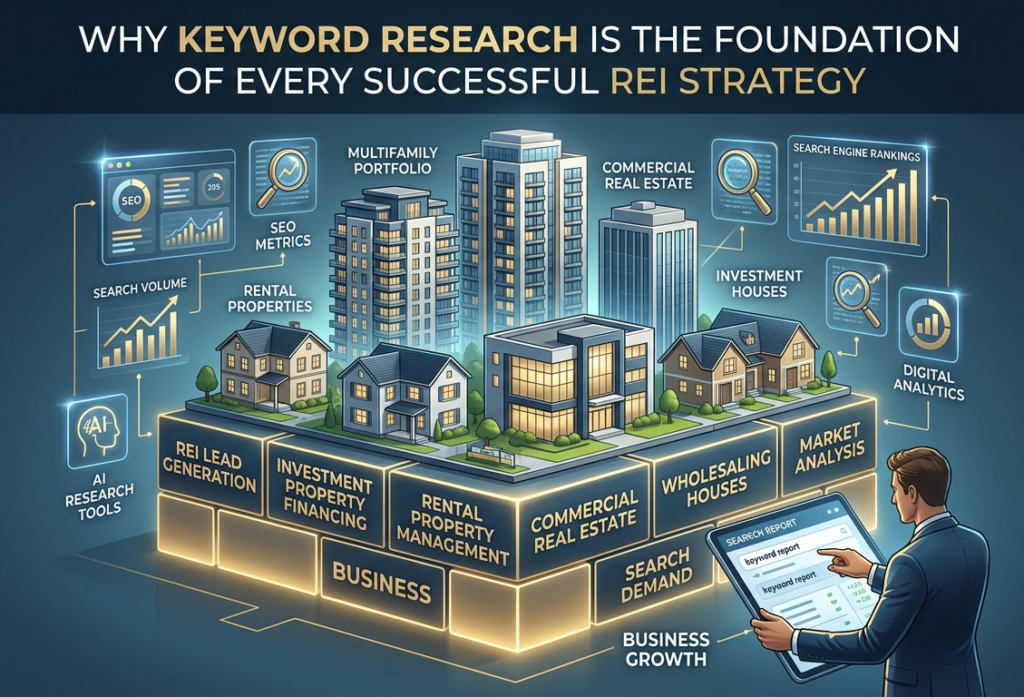
Before we get into specific phrases and categories, it is worth taking a moment to understand why investor keyword research matters so much in the first place. When a distressed homeowner in your market types something like “sell my house fast without repairs” into Google, they are not browsing casually.
They have a problem they want solved, and they are actively looking for someone who can solve it. If your website appears in front of that person at that exact moment, you have an enormous opportunity to convert a search into a conversation and a conversation into a contract.
The same principle applies on the buyer side. When a cash buyer or a fellow investor types “wholesale deals in [your city]” or “off-market properties near me,” they are equally motivated and equally ready to engage. The entire art and science of a solid REI keyword strategy is about making sure you are the answer that appears when those high-intent searches happen.
What makes 2026 different from years past is that the search landscape has matured considerably. There is more competition for the broad, obvious terms than there used to be, and Google has become significantly better at understanding context and intent.
This means that the investors who will win the most organic traffic this year are not just targeting the most popular phrases. They are building a thoughtful mix of competitive head terms, highly specific long-tail phrases, and location-based queries that collectively capture an entire market.
The 3 Core Categories of Real Estate Investor Keywords
When you think about the best keywords real estate investors should target, it helps to organize them into three broad categories based on who you are trying to reach and what they are looking for.
The first category covers motivated-seller keywords, the second covers cash-buyer and deal-sourcing terms, and the third covers educational and authority-building phrases. A well-rounded SEO strategy for any real estate investor requires all three to work together.
Motivated seller keywords are the phrases that homeowners in distress use when they are searching for solutions. These are people dealing with divorce, foreclosure, probate, job loss, inherited properties, and a dozen other circumstances that create urgency around selling a home.
The words they type tend to be emotionally driven and solution-focused. Phrases like “how to sell my house fast for cash,” “sell my house before foreclosure,” “we buy houses in [city name],” and “how to sell an inherited property quickly” all fall into this category. These are among the most valuable phrases you can rank for because the searcher is already close to making a decision. They are not doing early-stage research. They are looking for someone to call.
The best SEO keywords for cash buyers operate somewhat differently. These searchers tend to be more sophisticated, and they are using terms related to deal flow, investment opportunities, and distressed properties available for purchase. Phrases like “buy distressed homes in [city],” “wholesale real estate deals,” “off-market properties for investors,” and “fix and flip houses for sale” attract people who already understand the language of real estate investing and are actively looking to deploy capital.
Ranking for these terms can help you build your buyer list, fill your pipeline with ready purchasers, and ultimately move properties faster when you have deals under contract.
The third category, the educational and authority-building terms, is one that many investors overlook entirely, and that is a significant missed opportunity. When someone types “how does wholesaling real estate work,” or “what is a motivated seller in real estate,” or “how to find off-market deals,” they are often an investor or aspiring investor who is hungry for guidance.
ALSO READ: Local SEO for Real Estate Investors: The Best 2026 Guide
By creating content that answers those questions thoroughly and honestly, you establish yourself as a trusted expert in your market. That trust builds over time into phone calls, partnership opportunities, and referrals. This category is where a strong content marketing strategy intersects with your REI keyword strategy to create long-term compounding value.
The Specific Phrases That Are Driving Results in 2026

Now, let us get into the actual phrases that are working right now. When it comes to motivated seller keywords, the research consistently shows that people in difficult housing situations use very specific language.
They are not searching for “real estate agent.” They are searching for “cash home buyers near me,” “sell my house as-is,” “how to stop foreclosure fast,” “sell my house without a realtor,” and “home buyers who pay closing costs.” Each of these phrases represents a searcher with a real problem and a genuine readiness to work with someone who can help.
Location-based variations of these phrases are particularly powerful because they signal local intent. Adding a city name, a neighborhood, or even a county to any of these phrases dramatically increases the commercial relevance of the search. Someone typing “sell my house fast in Houston” is not just browsing.
They are a Houston homeowner who wants action, and if you have a page specifically optimized for that phrase, you have a legitimate chance of being the business they call.
On the cash buyer side, the best SEO keywords in 2026 include terms like “investment properties for sale by owner,” “discounted properties for cash buyers,” “real estate deals below market value,” and “motivated seller leads.” These are the phrases that attract deal-hungry buyers, and they tend to generate high-quality traffic because the people searching them know exactly what they want and are ready to move quickly when they find it.
It is also worth mentioning the growing importance of question-based keywords in any serious investor keyword research effort. Google’s featured snippets and the rise of voice search have elevated question-format phrases considerably over the past few years. Phrases like “what does it mean to sell a house for cash,” “how fast can I close with a cash buyer,” and “is it better to sell to an investor or a realtor” are all generating meaningful search volume in 2026.
Creating content that answers these questions directly and in plain language gives you a strong shot at capturing both featured snippet placement and the trust of the reader simultaneously.
Long-Tail Keywords and Why They Often Outperform Broad Terms
One of the most important lessons in investor keyword research is that longer, more specific phrases almost always convert better than shorter, more generic ones. This is counterintuitive at first because the shorter phrases tend to have higher search volumes, and it is tempting to go after the biggest numbers.
But a phrase like “sell my house fast” is extremely competitive and attracts searchers at many different stages of the decision-making process. A phrase like “sell my inherited house fast in Atlanta without repairs” is far more specific, far less competitive, and attracts someone who is essentially already qualified as a motivated seller in your target market.
This is the power of the long-tail keyword, and it is central to any effective REI keyword strategy in 2026. When you build out a content library that covers dozens or even hundreds of these highly specific phrases, each one might drive only a small amount of traffic on its own, but collectively they create a steady, compounding stream of highly qualified visitors who are genuinely likely to convert into leads. This approach also tends to build domain authority over time, which eventually helps you rank for the more competitive head terms as well.
The key is to think about your target audience as real human beings with specific situations, not just abstract search engine users. A homeowner facing foreclosure thinks differently and searches differently than someone going through a divorce or dealing with a vacant rental property they no longer want to manage.
When you create content that speaks directly to each of those specific situations, you are not just winning keywords. You are building genuine connections with people who need your help.
Local SEO Is Non-Negotiable for Real Estate Investors
No conversation about the best keywords real estate investors should target would be complete without a serious discussion of local SEO. Real estate investing is, almost by definition, a local business. You are buying and selling properties in specific markets, and the people you want to reach are in those markets. This means that every keyword strategy you build should have a strong local component baked in from the very beginning.
Google’s local search results, including the map pack that appears at the top of many real estate-related searches, are driven by a combination of your website’s local optimization, your Google Business Profile, and the authority signals associated with your specific geographic area.
Phrases like “we buy houses [city name],” “cash home buyers [city name],” and “[city] real estate investors” are cornerstone terms for anyone serious about dominating their local market.
Beyond just adding city names to your main phrases, you can also look at neighborhood-level targeting, county-specific terms, and even phrases related to nearby landmarks or communities.
This level of geographic granularity signals to Google that you are a genuinely local resource, not just a national aggregator stuffing location names into generic content. That distinction matters enormously in how search engines evaluate and rank your pages.
Building a Content Strategy Around Your Target Keywords
Identifying the right real estate investor keywords is only the first half of the equation. The second half is creating content that actually earns those rankings over time. In 2026, Google rewards content that is genuinely helpful, thoroughly researched, and written for real people rather than for search engines. This means that stuffing keywords into thin pages or spinning generic content is not going to move the needle the way it once might have.
What does work is creating in-depth pages and articles that fully address the questions and concerns of your target audience. A page targeting motivated sellers in your city should explain your process clearly, address common objections, include testimonials or proof of past closings, and answer the specific questions that someone in a distressed situation is likely to have.
A page targeting cash buyers should speak their language, describe the types of deals you work with, and make it easy for them to reach you or submit a deal.
Consistency also matters enormously. Search engine rankings are not won overnight, and a single great page is not enough to build lasting visibility. The investors who are winning the organic search game in 2026 are publishing regularly, updating their existing content to keep it fresh and accurate, and building topical authority across their entire content library.
When Google sees that your site consistently provides valuable information across the full spectrum of topics relevant to real estate investing in your market, it begins to treat your domain as a go-to resource. That authority translates into rankings across dozens or even hundreds of relevant phrases.
Conclusion: The Best Keywords Real Estate Investors Should Target
The bottom line is that the best keywords real estate investors should target in 2026 are the ones that connect you most directly to motivated sellers, active buyers, and potential partners in your specific market. Real estate investor keywords are not just technical SEO tools. They are the language your customers are already speaking, and learning to meet them in that language is one of the most powerful things you can do for your business.
A smart investor keyword research process starts with a deep understanding of your audience, moves through the careful identification of phrase categories and geographic modifiers, and culminates in a consistent content creation effort that builds authority over time.
When your motivated seller keywords are capturing distressed homeowners in their moment of need, when your best SEO keywords for cash buyers are filling your pipeline with ready purchasers, and when your educational content is establishing you as the most trusted voice in your local real estate community, you will have built something truly valuable.
You will have built a business that grows while you sleep, powered by the most reliable lead generation machine that has ever existed for real estate investors, and that machine is called organic search. Start with the keywords, commit to the content, and stay consistent. That is the formula for real estate SEO success in 2026 and beyond.