

Building a seller FAQ page for long-tail keywords is one of the most underrated ways to bring in organic traffic that actually converts.
Most real estate investors treat their FAQ section as an afterthought, a short list of generic questions tucked at the bottom of a page. That is a missed opportunity.
A well-built FAQ page can quietly capture dozens of specific searches that a homepage or service page never will, and it can do it with far less content than a full blog post.
This matters because sellers rarely search using broad terms like sell my house. Real questions are longer, more specific, and closer to what someone is actually thinking.
Phrases like can I sell my house if I am behind on payments or do I need to fix anything before selling to a cash buyer are exactly the kind of long-tail searches an FAQ page is built to answer.
Why Long Tail Keywords Matter for Real Estate Investors
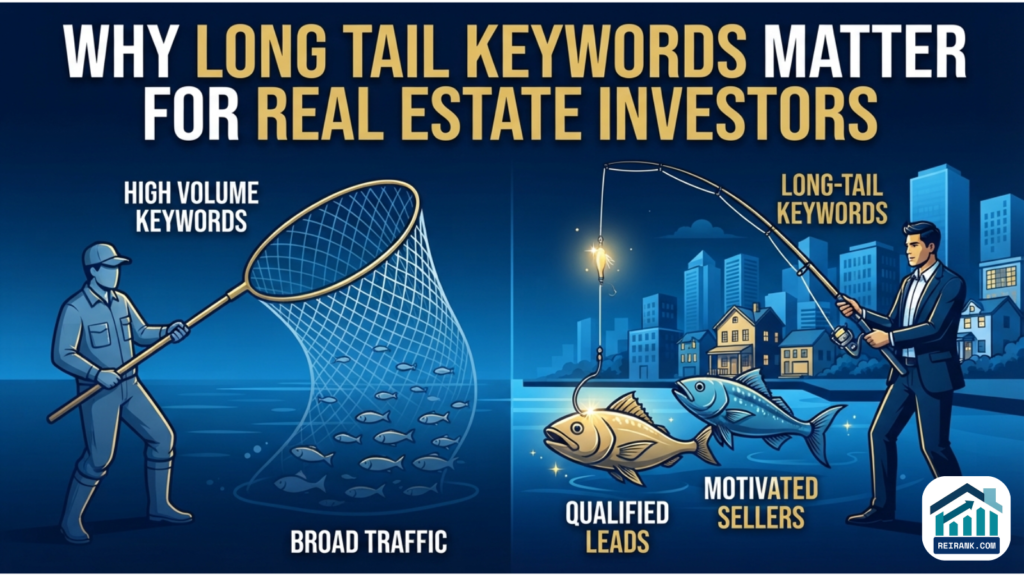
Long-tail keywords for real estate investors tend to have lower search volume individually, but there are far more of them, and the people searching them are usually much closer to taking action.
Someone searching to sell my house is browsing. Someone searching for ” how do I sell my house during a divorce in Ohio is dealing with a real situation right now.
An FAQ page is one of the few content formats built specifically to match this kind of search behavior. Each question can target its own long-tail phrase, without forcing you to write a full article for every single scenario a seller might be facing.
#1: Collect Real Questions From Real Sellers
The strongest FAQ pages are built from actual questions, not guesses. Before writing anything, pull together the questions your team hears most often from:
- Phone calls with sellers
- Contact form submissions
- Text conversations during the qualification process
- Comments or messages on social media
These sources reveal the exact language sellers use, which is often different from how an investor or marketer would phrase the same question. That gap is where the long-tail keyword opportunity usually hides.
It helps to actually write these questions down word for word rather than paraphrasing them. A seller might ask what happens to my mortgage if I sell to you, while a marketer writing from memory might shorten that to selling with a mortgage.
The first version is closer to how people actually search, and it is far more likely to match a real long-tail query.
#2: Group questions on the FAQ page by Intent, Not Just Topic

Once you have a list of real questions, group them by what the seller is actually trying to figure out, not just the surface topic. Someone asking Do you buy houses with foundation issues and someone asking Do you buy houses that need a new roof are both asking a version of the same underlying question: will you buy a house that needs repairs?
Grouping by intent helps you decide whether a question deserves its own FAQ entry or whether it can be folded into a broader one. This keeps the page organized and prevents several near-duplicate questions from competing with each other for the same search.
A simple way to do this is to sort every question into one of a few broad categories first, such as property condition, timeline, ownership situation, and paperwork or legal concerns. Within each category, you can then decide which individual questions are specific enough to earn their own entry.
#3: Write One Question Per Long Tail Phrase
A common mistake is combining several ideas into one broad FAQ question, which dilutes its ability to rank for anything specific. Instead, write each question as its own focused entry, closely matching a real long-tail phrase.
For example, instead of one large question like ” What should I know before selling my house, break it into separate, specific entries such as:
- Do I need to make repairs before selling my house to a cash buyer?
- Can I sell my house if I still owe money on it?
- How fast can I sell my house if I need to move quickly?
Each of these targets a distinct long-tail search, and each has a real chance of ranking on its own.
#4: Answer in Plain, Conversational Language
Search engines reward content that directly and clearly answers the question being asked, and so do sellers. Avoid vague, marketing-style language in your answers. Get straight to the point, then add helpful context afterward.
A good structure looks like this: answer the question in the first sentence or two, then follow with two or three sentences of useful detail. This format also happens to align well with how featured snippets are pulled from a page, since search engines tend to favor direct, well-structured answers near the top of a section.
#5: Add FAQ Schema Markup
FAQ schema markup is a small technical step with a meaningful payoff. It tells search engines exactly which parts of your page are questions and which parts are answers, which increases your chances of appearing in expanded search results, including question and answer boxes directly in the search results page.
Most website platforms and page builders support FAQ schema through a plugin or built-in block, so this does not require custom development in most cases. If your current FAQ section does not have this markup in place, it is one of the highest-value, lowest-effort fixes available on an existing page.
It is worth checking your markup after publishing rather than assuming it worked correctly. A quick search for a structured data testing tool, paired with your page URL, will show whether the questions and answers are actually being read the way you intended. Small errors in the code, like a missing closing tag or a mismatched question count, can quietly prevent the whole block from being recognized.
#6: Link Each Answer to a Relevant Page
An FAQ page should not exist in isolation. Where it makes sense, link individual answers to the pages that go deeper on that topic. A question about selling a house with tenants still living in it can link to a dedicated page about buying tenant-occupied properties. A question about selling an inherited property can link to a page built specifically for that situation.
This does two things. It keeps visitors moving through your site instead of leaving after reading one answer, and it helps search engines understand how your pages relate to each other, which supports the rankings of both the FAQ page and the pages it links to.
#7: Keep Expanding the FAQ page Over Time
An FAQ page is never really finished. New seller questions come up constantly, especially as your business expands into new situations or markets. Set a habit of reviewing new calls and form submissions every month or two, and add fresh questions as patterns appear.
Pages that grow steadily over time, with genuinely new and useful content, tend to hold and improve their rankings far better than a page that was built once and never touched again.
Common Mistakes to Avoid
A few habits tend to quietly undermine an otherwise solid FAQ page:
- Answering too briefly. A one-line answer might feel efficient, but it rarely gives search engines or sellers enough context to see the page as genuinely useful. Aim for a direct answer followed by a bit of real substance.
- Reusing the same answer with slightly different wording across questions. This tells search engines the questions are not actually distinct from each other, which works against the entire point of targeting separate long-tail phrases.
- Letting the page go stale. A page that has not changed in over a year, while your business has expanded into new situations or markets, sends a weaker signal than one that shows regular, genuine updates.
- Writing answers that sound like ad copy. Sellers can tell the difference between a real answer and a sales pitch wearing the shape of one. Straightforward, honest answers consistently build more trust than promotional language.
How REIRank Can Help
Building an FAQ page that actually captures long-tail search traffic takes more than listing a few generic questions. It means gathering real seller language, organizing it around search intent, writing clear answers, and setting up the technical pieces like schema markup correctly, all while keeping the page updated as new questions come in.
Most investors are focused on acquisitions and simply do not have the time to manage this properly.
This is where REIRank steps in. We build seller-focused content, including FAQ pages, city-specific landing pages, and full SEO strategies, designed specifically for real estate investors and wholesalers.
We handle the keyword research, the writing, and the technical setup, so your FAQ page and the rest of your site are working together to capture the long-tail searches your ideal sellers are already typing.
If your current FAQ page is short, generic, or has not been updated in a while, there is likely real traffic being left on the table. Visit our services page to see how REIRank builds SEO and content strategies for real estate investors, and book a free consultation to talk through what a stronger FAQ and content strategy could look like for your business.
Conclusion: seller FAQ page for long-tail keywords
A seller FAQ page for long-tail keywords is one of the simplest content assets to build, yet one of the most overlooked. It does not require the length of a full blog post, but it can capture dozens of specific searches that a general service page never will.
Start with the real questions your sellers are already asking, organize them by intent, write clear and direct answers, add proper schema markup, and keep the page growing. Done well, a single FAQ page can quietly become one of the steadiest sources of organic traffic on your entire site.