

Understanding Google Ads quality score for real estate investors is one of those topics that many people running paid search campaigns have heard about but never fully dug into, and that gap in understanding is quietly costing them more per click than they should be paying on every motivated seller keyword they bid on.
Quality score is not just a number that appears in your Google Ads dashboard. It is a direct determinant of how much you pay for each click, where your ads appear relative to competitors bidding on the same keywords, and ultimately how efficiently your entire advertising budget converts into motivated seller leads.
An investor with a consistently high quality score across their campaign effectively gets a discount on every click compared to a competitor bidding the same amount with a lower score, and over the course of months and years of active advertising, that efficiency advantage compounds into a meaningful cost advantage that makes their lead generation economics progressively better while competitors with low quality scores pay more for the same or worse results.
What Quality Score Actually Is and How It Works
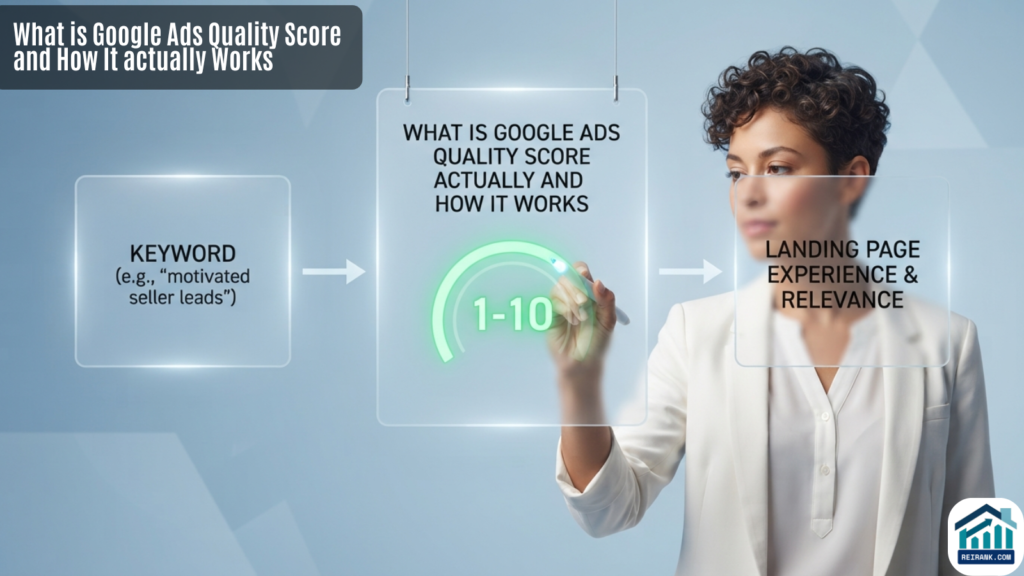
Quality score is Google’s numerical assessment of the relevance and expected usefulness of your keyword, your ad, and your landing page to the person who searched the term that triggered your ad.
It is expressed as a number from one to ten for each keyword in your campaign, with ten representing the highest possible relevance and one indicating that Google considers your ad and landing page poorly matched to the keyword and the searcher’s intent.
The score itself is calculated based on three underlying components that Google evaluates separately and then combines into the overall quality score figure. Each component is rated as above average, average, or below average, and understanding which components are dragging your score down is essential for knowing where to focus your improvement efforts rather than making changes that do not address the actual problem.
The way quality score affects your real estate investor PPC performance is most directly visible through its impact on what Google calls Ad Rank. Ad Rank is the calculation Google uses to determine which ads appear and in which positions, and it is determined by multiplying your bid by your quality score along with several other factors.
This means that an investor with a quality score of eight on a keyword can outrank a competitor with a quality score of four even when bidding less money per click. The competitive and financial implications of this are significant in a paid search environment as expensive as the motivated seller keyword space.
The Three Components That Determine Your Google Ads Quality Score

#1. Expected Click-Through Rate
Expected click-through rate is Google’s prediction of how likely a searcher is to click your ad when it appears for a given keyword, based on historical performance data from your account and across the broader Google Ads ecosystem.
This component essentially asks whether your ad is compelling enough relative to what searchers in this query category have historically found worth clicking.
Improving expected click-through rate requires writing ad headlines and descriptions that speak directly and specifically to what the searcher is looking for, rather than generic ad copy that could apply to any real estate service.
A headline that specifically addresses the situation of the motivated seller typing that keyword, using language that mirrors their search intent closely, earns more clicks than a generic headline even when the bid amounts are identical.
For real estate investors, this means crafting separate ad copy for different seller situation keyword groups rather than using the same generic ad across all campaigns. An ad appearing for a foreclosure-related search should feature headlines speaking directly to foreclosure urgency and timeline.
An ad appearing for inherited property searches should use language specific to that seller situation. This level of specificity in ad copy is what drives above-average expected click-through rates across a campaign and raises quality scores on the keywords that matter most.
#2. Ad Relevance
Ad relevance measures how closely your ad copy matches the intent behind the keyword that triggered it. While expected click-through rate is about whether the ad is compelling enough to earn a click, ad relevance is specifically about whether the message in your ad aligns with what the keyword is actually asking for.
These two components are related but evaluated separately, and it is possible to have below-average ad relevance even when your click-through rate is respectable if your ad is getting clicks for reasons unrelated to the specific keyword intent.
The practical implication for improving Google Ads quality score efforts is that ad groups need to be organized with tight thematic focus so that the ad copy written for each group is genuinely relevant to every keyword in that group.
When ad groups contain too many different keyword variations with different intents and those keywords are all served the same generic ad, ad relevance suffers across the group because no single ad can be perfectly relevant to a diverse range of keyword intents simultaneously.
Real estate investors who build tightly themed ad groups around specific seller situations- one group for foreclosure-related keywords, one for inherited property keywords, one for the core cash buyer phrases, and write ad copy specifically for each group will see above-average ad relevance ratings that contribute positively to overall quality scores across their campaign.
#3. Landing Page Experience
Landing page experience is Google’s assessment of how useful and relevant your landing page is to someone who clicks your ad, and it is the component that many real estate investors improve Google Ads quality score efforts overlook in favor of focusing exclusively on the campaign-side elements. This is a mistake, because landing page experience is one of the most significant drivers of overall quality score and one of the areas where investor websites most commonly underperform.
Google evaluates landing page experience based on several factors including page load speed, particularly on mobile devices, the relevance of the page content to the keyword and ad that brought the visitor there, how easy it is for visitors to find what they were looking for on the page, and whether the page appears to offer genuine value to visitors rather than existing purely as a lead capture mechanism with no real informational content.
For a motivated seller landing page, this means the page needs to load quickly, present a headline that immediately and specifically addresses the seller’s situation, provide genuine and useful information about how the selling process works, and make the path to contact obvious and easy.
A landing page that is slow to load, generic in its content, or difficult to navigate on a mobile device will receive a below-average landing page experience rating that drags down quality scores on every keyword in the ad groups pointing to it.
Why Google Quality Score Matters More in Competitive Investor Markets
In markets where multiple real estate investors are actively bidding on the same motivated seller keywords, quality score becomes an even more significant competitive factor because the differences in Ad Rank between advertisers are often more influenced by quality score variation than by bid variation.
When three investors are all bidding thirty to forty dollars per click on “sell my house fast [city],” the differences in their quality scores determine who appears first, who appears second, and who gets pushed to a less visible position.
An investor with quality scores of eight and nine across their keywords consistently occupies better positions at lower effective costs than competitors with scores of four and five, even when those competitors are bidding more aggressively per click.
This quality score advantage compounds in meaningful ways for real estate investor PPC performance over time. Better ad positions mean more impressions from motivated sellers who are most likely to convert, since higher positions in search results capture a disproportionate share of clicks compared to lower positions.
Lower effective costs per click mean more budget available to reach more motivated sellers from the same advertising spend. And the continuous improvement in quality scores that comes from consistently running relevant, well-performing ads means the advantage grows rather than diminishes as the campaign matures.
How to Diagnose Your Current Quality Score Problems
Before making changes to improve quality score, you need to understand which components are holding your scores down on which specific keywords, because the right fix for a below-average expected click-through rate is different from the right fix for a below-average landing page experience.
In your Google Ads account, navigate to the Keywords tab and add columns for quality score and for each of the three component ratings. This view shows you exactly where each keyword stands and which specific component is rated below average.
Any keyword with an overall quality score of five or below warrants investigation, and the component ratings tell you exactly where to start.
Keywords showing below-average expected click-through rate need stronger, more specific ad copy that better matches the intent of that search. Keywords showing below-average ad relevance need to be reorganized into tighter ad groups where the ad copy can be written specifically for that keyword’s intent.
Keywords showing below-average landing page experience need the landing page they point to improved for speed, relevance, and usefulness.
Focusing your improvement efforts on the keywords that receive the most impressions first produces the fastest overall quality score improvement, since raising scores on high-impression keywords has a more immediate impact on your campaign’s average quality score and your overall Ad Rank than improving scores on rarely triggered keywords.
Practical Steps to Improve Google Ads Quality Score for Each Component
For expected click-through rate, write headline variations that incorporate the exact phrase or close variants of the keyword that triggered the ad, since searchers are more likely to click ads whose headlines visually match what they searched for.
Test emotional hooks that speak to the seller’s specific situation alongside factual benefit statements, since different searchers in different emotional states respond to different ad framings.
For ad relevance, audit your ad groups and identify any that contain keywords with meaningfully different intents grouped. Split these groups into single-theme groups and write dedicated ad copy for each.
A group targeting foreclosure keywords should contain only foreclosure-related keywords and ads written specifically about buying houses in foreclosure situations. Mixing these with general fast-sale keywords in the same group dilutes relevance for both keyword types.
For landing page experience, run your landing pages through Google PageSpeed Insights and address every issue flagged as high priority for mobile performance.
Rewrite your landing page headline to incorporate the specific keyword phrase or situation the page targets, making it immediately clear to a visitor that they have arrived at the right place for their specific search.
Add genuine, useful content about your buying process, your local market knowledge, and what sellers in different situations can expect when working with you. And verify that your contact form is visible above the fold on every major mobile screen size without requiring any scrolling.
Common Quality Score Mistakes Real Estate Investors Make
The most common mistake is sending all campaign traffic to the same generic homepage or general motivated seller landing page regardless of which keyword triggered the click.
This approach produces below-average landing page experience ratings across the entire campaign because no single generic page can be highly relevant to the full range of specific situations different keyword groups target.
Another frequent mistake is building ad groups that are too broad, containing dozens of keywords with varied intents that are all served the same ad. This structure almost guarantees below-average ad relevance ratings because the ad written for the group cannot possibly be specifically relevant to every keyword within it.
Many investors also ignore their quality score data entirely after launching a campaign, never reviewing the component ratings that would tell them exactly where their campaigns are underperforming and what needs to be fixed.
Quality score improvement requires ongoing attention to this data and a willingness to make structural changes to the campaign when the data indicates that existing structures are not serving the campaign’s goals.
How Reirank.com Helps Investors Improve Quality Score and PPC Performance
Diagnosing quality score problems across a real estate investor Google Ads account, building the restructured ad groups and new landing pages needed to address those problems, and maintaining the ongoing optimization discipline required to sustain quality score improvements over time requires both paid search expertise and deep understanding of motivated seller marketing.
Reirank.com helps real estate investors build and manage Google Ads campaigns where quality score improvement is treated as a core ongoing priority rather than an afterthought.
From initial campaign audits that identify every quality score problem and its root cause, through restructuring campaigns around tight thematic ad groups, developing situation-specific landing pages that earn above-average landing page experience ratings, and managing the continuous ad copy testing that builds expected click-through rate over time, every element of our campaign management is oriented toward the real estate investor PPC performance improvements that quality score drives.
If your Google Ads campaign is producing high cost per click, weak ad positions, or lower lead volumes than your budget should support, quality score is likely a significant part of the explanation.
Visit our services page today to explore how Reirank.com can audit your current campaign, identify your specific quality score problems, and build an optimization roadmap that addresses them systematically.
Your free consultation is the starting point for a Google Ads strategy that gets more motivated seller leads from the same budget by competing more intelligently rather than simply spending more.
Conclusion: Google Ads Quality Score Guide for Investors
Google Ads quality score for real estate investors is not a technical abstraction to be aware of and then ignore.
It is one of the most direct levers available for improving the efficiency and competitiveness of every motivated seller campaign you run, and the investors who understand and actively manage their quality scores consistently generate better real estate investor PPC performance than those who treat it as a background metric.
Improving quality score across each of its three components- expected click-through rate through better ad copy, ad relevance through tighter campaign structure, and landing page experience through faster and more relevant pages- produces a compounding efficiency advantage that makes your campaigns progressively more cost-effective over time.
The investors who commit to this optimization process in 2026 are building paid search systems that generate more motivated seller leads at lower cost with each passing month, which is the kind of competitive advantage that makes a real difference at the deal level.
Visit Reirank.com today to start building a Google Ads campaign where quality score is treated as the strategic priority it deserves to be.