

If you are pouring money into ads and traffic but your phone is not ringing with seller calls, the problem is rarely the number of visitors. It is what happens after they land on your site.
When you Boost Real Estate Investor Website Conversion Rate the right way, it is often the fastest and most affordable way to grow your deal flow, because you are working with people who already showed up. You just need to give them a reason to take the next step.
This post breaks down seven practical, tested ways to turn more of your website visitors into real seller conversations, without increasing your ad spend.
Why Conversion Rate Matters More Than Traffic
Many investors assume the answer to slow lead flow is simply more traffic. Run more ads, boost more posts, spend more on SEO. But traffic without conversion is just noise.
If your site brings in 500 visitors a month and converts at 1 percent, you get 5 leads. Improve that conversion rate to 3 percent, and you get 15 leads from the same traffic, at the same cost.
For anyone focused on real estate investing lead generation, this is the leverage point that gets overlooked most often. A better converting site means every dollar spent on marketing works harder, and every visitor gets a genuine chance to become a lead.
Think about it from the seller’s side. Someone searching online for a fast way to sell their house is usually comparing a handful of options within a few minutes. They rarely read every word on a page.
They scan, they judge, and they decide almost instantly whether a site feels trustworthy and easy to act on.
If your website does not answer their basic questions quickly, they move to the next result. This is why small, targeted changes to a website can have a bigger impact on lead volume than almost any other marketing decision an investor makes.
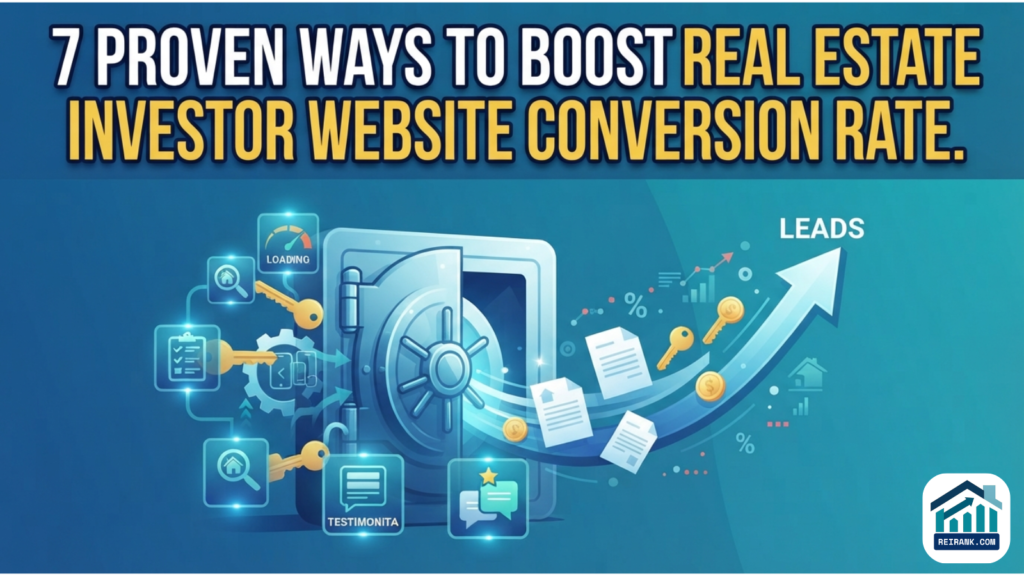
7 Proven Ways to Boost Real Estate Investor Website Conversion Rate
#1. Simplify Your Website Design and Navigation
Motivated sellers are often dealing with a stressful situation. A confusing website with too many menu options, cluttered pages, or unclear messaging adds friction at the worst possible moment. Visitors should understand within seconds what you do and how you can help them.
Keep your homepage focused on one clear message: you buy houses, in a specific area, in any condition, for cash. Remove distractions. Every extra click or unclear section is a chance for someone to leave before they reach your form.
A useful exercise is to look at your homepage as if you were a stressed homeowner seeing it for the first time. Can you tell within five seconds what the company does?
Can you find the phone number or contact form without scrolling through blocks of unrelated text? If a friend or family member cannot answer these questions quickly after glancing at your site, your visitors likely cannot either.
#2. Build Landing Pages Made for Motivated Sellers
Your homepage is not always the best place to send paid traffic. A dedicated landing page built around a specific offer, such as selling a house fast for cash in a particular city, tends to convert far better than a general website page.
These pages work because they speak directly to one type of visitor and one type of problem. A homeowner facing foreclosure has different concerns than someone who simply inherited a property they do not want.
Building separate landing pages for these situations, each with messaging that matches the visitor’s mindset, is one of the most effective ways to capture motivated seller leads without wasting ad spend on generic pages.
For example, a landing page aimed at homeowners dealing with an unwanted inherited property might focus on how simple the process is and how there is no need to clean, repair, or list the home.
A page aimed at homeowners facing foreclosure might focus more on speed and how quickly a sale can close. Matching the message to the situation, rather than using one generic page for every visitor, tends to lift conversion rates noticeably.
#3. Speed Up Your Website to Boost Conversion Rate

Page speed has a direct and measurable effect on conversion rate. If your site takes more than a few seconds to load, especially on mobile, a large portion of visitors will simply leave before they ever see your offer.
Compress images, remove unnecessary plugins, and choose reliable hosting. Test your site regularly using free tools like Google PageSpeed Insights.
A faster site is not a small technical detail. It is often the difference between a visitor filling out your form and a visitor bouncing to a competitor’s site instead.
#4. Add Trust Signals and Social Proof
Homeowners considering a cash sale are often cautious, and understandably so. They want to know they are dealing with a real, credible buyer and not a scam. Trust signals help remove that hesitation.
Include things like:
#1. Client testimonials with real names and locations.
#2. Before and after photos of properties you have purchased.
#3. Reviews from platforms like Google or the Better Business Bureau.
#4. Clear information about your company and how long you have been buying houses
These elements do not need to be flashy. They simply need to be honest and visible, so visitors feel confident enough to reach out.
It also helps to be specific rather than vague. A testimonial that says “great experience, highly recommend” carries far less weight than one that mentions a real detail, such as how quickly the offer came through or how the closing was handled without any surprises. Specific details read as more genuine, and visitors tend to trust them more than generic praise.
#5. Use Clear and Direct Calls to Action
A confusing or vague call to action is one of the most common reasons visitors leave a site without converting. Phrases like “Learn More” or “Submit” do not tell someone what happens next or why they should bother.
Instead, use direct language tied to the outcome the visitor wants, such as “Get Your Cash Offer” or “See What Your House Is Worth.” Place this call to action above the fold, and repeat it at logical points as the visitor scrolls. The goal is to make the next step obvious every single time.
Color and placement matter too, though not in the way many people assume. A button does not need to be flashy to work well. It simply needs to stand out clearly from the rest of the page and be easy to find on both desktop and mobile screens.
Testing a couple of variations of your button text and color over a few weeks can reveal which version visitors respond to more, without needing to guess.
#6. Offer Multiple Ways to Contact You to Boost Conversion Rate
Not everyone wants to fill out a form. Some sellers prefer to call. Others might feel more comfortable sending a text first. Offering a mix of contact options, including a phone number, a short form, and even a live chat option, removes barriers for people with different comfort levels.
Keep forms short. Asking for a name, phone number, and property address is often enough to get the conversation started. Every extra field you add is one more reason someone might abandon the form halfway through.
It also helps to be upfront about what happens after someone reaches out. A short line near the form, such as letting visitors know they will receive a cash offer within 24 hours, sets clear expectations and reduces the hesitation that comes from not knowing what to expect next.
#7. Follow Up Quickly and Consistently
Conversion does not end the moment someone submits a form. What happens in the minutes and days after matters just as much. Leads that are contacted within minutes convert at a significantly higher rate than those contacted hours later.
Set up automated confirmation emails or texts the moment a form is submitted, so the seller knows their information was received. Pair this with a real, personal follow-up call as soon as possible.
A strong follow-up system turns a website inquiry into an actual motivated seller lead, rather than a form that sits unanswered.
Many investors focus so much energy on getting the lead that they underinvest in what happens right after. A simple system, such as an automated text confirming receipt followed by a call within the hour, often makes the difference between a seller who chooses to work with you and one who takes the next call that comes in first.
How to Track Your Website Conversion Rate
Before making changes, it helps to know your current numbers. Without a baseline, it is hard to tell whether any of the strategies above are actually working.
A basic tracking setup does not need to be complicated. Google Analytics can show how many visitors land on your site and how many reach a thank-you page after submitting a form.
Most form builders also let you track submissions directly, and call tracking numbers can show how many visitors call instead of filling out a form.
Once you have these numbers, calculating your conversion rate is simple. Divide the number of leads by the number of visitors, then multiply by 100.
If 400 people visit your site in a month and 8 of them submit a form or call, your conversion rate is 2 percent. From there, you have a clear starting point to measure whether changes to your site are actually helping.
Checking this monthly, rather than guessing based on how busy the phone feels, gives you real data to work with. Small shifts, such as a 1 percent increase in conversion rate, can mean a meaningful jump in motivated seller leads over a full year, especially for investors running consistent traffic to their site.
Common Mistakes That Hurt Website Conversion Rates
Even well-meaning websites often make small errors that quietly push visitors away. A few of the most common ones include:
#1. Asking for too much information upfront, before a visitor has any reason to trust you yet
#2. Using stock photos that feel generic instead of real photos of purchased properties or the team
#3. Burying the phone number in a footer instead of placing it clearly at the top of the page
#4. Writing headlines focused on the company instead of the seller’s problem
#5. Sending paid traffic to a homepage instead of a page built around that specific ad or offer
None of these mistakes are dramatic on their own, but together they add friction that quietly lowers your real estate investor website conversion rate without ever showing up as an obvious red flag.
Reviewing your site with a critical eye every few months, or asking someone outside your business to look at it fresh, often reveals issues that are easy to miss when you look at the same pages every day.
Frequently Asked Questions
#1. What is a good conversion rate for a real estate investor website? There is no single number that applies to every market, but many investor websites see conversion rates somewhere between 1 and 5 percent. What matters most is tracking your own baseline and improving on it steadily, rather than comparing yourself to a number that may not reflect your specific traffic source or local market.
#2. How long does it take to see results from conversion rate changes? Some changes, such as fixing a slow-loading page or a broken form, can show results almost immediately. Others, such as testing new landing page messaging, may take a few weeks of consistent traffic before a clear pattern emerges. Patience paired with regular tracking tends to work better than making constant changes without giving each one time to show results.
#3. Should I focus on more traffic or better conversion first? If your website already receives a reasonable amount of visitors each month but very few leads, improving conversion rate is usually the faster and more affordable place to start. If your site barely gets any visitors at all, some investment in traffic may need to happen alongside conversion improvements.
Why Conversion Rate Matters More Than Traffic
Many investors assume the answer to slow lead flow is simply more traffic. Run more ads, boost more posts, spend more on SEO. But traffic without conversion is just noise.
If your site brings in 500 visitors a month and converts at 1 percent, you get 5 leads. Improve that conversion rate to 3 percent, and you get 15 leads from the same traffic, at the same cost.
For anyone focused on real estate investing lead generation, this is the leverage point that gets overlooked most often. A better converting site means every dollar spent on marketing works harder, and every visitor gets a genuine chance to become a lead.
Think about it from the seller’s side. Someone searching online for a fast way to sell their house is usually comparing a handful of options within a few minutes. They rarely read every word on a page. They scan, they judge, and they decide almost instantly whether a site feels trustworthy and easy to act on.
If your website does not answer their basic questions quickly, they move to the next result. This is why small, targeted changes to a website can have a bigger impact on lead volume than almost any other marketing decision an investor makes.
How REIRank Can Help You Boost Real Estate Investor Website Conversion Rate
Improving a real estate investor website conversion rate is rarely about one single fix. It usually comes down to combining the right design, the right messaging, and a lead generation system built specifically for how motivated sellers think and behave.
That is where a lot of investors get stuck. They know something is not working, but they are not sure which piece needs attention first.
This is exactly the kind of problem REIRank was built to solve. Instead of guessing at what might improve results, REIRank works directly with real estate investors to build websites and campaigns designed around one goal: turning visitors into real, qualified seller conversations.
From landing pages built for specific seller situations to ongoing testing that shows what is actually converting, the focus stays on results you can track and measure.
If your website is bringing in traffic but not enough real leads, it may be time for a closer look at what is happening between the click and the form submission.
Visit our services page to see how REIRank helps real estate investors build websites and lead generation systems that are built to convert, not just to look good.
Conclusion: Boost Real Estate Investor Website Conversion Rate
A high-converting website is one of the most valuable assets a real estate investor can have. It does not require a complete overhaul overnight.
Start with one or two of the strategies above, whether that is simplifying your homepage, speeding up your site, or tightening your follow-up process, and measure the impact before moving to the next.
Small, consistent improvements to boost real estate investor website conversion rate add up. Over time, they mean more motivated seller leads, more conversations, and more opportunities to close deals, all without spending an extra dollar on traffic.
If you are pouring money into ads and traffic but your phone is not ringing with seller calls, the problem is rarely the number of visitors. It is what happens after they land on your site.
To boost your real estate investor website conversion rate is often the fastest and most affordable way to grow your deal flow, because you are working with people who already showed up. You just need to give them a reason to take the next step.
This post breaks down seven practical, tested ways to turn more of your website visitors into real seller conversations, without increasing your ad spend.