

Using Facebook Groups to market to motivated sellers is one of the most consistently undervalued strategies in real estate investor social media marketing, and the investors who are doing it well in 2026 are building local trust and brand presence in ways that no paid advertising campaign can fully replicate.
While most investors are focused on Google Ads budgets and SEO rankings, a meaningful portion of the homeowners you most want to reach are spending significant time in local Facebook Groups every single day, discussing their neighborhoods, sharing community concerns, and in many cases expressing exactly the kind of property challenges that lead to a motivated seller inquiry.
The investor who shows up in those communities consistently, with genuine helpfulness and local relevance rather than obvious self-promotion, builds the kind of familiarity and credibility that makes a homeowner think of them first when the moment arrives to sell.
This guide covers seven specific, practical ways to use Facebook Groups as part of your motivated seller social media strategy in 2026, with real guidance on how to engage in a way that builds your pipeline without damaging your reputation in the communities where you want to do business.
Why Facebook Groups Work Differently Than Paid Ads for Motivated Sellers
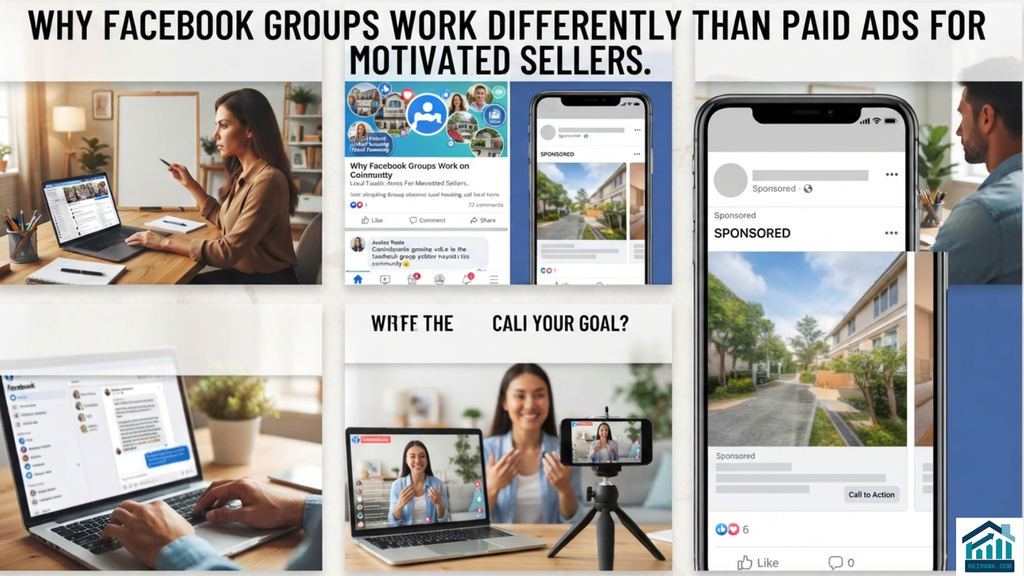
Before getting into the specific strategies, it is worth understanding the fundamental difference between Facebook Group marketing and the paid advertising approaches most investors are more familiar with. Paid ads reach people who match a demographic or behavioral profile but have no prior relationship with your business.
Facebook Group marketing reaches people who are already part of communities where trust is the currency of every interaction, and that context changes everything about how your presence there needs to be managed.
A motivated seller who encounters your investor business through a genuine, helpful comment in a local community group they have been part of for years experiences your business in a fundamentally different context than one who clicks your ad while scrolling through their feed.
The group context provides a form of social validation, because other group members can see your contributions, your consistency, and the responses you receive over time. That accumulated credibility cannot be purchased or manufactured quickly, but for investors willing to build it patiently and genuinely, it produces a quality of lead relationship that paid channels rarely match.
Real estate investor Facebook marketing through groups also works particularly well alongside SEO and paid search because it reaches motivated sellers at different stages of their decision process.
A homeowner who is three months away from needing to sell may not be searching for a cash buyer yet, but they are in your local Facebook Group. Your consistent presence there means that when they do start searching, they are not encountering you for the first time. They already know who you are.
#1: Identify and Join the Right Facebook Groups
The foundation of any effective motivated seller social media strategy on Facebook is finding and joining the groups where your target sellers are actually spending time.
Not all groups are created equal for this purpose, and investing your energy in the wrong communities produces very little regardless of how well you execute your engagement strategy.
Local neighborhood groups and community groups specific to the cities and zip codes where you buy properties are your highest-priority targets. These groups typically include a broad cross-section of local homeowners, which means your target sellers are almost certainly present even when they are not yet thinking about selling.
The conversations happening in these groups give you insight into community concerns, neighborhood developments, and the kinds of property challenges that often precede a motivated sale.
Local buy, sell, and trade groups are another valuable category, because these attract active, engaged local community members who are comfortable transacting with local businesses they discover through the group.
Estate sale groups and groups focused on local housing and real estate discussions often contain more explicitly relevant audiences, including people who are already in the process of managing properties they may need to sell.
Facebook Groups for local landlords and property managers are worth joining if you are interested in leads from tired landlords who want to exit their rental properties, as these groups frequently contain members discussing the challenges of property management in ways that signal potential motivated seller interest.
#2: Contribute Genuine Value to the Facebook Group Before Mentioning Your Business

The most common mistake real estate investors make when first joining local Facebook Groups is jumping directly into promotional content about their buying services.
This approach almost always backfires because group members recognize promotional intent immediately, and being perceived as someone who joined the group just to advertise rather than to contribute tends to result in being ignored, reported, or removed.
The right approach to using Facebook Groups to market to motivated sellers is to spend the first several weeks as a pure contributor with no promotional intent visible in any of your posts or comments.
Answer questions about property-related topics where your knowledge is genuinely useful. Share relevant local market information that helps homeowners understand what is happening with property values in their area. Comment thoughtfully on community discussions about neighborhood development, local businesses, or housing topics.
During this initial period, your goal is simply to become a recognizable, consistently helpful presence in the group. When other members start associating your name with useful information and genuine engagement, you have built the credibility foundation that makes everything you post later more effective and more trusted.
#3: Share Educational Content That Addresses Seller Pain Points
Once you have established a consistent presence through general contribution, sharing educational content specifically relevant to homeowners facing common motivated seller situations begins building a more targeted form of trust with the subset of group members who have property challenges.
Educational posts that work well in local community groups address common homeowner concerns without being promotional. A post that explains what options are available to homeowners in your state who have received a notice of default, with clear and accurate information about timelines and choices, provides genuine value to any group member in that situation while positioning you as a knowledgeable local resource.
Posts about local market trends, explained in plain language rather than investor jargon, attract engagement from homeowners who are curious about their property values and are naturally receptive to further conversation with someone who demonstrates real market knowledge.
Content about the real costs of selling through a traditional agent, covered honestly and without exaggeration, helps homeowners who have been considering listing to understand the full picture of their options.
The key in all of these posts is that the primary purpose is genuinely to inform rather than to sell. Group members can tell the difference, and content that exists primarily to educate will consistently generate more positive responses and more private messages from interested homeowners than content that uses an educational frame as a thin cover for what is really a sales pitch.
#4: Respond Privately and Thoughtfully to Relevant Posts in the Facebook groups
One of the highest-converting activities available in real estate investor Facebook marketing through groups is monitoring group posts for homeowners expressing property challenges and responding with genuine, specific helpfulness.
A homeowner who posts asking what to do with a house that needs major repairs before selling, or who mentions being overwhelmed by managing a property inherited from a parent, is expressing exactly the kind of situation that produces motivated sellers.
The right way to engage with these posts is through a public comment that addresses their question directly and helpfully, without any mention of your buying services in the comment itself. The comment should provide genuinely useful information that helps them understand their situation better, which establishes your credibility and expertise publicly.
After leaving a helpful public comment, sending a brief, thoughtful private message that acknowledges their situation, references the specific concern they mentioned, and offers to have a no-pressure conversation about their options can be appropriate in many cases.
The tone of this private message should be consultative and human rather than transactional, because the homeowner is in a potentially stressful situation and needs to feel that you are interested in helping them rather than just acquiring a deal.
#5: Create and Run Your Own Local Facebook Group
Beyond participating in existing groups, creating and moderating your own local Facebook Group gives you a platform with considerably more control and considerably more visibility than contributing to groups you do not own.
A well-run local real estate information group for homeowners in your target market positions you as the host and authority from the beginning rather than a participant working to establish credibility within someone else’s community.
The group should be designed to serve genuine informational needs of local homeowners rather than to function as a lead generation platform dressed up as a community.
A group titled something like “[Your City] Homeowner Resource Group” or “[Your City] Real Estate Q&A” that consistently delivers useful content, hosts relevant discussions, and answers member questions builds a genuinely valuable community that grows organically as members invite neighbors and friends.
Your role as the group owner and consistent contributor naturally establishes you as the local expert, and when members have property challenges or know someone who does, you are the person they think of first.
This organic positioning through community leadership is one of the most durable forms of motivated seller social media strategy available, and the group itself becomes a growing asset rather than a channel requiring continuous paid investment.
#6: Use Facebook Live in Groups to Build Personal Connection
Facebook Live video within groups is a particularly powerful tool for building the personal familiarity that motivates homeowners to reach out to you specifically rather than a competitor they found through an ad.
A motivated seller choosing between two investors they have never met will default to the one whose name and face they recognize, and regular live video in the communities you serve creates that recognition at scale.
Live sessions do not need to be elaborate productions. A ten- to fifteen-minute live from your car or your office discussing what is happening in the local real estate market, answering common homeowner questions, or walking through a property transformation after an acquisition gives group members a genuine, personal window into who you are and how you think. That authenticity is something no ad creative or web page can fully replicate.
Scheduling regular live sessions, such as a monthly market update or a weekly Q&A where members can ask property-related questions, gives your audience a reason to watch consistently and builds the habitual familiarity that is the foundation of top-of-mind brand awareness.
#7: Follow Facebook Group Rules and Maintain Long-Term Presence
Every Facebook Group has its own rules about promotional content, business advertising, and the kinds of posts that are allowed. Violating these rules, even once with a promotional post in a group that prohibits them, can result in removal from the group and the permanent loss of all the credibility you have built there.
Reading and respecting the specific rules of every group you participate in is not just good manners. It is a fundamental requirement for maintaining the long-term presence that makes Facebook Group marketing effective.
Real estate investor Facebook marketing through groups is a long-term strategy that produces compounding results over time rather than immediate conversions from initial participation.
Investors who approach it with patience, genuine community contribution, and consistent presence over months and years build local authority that no competitor who abandons the strategy after a few weeks of participation can replicate or displace.
How Reirank.com Helps Investors Build a Complete Motivated Seller Marketing System
Our Approach to Social and Digital Marketing for Investors
Facebook Group marketing works most effectively when it is integrated into a broader digital marketing system rather than operating as a standalone channel.
A homeowner who encounters you in a local Facebook Group will almost certainly search your name or your business online before reaching out, and what they find when they search- your website, your Google reviews, and your online content- either reinforces the credibility you have built in the group or undermines it.
Reirank.com helps real estate investors build the complete digital infrastructure that makes every marketing channel, including Facebook Group engagement, more effective.
Our services include SEO-optimized website development that ensures homeowners who search for your business find a credible, professional, conversion-optimized presence.
Local SEO and Google Business Profile management ensure you appear prominently in the local searches that follow a group member’s offline encounter with your brand.
Content strategy and production support your Facebook Group contribution with a library of genuinely useful, locally specific content you can share consistently.
Frequently Asked Questions About Facebook Group Marketing for Investors
How many groups should a real estate investor actively participate in? The quality of participation matters far more than the quantity of group memberships. Active, consistent, genuinely helpful participation in five to ten strategically chosen local groups yields significantly better results than passive membership in fifty groups, where your activity is occasional and surface-level.
How long before Facebook Group marketing produces motivated seller leads? Most investors who commit to consistent, genuine participation for ninety days or more begin seeing direct inquiries from group members or referrals from members who know someone with a property challenge. The timeline varies based on group size, your posting consistency, and the quality of the content and engagement you contribute.
Is Facebook Group marketing compliant with Facebook’s terms of service? Genuine community participation that prioritizes value for group members over direct promotional activity is fully compliant. Direct solicitation of business within groups that prohibit promotion, mass group spamming, or creating fake profiles to amplify your presence violates Facebook’s terms and should be avoided entirely.
Can Facebook Group marketing replace paid advertising for motivated seller leads? For most investors, Facebook Group marketing works best as a complementary channel alongside rather than a replacement for paid advertising and SEO. It excels at building local trust and capturing leads from homeowners in the early stages of their decision-making process, while paid search captures high-intent searchers who are ready to act immediately.
Visit our services page today to explore Reirank.com’s complete range of real estate investor digital marketing and lead generation services. Your free consultation is the starting point for building a complete marketing system where your Facebook Group presence, your website, your local SEO, and your paid campaigns all work together to build a consistent motivated seller pipeline.
Real Journeys, Real Results with real clients
Every client that walks through REIRAN’s door brings a different story — different goals, different obstacles, different definitions of success. What we love most about this work is getting to walk alongside them through it: the strategy sessions, the pivots, the breakthroughs nobody saw coming.
What makes these journeys work isn’t a one-size-fits-all playbook. It’s the way we tailor our approach to each professional’s unique situation — listening first, adapting constantly, and staying in the trenches with our clients until the results speak for themselves.
Curious what that looks like in practice?
Explore our case studies to see how we’ve helped professionals like you navigate their toughest challenges and come out stronger on the other side.
👉 [Read Our Case Studies Here]
Conclusion: Facebook Groups to market to motivated sellers
Using Facebook Groups to market to motivated sellers is one of the most genuinely relationship-driven strategies available to real estate investors who are willing to invest in a channel that rewards patience, consistency, and authentic community contribution over quick promotional wins.
The seven strategies covered in this guide, from joining the right groups and contributing genuine value through creating your own group, using live video, and engaging privately with homeowners expressing property challenges, give you a practical framework for building local authority in the communities where your target sellers are already spending time.
Real estate investor Facebook marketing through groups produces the kind of trust and familiarity that makes a homeowner choose to reach out to you specifically when they are ready to sell, rather than treating you as interchangeable with every other investor whose ad they have seen.
That differentiation is genuinely valuable in a competitive market, and building it through a consistent, motivated-seller social media strategy is something your competitors who rely exclusively on paid channels cannot easily replicate.
Visit Reirank.com today to start building the complete digital marketing presence that makes your Facebook Group efforts more effective and your overall motivated seller pipeline more consistent.