

If you run a real estate investing business, you already know ranking on Google is no longer optional. Sellers, wholesalers, and buyers are searching online before they call anyone.
One of the most overlooked pieces of that puzzle is building quality backlinks for real estate investors. Without them, even the best content on your site can sit buried on page five, invisible to the motivated sellers who need to find you.
This guide explains what backlinks do for your business, what makes a backlink worth chasing, and a practical process you can follow to earn links that move your rankings and lead flow.
How Backlinks Matter for Your Real Estate Investing Business
A backlink is simply a link from another website pointing to yours. Google treats these links as votes of confidence. When a respected site links to your page, search engines read that as a signal that your content is trustworthy and worth showing to searchers.
For anyone doing real estate investor website SEO, this matters more than most people realize. The real estate investing space is competitive. Thousands of investors, agents, and wholesalers are all fighting for the same keywords like “sell my house fast” or “we buy houses in cash.” Content alone will not win that fight.
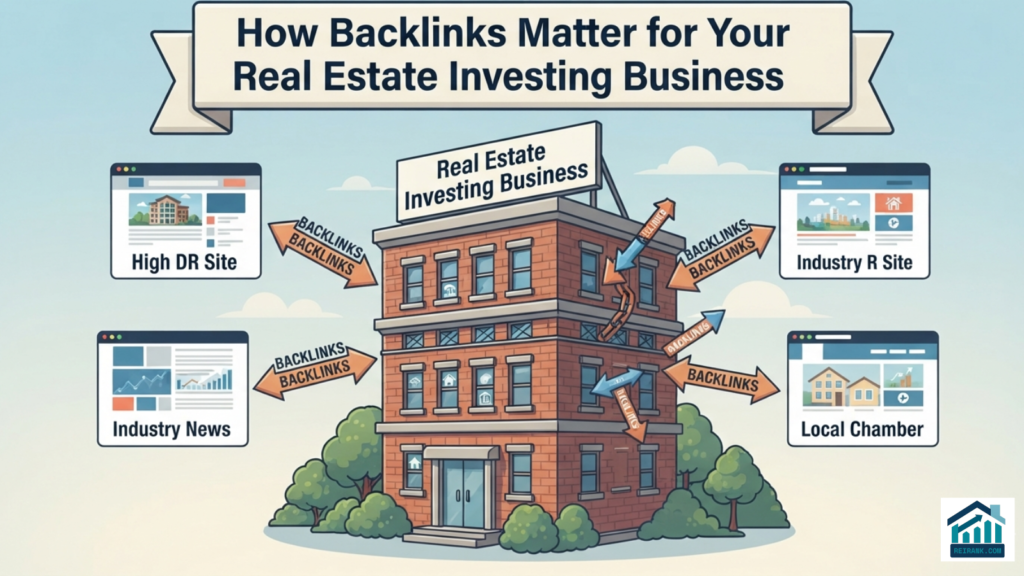
You need authority, and authority is built largely through links. Here is what strong backlinks can do for your business.
#1. Improve your rankings for local and national search terms. When multiple relevant sites link to your pages, search engines start to see your domain as a credible source on real estate investing topics.
This shows up in better positions for both city-specific searches like “sell my house fast in Dallas” and broader national terms. Investors who rely only on content, without any link building, often plateau on page two or three no matter how much they publish.
#2. Send direct referral traffic from other websites. Backlinks are not only useful for rankings. A link placed on a well-read blog, local news site, or partner page brings people directly to your site who are already interested in the topic.
This traffic tends to convert well because it arrives with context; for example, someone reading about selling a distressed property is far more likely to click through and reach out than a random visitor.
#3. Build trust with search engines and with potential sellers. Trust works on two levels here. Search engines use backlinks as one of the strongest signals for determining whether a site is reliable and worth ranking. At the same time, human visitors form their own impressions.
If someone finds your site mentioned or linked from a local news outlet or an established real estate resource, it adds credibility before they even speak with you.
#4. Help newer pages get indexed and ranked faster. Brand-new pages on your site can go unnoticed for weeks if nothing points to them. A link from an already established, well-indexed site gives search engines a faster path to discover and crawl your new content.
This is especially useful when you launch a new city page, a new landing page for a specific seller situation, or a fresh blog post you want to start ranking quickly.
#5. Strengthen your domain so future content ranks quicker. Backlinks do not just help the specific page they point to. Over time, a growing collection of quality links raises your domain’s overall authority.
This means that new pages you publish later benefit from that accumulated trust and tend to rank faster than they would on a domain with little to no backlink history. In this sense, every quality link you earn today makes tomorrow’s content marketing easier.
Without a steady link-building strategy for real estate investors, your site competes on content alone, and that is rarely enough in a crowded market.
What Makes a Backlink Actually Worth Having
Not every link helps. Some can hurt you. Before chasing links, it helps to understand what separates a valuable backlink from a wasted one.

#1. Relevance. A link from a real estate blog, a local news site, or a home improvement resource carries more weight than a random, unrelated website. Search engines look at context, not just quantity.
#2. Authority. Sites with real traffic, real content, and a solid reputation pass more value than thin or spammy sites. A single link from a respected local publication can outperform fifty links from low-quality directories.
#3. Placement. A link inside the body of an article, surrounded by relevant text, is worth far more than a link buried in a footer or sidebar.
#4. Anchor text. The clickable text used for the link should read naturally. Overusing exact match phrases like “cash home buyers” in every link can look manipulative to search engines and may trigger penalties.
#5. Follow status. Dofollow links pass ranking value directly. Nofollow links still bring traffic and visibility, but they do not pass the same SEO weight. A healthy backlink profile includes a mix of both, earned naturally over time.
Keeping these factors in mind protects you from a common mistake: chasing volume instead of value. Ten strong, relevant links will do more for your rankings than two hundred weak ones.
Where Real Estate Investors Can Realistically Earn Backlinks
Now that you know what to look for, here are the channels that consistently work for real estate investors to build backlinks.
#1. Local Business Directories and Citations
Sites like the Better Business Bureau, Chamber of Commerce listings, and local real estate association directories are often underused. These citations are usually easy to get and build trust in your domain, especially if you serve a specific city or region.
#2. Guest Posting on Real Estate and Finance Blogs
Writing a genuinely useful article for a real estate blog, personal finance site, or home improvement publication is one of the most reliable ways to earn a relevant, contextual link. The key is to offer real value to their readers, not just insert a link. Editors can tell the difference, and so can Google.
#3. HARO and Journalist Outreach
Reporters covering housing markets, foreclosure trends, or local economic news often look for expert sources. Responding with a thoughtful, specific answer can land you a link from a major news outlet, something that is very difficult to buy or fake.
#4. Partnering With Local Vendors and Service Providers
Title companies, contractors, moving companies, and property managers often maintain resource pages or blogs. Building genuine working relationships with these businesses can lead to natural mentions and links, especially if you refer clients to each other.
#5. Publishing Original Data or Local Market Reports
Investors who publish their own research, such as a report on cash sale trends in their market or average days on market for distressed properties, tend to attract links naturally. Journalists, bloggers, and other investors prefer original numbers over repeating someone else’s claims.
#6. Testimonials and Case Study Features
Many software companies, lenders, and service providers feature customer testimonials with a link back to the customer’s site. If you use tools for lead generation, CRM, or direct mail, offering a genuine testimonial can be a simple, low-effort way to earn a quality link.
#7. Broken Link Building
This involves finding dead links on real estate resource pages and offering your own relevant content as a replacement. Site owners often appreciate the heads-up about a broken link, and many will happily swap it for a working resource, especially if your content fits well.
#8. Social Media
Social media platforms and paid ads do not hand you backlinks directly. Most links shared on Facebook, LinkedIn, or Instagram are nofollow, so they don’t pass the same ranking value as a link from a blog or news site.
Their real value lies in something less obvious: they help your content get seen by the people who are in a position to link to it.
When you publish a local market report, a helpful guide for sellers, or original research, sharing it across your social channels puts it in front of local journalists, other investors, bloggers, and industry groups who might otherwise never see it.
If that content is genuinely useful, some of those people will reference it or link to it from their own site or newsletter. The social post itself is not the backlink; it is the delivery system that gets your content into the right hands.
#9. Paid Ads
Paid ads work like social media to Amplify Link-Worthy Content, just with a wider, faster reach. Running a small budget campaign on Facebook or Google to promote a strong piece of content, such as a data-driven report on cash sale trends in your market, can put it in front of local reporters, real estate bloggers, and community group admins who would never have found it organically.
A few of those views can turn into genuine mentions or links, especially if the content offers something they cannot easily find elsewhere.
This approach only works when the content is worth linking to in the first place. Paying to promote a generic blog post rarely leads to backlinks.
Paying to promote something with real, specific value, like local statistics, a case study, or a guide that answers a question sellers are actively searching for, gives you a much better chance of turning that visibility into an actual link.
It is also worth being clear that paying a site directly for a placed link, as opposed to promoting your own content through ads, is against Google’s guidelines and can put your rankings at risk rather than help them
Each channel reflects different intent, and mixing them keeps your backlink profile natural rather than repetitive.
Step-by-Step Process for Building Backlinks Effectively
Knowing the channels is one thing. Executing consistently is where most investors fall behind. Here is a practical process to follow.
Step 1: Audit your current backlink profile. Before building new links, understand what you already have. Use a tool like Ahrefs, Semrush, or Google Search Console to see which domains link to you, which pages they point to, and whether any links look spammy or harmful.
Step 2: Set clear, realistic goals. Decide how many quality links you want per month and which pages need them most. Your homepage, your “sell my house fast” landing page, and your city-specific pages are usually the priority.
Step 3: Build a target list of relevant sites. Research blogs, local publications, directories, and service providers in your niche and area. Prioritize sites with genuine traffic and relevant content over sites that simply accept any submission.
Step 4: Create content worth linking to. This might be a local market report, a helpful guide for sellers facing foreclosure, or a comparison of selling options. Content built specifically to attract links performs far better than generic blog posts.
Step 5: Send a personal, specific pitch. Generic mass emails rarely work. Reference the site’s existing content, explain why your resource fits, and keep the message short and genuine.
Step 6: Track results and follow up. Keep a simple spreadsheet of outreach sent, responses received, and links secured. A polite follow-up after a week often makes the difference between a yes and silence.
Step 7: Monitor your backlink profile regularly. Link building is not a one-time project. Check new links monthly, and disavow any harmful or spammy links to protect your domain’s health.
Following this process consistently, month after month, is what separates investors who rank consistently from those who plateau after a few quick wins.
How Reirank.com Fits Into Your Link Building Strategy to Build Backlinks for Real Estate Investors
Doing all of this manually, on top of running an actual investing business, is a lot to manage. That’s where Reirank.com comes in.
Reirank.com specializes in digital marketing built specifically for real estate investors and wholesalers, not generic small businesses. That focus matters because real estate investor website SEO requires understanding seller intent, local market dynamics, and the content that actually earns links in this niche.
Reirank.com’s team handles the research, outreach, and relationship-building needed to secure relevant, high-quality backlinks, so investors can stay focused on closing deals instead of chasing link prospects.
From auditing your current backlink profile to identifying realistic opportunities and executing outreach at scale, we apply the same care outlined above, tailored to the real estate investing niche.
Frequently Asked Questions
How many backlinks does a real estate investor website need to rank well? There is no fixed number. Quality and relevance matter far more than volume. A smaller number of strong, relevant links will usually outperform a large batch of weak or unrelated ones.
How long does it take to see results from backlink building? Most investors start noticing ranking movement within two to four months of consistent, quality link building. SEO is a gradual process, and results tend to compound over time rather than appear overnight.
Are paid backlinks safe to use? Buying links designed to manipulate rankings violates Google’s guidelines and can lead to penalties. Sponsorships, partnerships, and genuine collaborations are a safer and more sustainable path.
Can local citations really help my rankings? Yes. Local citations help confirm your business information across the web and support local search visibility, especially for investors targeting specific cities or regions.
Should I focus on backlinks or content first? Both work together. Strong content gives other sites a reason to link to you, and backlinks help that content actually get found and ranked. Neglecting either one limits your results.
START WITH A FREE CONSULTATION TODAY
Conclusion: Ways to Build Backlinks for Real Estate Investors
Building quality backlinks for real estate investors isn’t a quick fix, and anyone promising instant rankings isn’t being honest. It is a steady process built on relevance, genuine outreach, and useful content.
Investors who commit to this process consistently tend to see stronger rankings, more organic traffic, and ultimately more inbound seller leads over time.
If your website has been stuck at the same rankings for months despite regular content, the missing piece is often your backlink profile, not your content. This is a common pain point for investors who write great blog posts but never see the traffic to match.
See how Reirank.com approaches digital marketing and lead generation for real estate investors, from SEO and content to paid lead generation.
You can also see real results from other investors and wholesalers in our case studies, where we walk through the process, the challenges they faced, and how they scaled with a stronger online presence.