

Buying motivated seller leads or generating your own is one of the biggest decisions a real estate investor makes, and it matters more every year.
Marketing costs keep climbing, competition for off-market deals keeps growing, and compliance rules around calling and texting homeowners keep changing.
As you plan for 2027, the question isn’t just “Which method gets me leads?” It’s “Which method gets me signed contracts at the lowest true cost?”
That’s the number that matters: cost per contract. Cost per lead can look attractive on paper and still hide a very expensive path to a deal. A cheap lead that never converts costs far more than a pricier lead that becomes a signed agreement.
In this guide, we’ll compare buying motivated seller leads with generating your own through cold calling, direct mail, texting, pay-per-click ads, and SEO.
We’ll walk through how to calculate your true cost per contract, uncover the hidden costs most investors overlook, and help you decide which approach, or which mix, makes the most sense for your business in 2027.
Why Cost Per Contract Is the Only Number That Matters
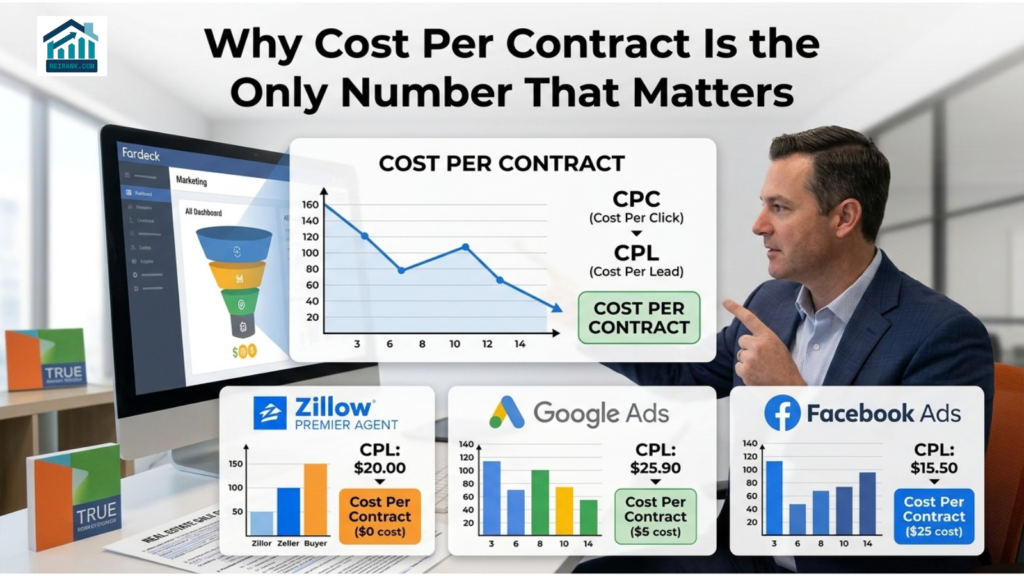
Many investors judge their marketing by cost per lead, because it’s the easiest number to see. If a direct mail campaign produces a lead for $50 and a purchased lead costs $250, the mail campaign looks like the clear winner. But that comparison leaves out everything that happens between the lead and the contract.
A lead from a mail campaign may be a curious homeowner who wants a retail price and has no timeline. A purchased, pre-qualified lead may be an owner who has already explained their motivation, timeline, property condition, and price expectations.
If you need forty of the first kind to sign one contract but only eight of the second kind, the “expensive” lead may be the cheaper path to a deal.
The formula is simple: total cost divided by the number of signed contracts equals your cost per contract. The challenge is making sure “total cost” includes everything.
That means data, software, marketing spend, labor, management time, training, and the opportunity cost of hours spent prospecting instead of negotiating. When investors compare buying motivated seller leads with generating their own using this full-cost view, the results often surprise them.
The True Cost of Generating Your Own Motivated Seller Leads
Generating your own leads gives you control, pipeline ownership, and the ability to build a long-term marketing asset. It also comes with costs that go far beyond the obvious marketing spend. Let’s look at the most common channels.

#Cold Calling
Cold calling is one of the most popular ways to generate motivated seller leads because the upfront costs seem low. You need property data, skip tracing, a dialer, a CRM, and people to make the calls. On paper, that might look like a few hundred dollars a month for data and software.
In practice, labor is the real cost. Even with a good list, it can take hundreds or thousands of dials to reach a small number of owners willing to talk, and only a fraction of those will be motivated.
Whether you make the calls yourself or hire callers, someone is paying for those hours. Hiring adds costs, from recruiting and training to managing performance and replacing callers who leave.
Cold calling also carries compliance responsibilities, including Do Not Call scrubbing and compliance with the Telephone Consumer Protection Act, which may require legal guidance and additional tools.
#Direct Mail
Direct mail remains a reliable channel for many investors, especially for reaching older homeowners and absentee owners who don’t answer unknown calls.
The costs include data, printing, postage, and often a mail house or design service. Because direct mail response rates are usually low, successful campaigns depend on volume and repetition. Many investors find they need to mail the same owners several times before they respond.
That means direct mail needs a patient budget. A campaign may take months to reach its full potential, and someone on your team still has to answer each response, qualify it, and follow up.
#Text Message Marketing
Texting can generate fast responses at a low cost per message, making it attractive to many investors. However, carriers have tightened filtering and registration requirements for business texting, and the legal rules around texting consumers are strict.
Messages may be blocked, numbers may be flagged, and campaigns that ignore consent rules can create serious legal risk. As you plan for 2027, treat texting as a channel that requires careful compliance planning, not a cheap shortcut.
#Pay-Per-Click Advertising
Pay-per-click ads on search engines and social media bring in inbound leads, meaning homeowners who search for phrases like “sell my house fast” and reach out to you. Inbound leads often have higher intent than outbound leads, because the seller started the conversation. The trade-off is cost.
Competitive keywords in many markets are expensive, and costs have risen as more investors compete for the same searches.
You’ll also need a well-built landing page, ongoing campaign management, and fast follow-up, because inbound sellers often contact several investors at once.
#SEO and Organic Content
A website that ranks for seller-focused searches can become one of your most cost-effective lead sources over time. The downside is time.
SEO often takes many months, sometimes a year or more, to produce a steady flow of leads, and it requires ongoing investment in content, technical upkeep, and link building. It’s a strong long-term asset, but rarely a quick answer for investors who need deals this quarter.
The Hidden Costs of Generating Your Own Leads
Across every channel, generating your own leads carries costs that rarely appear on a marketing invoice. The biggest is your own time.
Every hour you spend pulling lists, managing callers, tweaking ads, or answering unqualified calls is an hour you aren’t spending on negotiation, dispositions, or growing your business.
There’s also the ramp-up period, since most channels need weeks or months of testing before they perform well. And there’s the learning curve. Many investors spend a lot on campaigns that don’t work before they find the right combination.
The True Cost of Buying Motivated Seller Leads
Buying motivated seller leads shifts much of the prospecting work to a specialized provider. Instead of building your own marketing machine, you pay for leads that have already been generated and, in the best cases, verified and pre-qualified.
The price per lead is usually higher than the cost per lead from your own campaigns. That’s because you’re paying for the provider’s data, marketing, callers, technology, qualification process, and compliance systems.
But you’re also skipping much of the labor, ramp-up time, and trial and error that come with doing it yourself.
The value of buying motivated seller leads depends heavily on quality. A cheap, shared lead sold to five other investors may cost less upfront but convert poorly because the seller is flooded with calls.
An exclusive, pre-qualified lead that includes the seller’s motivation, timeline, property condition, and price expectations costs more but often converts at a much higher rate. When comparing providers, always look past the price per lead and ask what you’re getting for that price.
There are costs on your side as well. Someone on your team still needs to follow up quickly, build rapport, make offers, and negotiate. Buying motivated seller leads removes much of the prospecting work, but it doesn’t replace strong acquisition skills.
Cost Per Contract Compared: A Sample 2027 Scenario
To make the comparison concrete, let’s walk through a simplified, hypothetical example. These numbers are for illustration only. Actual costs and conversion rates vary widely by market, provider, team skill, and lead type, so plug in your own figures to get an accurate picture.
Imagine an investor who builds an in-house cold calling operation. Each month, they spend about $500 on property data and skip tracing, $400 on dialer and CRM software, and $2,400 on two part-time callers.
That’s $3,300 in direct costs. Add roughly twenty hours of the investor’s own time spent managing callers, reviewing leads, and following up.
If you value that time at $50 an hour, that’s another $1,000, bringing the true monthly cost to about $4,300. If this operation produces one signed contract a month, the cost per contract is about $4,300.
If it produces two, it drops to about $2,150. If it produces none during the ramp-up months, the cost per contract for that period is effectively the entire spend.
Now imagine the same investor spends money buying motivated seller leads instead. Say they buy twenty pre-qualified leads at $250 each, for a total of $5,000.
Because much of the prospecting work is already done, the investor spends about ten hours following up, valued at $500. The true monthly cost is $5,500.
If the investor converts two of those twenty leads into contracts, the cost per contract is $2,750. If they convert three, it drops to about $1,833.
In this example, the two approaches land in a similar range. The difference comes from consistency, speed, and risk. The in-house operation may become cheaper once it’s fully tuned, but it carries more upfront risk, more management work, and a longer ramp-up.
Buying motivated seller leads offers a more predictable path to contracts from the first month, with less time spent on prospecting.
The key takeaway is that neither option is automatically cheaper. Your true cost per contract depends on your market, your lead-conversion skills, the quality of your data or provider, and how much your time is worth.
Factors That Will Shape Lead Costs in 2027
Several trends will likely affect the cost of buying and generating motivated seller leads in 2027.
The first is competition. As more investors, iBuyers, and wholesalers target the same off-market sellers, marketing channels become more crowded, and homeowners grow more selective about who they respond to.
The second is compliance. Rules around calling and texting consumers keep changing, and carriers keep tightening filters for business messaging.
Investors who generate their own leads need to budget for compliance tools and legal advice, while those buying motivated seller leads should ask how providers handle consent and Do Not Call scrubbing.
The third is technology. AI-powered dialers, lead scoring tools, and automated follow-up systems can lower the cost of generating your own leads, but they also require setup, subscriptions, and careful oversight.
The fourth is advertising costs, which have generally trended upward for competitive real estate keywords. These factors make accurate cost-per-contract tracking more important than ever.
When Buying Motivated Seller Leads Makes the Most Sense
Buying motivated seller leads is often the smarter choice for investors who value time and predictability. If you’re just starting and don’t yet have the systems, staff, or budget to run several marketing channels, purchased leads let you start having real seller conversations immediately.
If you’re an experienced investor who excels at negotiating but doesn’t want to manage callers and campaigns, buying leads lets you focus on your strengths.
It also makes sense when you’re expanding into a new market. Building a marketing presence in a new city can take months, while a provider that already operates there can deliver leads right away.
Finally, buying motivated seller leads helps when you need to fill pipeline gaps during slow months or while your own marketing is still ramping up.
When Generating Your Own Leads Makes the Most Sense
Generating your own leads often makes the most sense for investors with established teams, strong systems, and a long-term outlook. If you already have trained callers, a proven mail program, or a website that ranks well, your cost per contract may be very competitive.
Owning your marketing also builds a long-term asset. Your database of past contacts, your brand recognition, and your search rankings all grow in value over time.
In-house generation also gives you full control over your market, messaging, and follow-up. You decide which neighborhoods to target, which lists to use, and how often to reach out, which can be a real advantage in highly competitive areas.
The Hybrid Approach: Getting the Best of Both
For many investors heading into 2027, the most effective strategy is a combination. Buying motivated seller leads provides a steady flow of ready-to-talk sellers and predictable deal volume, while in-house marketing builds a long-term pipeline and brand.
The two approaches support each other. Purchased leads keep revenue coming in while your own campaigns ramp up, and your own campaigns reduce your reliance on any single source.
The key to making a hybrid strategy work is tracking. Record every cost, lead source, and contract, then calculate cost per contract for each channel monthly. Over time, you’ll see which sources give you the best return and can shift your budget to match.
Get Predictable Deal Flow Without the Guesswork with reirnk.com
If you’re tired of pouring money into campaigns that take months to pay off, buying motivated seller leads from a trusted provider can give your business a faster, more predictable path to signed contracts.
Our team delivers verified, pre-qualified sellers with the notes and details you need to open every conversation with confidence, so you can spend less time prospecting and more time closing.
Explore Our Motivated Seller Lead Service to see how ready-to-talk sellers can be delivered straight to your CRM.
Not sure whether buying leads, generating your own, or a hybrid approach is right for your business? Schedule a free, no-obligation consultation with our team.
We’ll review your market, budget, current lead sources, and goals, then help you estimate your cost per contract and build a strategy that fits. Book Your Free Consultation
Want to see how other investors have improved their results? Our case studies show how wholesalers and investors have used our leads, on their own and alongside their in-house marketing, to lower their cost per contract and grow their deal flow. View Our Case Studies
Is buying motivated seller leads worth it?
For many investors, yes, especially those who value time, want predictable results or don’t yet have an in-house marketing team.
The value depends on lead quality. Exclusive, verified, and pre-qualified leads usually deliver a much better return than cheap, shared, or unverified leads.
How do I calculate cost per contract?
Add up everything you spent to produce leads over a set period, including marketing, data, software, labor and the value of your own time.
Then divide that total by the number of signed contracts during the same period. This gives you a true cost per contract you can compare across channels.
Is it cheaper to generate my own motivated seller leads?
It can be, but not always. In-house lead generation often has a lower cost per lead, but once you factor in labor, software, ramp-up time, and lower conversion rates, the cost per contract can match or exceed buying motivated seller leads. Tracking your real numbers is the only way to know for sure.
What should I look for when buying motivated seller leads?
Look for providers that verify contact details and ownership, pre-qualify seller motivation through real conversations, offer exclusive or limited-share leads, scrub against Do Not Call lists, and provide a clear replacement policy for invalid leads. Asking for sample call recordings and case studies is also a smart step.
How long does it take to see results from generating my own leads?
It varies by channel. Cold calling and texting can produce conversations within days, though it may take weeks to refine your process.
Direct mail often needs several months of repeated mailings. Pay-per-click can generate leads quickly but requires ongoing testing, while SEO often takes months to build momentum.
Can I combine buying leads with my own marketing?
Yes, and many successful investors do. Buying motivated seller leads provides immediate deal flow, while in-house marketing builds a long-term pipeline. Tracking the cost per contract for each source helps you balance your budget over time.
Conclusion: Buying motivated seller leads
The debate between buying motivated seller leads and generating your own doesn’t have a one-size-fits-all answer. Generating your own leads gives you control, ownership, and a long-term marketing asset, but it demands time, systems, compliance planning, and patience.
Buying motivated seller leads offers speed, predictability, and less prospecting work, but its value depends entirely on the provider’s quality.
The smartest investors in 2027 will stop comparing cost per lead and start comparing cost per contract. When you include every expense and every hour, you’ll clearly see which approach, or blend, gives your business the strongest return.
Ready to find out what your cost per contract could look like with verified, pre-qualified sellers? Get started with our lead service or book your free consultation today.