

Pay-per-lead real estate marketplaces promise what every investor wants: motivated sellers delivered to your inbox without you having to build a marketing machine. You pay only when a lead shows up. On paper, that sounds like the safest way to buy deal flow.
In practice, the price on the sales page rarely matches what a deal ends up costing. One marketplace sells a “$45 lead” that five other investors also receive. Another charges $350 for an exclusive, phone-verified seller. Both call their product a “verified lead.”
This guide breaks down how pay-per-lead real estate marketplaces actually work. You’ll learn the common pricing tiers, what exclusivity really means, and how to calculate what a verified lead costs once you factor in conversion rates.
By the end, you’ll know how to compare vendors and when it makes more sense to build your own lead engine with local SEO for real estate investors.
What Are Pay-Per-Lead Real Estate Marketplaces?
A pay-per-lead real estate marketplace generates homeowner inquiries and sells them to investors, wholesalers, and cash buyers. Instead of paying a monthly retainer or ad budget, you pay a set price for each lead that matches your filters.
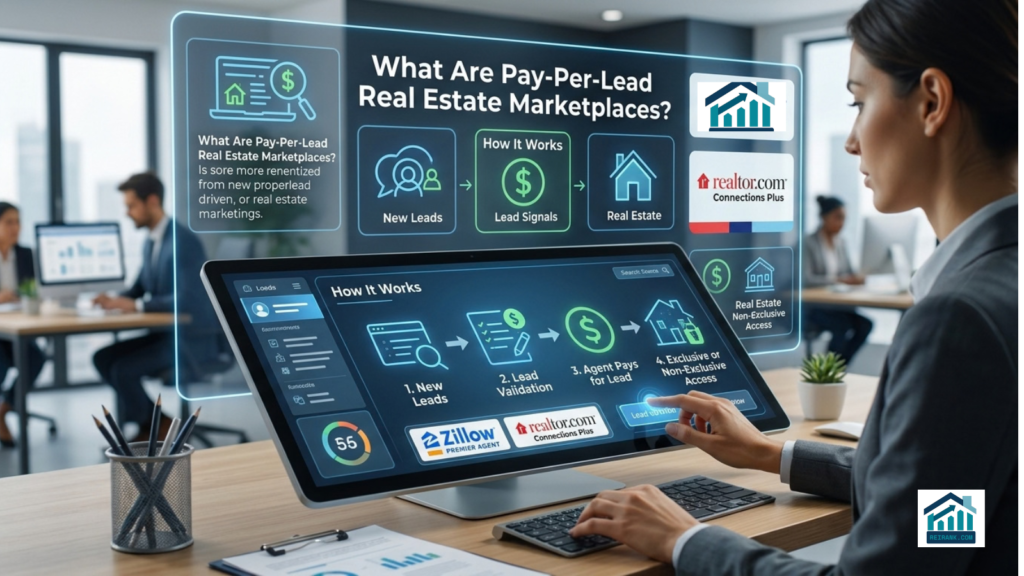
How the model works
#1. The marketplace runs the ads. Most vendors use Google Ads, Facebook, direct mail, or a network of “we buy houses” websites to attract sellers.
#2. Sellers fill out a form or call. The homeowner shares an address, condition, timeline, and sometimes an asking price.
#3. The lead gets filtered and scored. Better platforms check phone numbers, remove duplicates, and confirm the seller actually owns the property.
#4. The lead is sold. It goes to one buyer (exclusive) or to several buyers at once (shared).
#5. You get billed. Charges happen per lead, per appointment, or sometimes per closed deal.
Who uses these platforms?
New investors like pay-per-lead real estate services because they skip the learning curve of running ads. Established operators use them to fill gaps in their pipeline or test a new market before committing to a full marketing budget.
The catch is that you rent the lead source. When you stop paying, the leads stop. That trade-off matters a lot once we get into real costs.
Pay-Per-Lead Real Estate Pricing Tiers
Most pay-per-lead real estate marketplaces sort their inventory into four tiers. The higher the tier, the more filtering and exclusivity you get, and the more you pay.
| Tier | What you get | Typical price per lead (approx.) | Buyers per lead |
|---|---|---|---|
| Shared (raw) | Form fill with name, phone, address | $20–$80 | 3–6 investors |
| Semi-exclusive | Light verification, limited sharing | $80–$150 | 2–3 investors |
| Exclusive | Sold to one buyer only, basic phone check | $150–$350 | 1 investor |
| Verified / appointment-set | Seller spoken to, motivation and timeline confirmed, call booked | $250–$600+ | 1 investor |
Price ranges are approximate industry figures and vary widely by market, property type, and vendor. Always confirm current pricing with each marketplace.
#1. Shared leads
Shared leads are the cheapest entry point in real estate lead pricing. The same seller is sent to several investors, so speed-to-lead decides who wins. If you can’t call back in under five minutes, shared leads rarely pay off.
#2. Semi-exclusive leads
These cap the number of buyers, usually at two or three. You get less competition than a shared lead, but you still aren’t the only offer the seller hears.
#3. Exclusive leads
Exclusive real estate leads go to you alone for a set period, often 30 to 90 days. You pay more, but you control the conversation and follow-up.
#4. Verified and appointment-set leads
This is the premium tier. A call center or inside sales rep talks to the homeowner, confirms ownership, condition, motivation, and price expectations, and then books a call or appointment with you. It’s the closest thing to a warm hand-off in the pay-per-lead real estate world.
Other pricing models you’ll see
#1. Monthly lead packages: a fixed number of leads for a flat fee, often with a minimum commitment.
#2. Pay-per-call: you pay when a seller call lasts past a set time, such as 90 seconds.
#3. Pay-at-closing or revenue share: a percentage of your assignment fee or profit, typically charged only when the deal closes.
Exclusivity Explained: Shared vs Exclusive Real Estate Leads
Exclusivity is the single biggest driver of price in pay-per-lead real estate. It also has the biggest effect on your close rate.

Why shared leads convert poorly
When a motivated seller submits one form and gets five calls in ten minutes, two things happen. The seller feels overwhelmed and stops answering. Or they play investors against each other, which pushes the price up and your margin down.
What “exclusive” should actually mean
Not every vendor defines exclusivity the same way. Before you buy, get clear answers to these questions:
#1. Is it exclusive forever or for a set window? Some leads get resold after 30 days.
#2. Is it exclusive across the whole marketplace, or just your zip code? A lead can be “exclusive in your territory” and still sold to a partner network.
#3. Did the seller fill out other forms? A lead can be exclusive to the vendor but not to the seller, who may have contacted three other companies.
#4. Is there a replacement or credit policy? Good vendors credit you for bad numbers, duplicates, and non-owners.
The real value of exclusivity
Exclusive real estate leads often cost three to five times more than shared leads. They’re worth it only if they close at a higher rate. In most markets, a well-worked exclusive lead converts noticeably better than a shared one, because you’re having a real conversation rather than racing to underbid.
What a Verified Lead Actually Costs
The sticker price of a lead tells you almost nothing. What matters is your cost per closed deal, which depends on how many leads it takes to sign one contract.
A side-by-side example
Here’s how three pay-per-lead real estate options compare using illustrative close rates. Your numbers will differ, so plug in your own.
| Lead type | Price per lead | Assumed close rate | Lead cost per deal |
|---|---|---|---|
| Shared | $50 | 1 in 60 (1.7%) | $3,000 |
| Exclusive | $200 | 1 in 20 (5%) | $4,000 |
| Verified / appointment-set | $400 | 1 in 12 (8.3%) | $4,800 |
At first glance, shared leads look cheapest. But the table leaves out time. Sixty shared leads means sixty rounds of dialing, texting, and follow-up, often with a VA or acquisitions rep on payroll. Twelve verified leads take a fraction of that effort.
Hidden costs to add in
#1. Speed-to-lead tools: dialers, CRM, and SMS software, often $150–$500 a month.
#2. Staff time: an acquisitions manager or VA to work the leads.
#3. Bad leads not credited: wrong numbers, tire-kickers, and retail sellers who want full price.
#4. Minimum commitments: many vendors require monthly packages or setup fees.
So what does a verified lead really cost?
For most investors, a truly verified, exclusive motivated seller lead costs a few hundred dollars per lead, and several thousand dollars per closed deal once you factor in conversion.
If your average wholesale fee is $10,000–$15,000, those numbers can work. If your margins are thin, they can wipe out your profit fast.
How to Evaluate a Pay-Per-Lead Real Estate Marketplace
Before you hand over a credit card, run every pay-per-lead real estate vendor through this checklist.
Questions to ask every vendor
#1. Where do the leads come from? Paid search, Facebook, direct mail, and cold-call lists all produce very different seller intent.
#2. What does “verified” mean here? Ask whether a human spoke to the seller, or whether a script just checked that the phone number is active.
#3. How many buyers get each lead? Get the exact number in writing.
#4. What is the refund or credit policy? Look for credits on disconnected numbers, duplicates, non-owners, and listed properties.
#5. Are there contracts or minimums? Month-to-month terms let you test without getting locked in.
#6. Can you see sample data? Ask for close-rate data from investors in your market, not national averages.
#7. How is consent collected? Leads should include proper opt-ins for calls and texts to reduce compliance risk.
Red flags
#1. Prices that seem too good to be true for “exclusive” leads.
#2. No written definition of exclusivity or verification.
#3. Long contracts with no performance guarantees.
#4. Leads that arrive hours or days after the seller submitted the form.
#5. Vague answers about lead sources.
Track your own numbers
Whatever vendor you choose, tag every lead by source in your CRM. After 60 to 90 days, compare cost per contact, cost per appointment, and cost per deal. Your own data beats any vendor’s sales pitch.
Pay-Per-Lead Real Estate vs Owning Your Lead Source
Pay-per-lead real estate platforms are a rental. Local SEO is ownership. Both have a place, but they behave very differently over time.
| Factor | Pay-per-lead marketplace | Local SEO (owned) |
|---|---|---|
| Speed to first lead | Days | Typically 3–6 months |
| Exclusivity | Varies; often shared | 100% yours |
| Cost over time | Rises with every lead you buy | Cost per lead tends to fall as rankings grow |
| Seller intent | Mixed, depends on source | High; sellers searched for you |
| When you stop paying | Leads stop | Rankings and traffic keep working |
When a seller types “sell my house fast” into Google and finds your site, that lead is exclusive by default. Nobody else gets the form. You don’t pay per contact, and the seller already trusts you because they chose you.
That’s why many investors use pay-per-lead as a short-term bridge while they build organic rankings. Learn more about how this works in our guide to local SEO for real estate investors.
Real Results: Our Case Studies
Want to see what owned lead generation looks like in practice? Our real estate investor SEO case studies show how investors and cash home buyers grew organic seller leads, ranked in the Google Map Pack, and cut their reliance on paid lead vendors.
Ready to Stop Renting Your Leads?
REI Rank helps real estate investors build a steady flow of exclusive, motivated seller leads through proven local SEO.
- Explore our real estate investor SEO services
- Book your free SEO consultation and get a no-obligation review of your market, competitors, and ranking opportunities.
Frequently Asked Questions About Pay-Per-Lead Real Estate
How much does a pay-per-lead real estate lead cost?
Prices usually run from about $20 for a shared form fill to $600 or more for an exclusive, appointment-set seller. The final price depends on your market, property type, and how much verification the vendor does.
Are exclusive real estate leads worth the higher price?
Often, yes. Exclusive leads cost more upfront but usually close at a higher rate because you aren’t competing with other investors on the first call. Compare cost per deal, not cost per lead, to decide.
What makes a lead “verified”?
A verified lead should be confirmed by a real person. That means the seller owns the property, has a real reason to sell, and has agreed to talk to an investor. A working phone number alone isn’t verification.
Can I get refunds on bad leads?
Many marketplaces offer credits for disconnected numbers, duplicates, and non-owners. Ask for the replacement policy in writing before you buy.
Is pay-per-lead real estate better than SEO?
They solve different problems. Pay-per-lead delivers leads fast but costs money for every contact. Local SEO takes a few months to build, then produces exclusive leads at a lower cost over time. Many investors use both.
How long before I see a return on pay-per-lead?
You may get leads within days, but most investors need 60 to 90 days of tracking to know their true cost per deal. Give any vendor enough volume to judge fairly.
Conclusion: Know Your True Cost Before You Buy Pay-Per-Lead Real Estate
Pay-per-lead real estate marketplaces can help fill your pipeline, especially when you’re entering a new market or need deals quickly.
But the advertised price per lead is only the starting point. Exclusivity, verification quality, close rates, and follow-up labor determine what a deal really costs.
Start by defining what “verified” and “exclusive” mean with each vendor, track every lead by source, and judge results on cost per closed deal. Then ask the bigger question: how much longer do you want to rent your deal flow?
If you’re ready to build a lead source you own, REI Rank can help. See how our local SEO services work, review our investor case studies, or book a free consultation to get a clear plan for ranking in your market.