

Two real estate investor websites compete in the same city. Both have well-written content, both target the same keywords, and both have been publishing pages for roughly the same amount of time.
But one consistently appears on page one of Google for the searches that bring in motivated sellers, while the other is stuck on page three, generating almost no organic traffic and no inbound leads. The content quality is similar. The local SEO work is comparable. So what explains the gap?
In the majority of cases, the answer comes down to domain authority, one of the most misunderstood and underestimated factors in real estate investor SEO.
Understanding why domain authority matters is one of the most important shifts an investor can make in how they think about their online presence, because without a foundational understanding of how authority works, it is nearly impossible to diagnose why a website is not ranking, let alone build a strategy to fix it.
What Domain Authority Actually Is
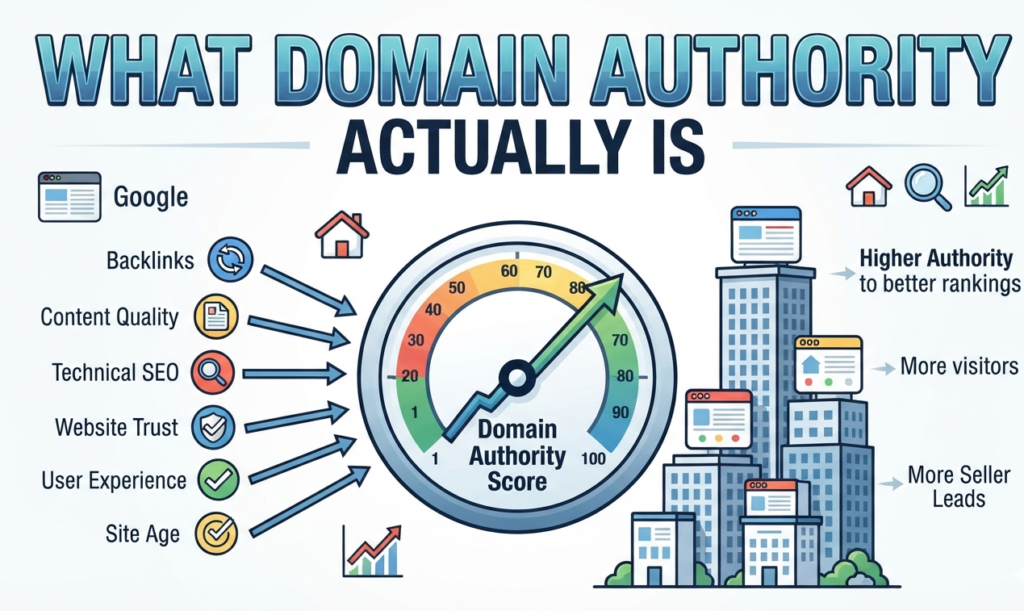
Domain authority is a metric developed by Moz and widely used across the SEO industry that predicts a website’s likelihood of ranking in search engine results. It is scored on a scale from one to one hundred, and higher scores generally indicate a stronger ability to rank for competitive search terms.
A brand-new website with no backlinks or track record typically starts at a score of 1. Established, widely linked platforms in major industries can reach scores in the eighties and nineties.
The critical thing to understand is that domain authority is not a metric that Google itself created or uses directly in its ranking algorithm.
It is a third-party estimate built by analyzing the same factors Google does consider, most notably the quantity and quality of backlinks pointing to a website, along with its overall link profile health.
When people talk about domain authority SEO in the context of real estate investing, they are really talking about the underlying web of trust signals that make some websites consistently outrank others for the same search terms.
For real estate investors, this translates into something very practical. A website with a domain authority score of 30 or 40 is going to struggle to rank for competitive terms like “sell my house fast in [city]” when competing against investors or real estate platforms with scores of fifty or sixty, even if the lower authority site has better written content.
This is why domain authority matters so much in the context of building a long-term organic lead generation strategy rather than a short-term content publishing plan.
Why Domain Authority Matters More Than Most Investors Realize
The real estate investor market is genuinely competitive online, and it is getting more so each year. National platforms, well-funded regional investors, and established local businesses have spent years building the kind of domain authority that gives them a structural advantage in search results.
A newer or less established investor website competing in that environment without a deliberate strategy to build authority is fighting uphill on every keyword.
This is not a reason to abandon the pursuit of organic search rankings. It is a reason to understand domain authority SEO deeply enough to build an intelligent, sustainable strategy around it.
The investors who are winning the most organic motivated seller leads in their markets in 2026 are not just the ones with the best content or the most pages. They are the ones who have systematically built the kind of authority that makes Google trust their websites enough to show them prominently for the searches that matter.
Domain authority also has a compounding effect, making early investment in it particularly valuable. A website that builds its authority steadily over a period of one to two years does not just rank for one or two target keywords.
It develops a rising tide that lifts the performance of new content and pages almost automatically, since the domain-wide trust it has accumulated extends to new pages faster than it would for a lower-authority site publishing the same content.
This is one of the clearest reasons why domain authority matters, not just today but as a long-term asset that becomes more valuable the longer it is consistently developed.
The Core Factors That Build Domain Authority

Understanding what actually drives domain authority makes it possible to work on it strategically rather than hoping it improves on its own. The primary driver is backlinks, specifically the number of unique, high-quality websites that link to your investor site.
Each link from a credible, relevant external source functions as a vote of confidence in your website’s trustworthiness and relevance, and search engines treat these votes as one of their most reliable signals for determining ranking potential.
Not all backlinks are equal. A single link from a well-regarded local news outlet, a regional business association, or an established real estate education platform carries significantly more authority weight than dozens of links from low-quality directories or unrelated websites.
Quality consistently outweighs quantity when it comes to building the kind of backlink profile that translates into meaningfully higher domain authority over time.
The relevance of linking domains also matters. A backlink from a financial education website writing about foreclosure options is more valuable to a real estate investor’s domain authority than a link from a general lifestyle blog that happened to mention your business in passing.
Google’s algorithm weights relevance heavily, and a link from a topically aligned source sends a much stronger trust signal than one from a completely unrelated domain.
Internal linking, the connections you create between pages within your own website, also contributes to authority distribution. A strong internal linking structure ensures that the authority accumulated by your highest-performing pages extends to newer or less visible pages, helping your entire site rank more effectively rather than concentrating all your search performance in a handful of isolated pages.
Step by Step: How to Improve Domain Authority for a Real Estate Investor Website
The most effective approach to improving domain authority starts with understanding where you currently stand. Tools like Moz’s free domain authority checker, Ahrefs, and SEMrush all provide authority metrics alongside backlink profile analysis that shows which sites are already linking to you, which links are most valuable, and where there are gaps or opportunities in your current profile.
Running this analysis before making any changes gives you a baseline to measure progress against and identifies the most impactful areas to focus on first.
After establishing your baseline, the next priority is earning high-quality backlinks from locally relevant and topically relevant sources. For real estate investors, the most accessible starting points include local chamber of commerce memberships, which typically include a directory listing that links to your website.
Real estate investor association memberships often come with the same benefits. Local press coverage, earned by making yourself available as an expert source for journalists covering housing markets, foreclosure trends, or local real estate issues, can produce high-authority links from news domains that carry significant weight.
Community sponsorships represent another accessible path to local backlinks. When a local charitable organization, youth sports program, or community event lists your business as a sponsor on their website with a link, that is a genuine, contextually relevant citation that contributes positively to your authority profile. These links tend to stay live for extended periods and come from sources that Google recognizes as locally trusted.
Content-driven link acquisition is a longer-term strategy that produces some of the most durable and valuable backlinks available.
Creating genuinely useful resources about your local real estate market, including neighborhood guides, foreclosure timeline resources for your state, or market reports with actual data, gives journalists, bloggers, community organizations, and other websites something worth linking to organically.
This approach requires patience, but the backlinks it generates tend to be from highly credible sources that meaningfully move your domain authority score over time.
Common Misconceptions About Domain Authority
One of the most persistent misconceptions is that domain authority is a metric Google uses directly to rank websites. It is not. Google has its own internal assessment of website authority and trustworthiness built into its ranking algorithm, and Moz’s domain authority score is a third-party estimation of that assessment rather than the real thing.
This does not mean domain authority is irrelevant. It means you should treat it as a useful directional indicator of your website’s competitive position rather than the literal number Google is using to rank you.
Another common misconception is that a high volume of backlinks automatically translates into higher domain authority. This was more true in earlier years of search engine optimization, but Google’s algorithm has become significantly more sophisticated in evaluating link quality.
A large number of low-quality or spammy backlinks can actually harm your website’s performance rather than help it, because they signal to Google that your link profile was built artificially rather than earned naturally. The goal is always quality and relevance first, with volume as a secondary consideration.
Many investors also mistakenly believe that domain authority improves quickly once they start working on it. In reality, meaningful movement in domain authority typically takes several months of consistent, quality-focused link-building effort.
It is a lagging indicator that reflects work done over an extended period rather than a real-time measurement of your current efforts, which means patience is genuinely required, and short-term impatience is one of the most common reasons investors abandon an authority-building strategy before it produces results.
Expert Tips for Accelerating Domain Authority Growth
One of the most underused strategies for real estate investors trying to improve domain authority is reaching out to local publications and offering to contribute guest content about their market expertise.
Local business journals, neighborhood websites, and community platforms are often receptive to guest contributions from knowledgeable local professionals, and these opportunities frequently include an author bio with a link back to your website from a locally authoritative source.
Monitoring your backlink profile regularly for toxic or spammy links is another practice that more experienced SEO practitioners maintain consistently. If low-quality websites have linked to your investor site over time, those links can drag on your overall domain authority.
Using Google Search Console’s disavow tool to reject these links keeps your profile clean and ensures that the authority signals pointing to your site are genuinely positive rather than a mixed bag that Google views with suspicion.
Partnerships with complementary local businesses, including mortgage brokers, probate attorneys, and property management companies, create natural opportunities for link exchanges and co-created content that generate high-quality, contextually relevant backlinks for both parties.
These professional relationships often produce backlinks from domains that share your target audience and have genuinely meaningful authority in related niches, making them some of the most valuable links available to a local real estate investor.
Real World Application
An investor in a mid-sized metro market had been publishing content consistently for nearly two years but was still unable to break onto the first page for any of their primary motivated seller keywords. An analysis of their backlink profile revealed that while they had a reasonable number of total backlinks, almost all of them were from low-quality general directories with very little authority of their own.
After shifting their link-building focus toward earning links from locally authoritative sources, including contributions to a local business journal, a chamber of commerce membership, sponsorship of a community housing education event, and a guest post on a regional real estate education website, the investor’s domain authority score began to move meaningfully within about four months.
Within six months of that shift, several of their highest-priority keyword pages moved from page two or three into the top five results, producing a noticeable increase in organic motivated seller inquiries without any change to the content or technical structure of the site.
The content had always been strong enough to rank. The domain authority had not been strong enough to support it. Once the authority gap was addressed, the content performed as it had always been capable of.
How Reirank.com Can Help You Build Domain Authority That Drives Leads
Understanding why domain authority matters and knowing how to build it systematically are two different challenges.
The practical work of identifying link-building opportunities, creating content worth linking to, building local relationships that produce genuine backlinks, and monitoring the health of your overall link profile requires both specialized knowledge and consistent effort over time.
Reirank.com works with real estate investors to build the kind of domain authority that creates sustainable organic visibility for motivated seller searches.
From comprehensive backlink profile audits that identify your current strengths and gaps to targeted local link-building campaigns and content strategies designed to earn authoritative citations, the goal is to build the underlying trust signals that make your website genuinely more competitive in organic search over time.
Conclusion: Why Domain Authority Matters for Real Estate Investors in 2026
Why domain authority matters for real estate investors in 2026 comes down to a straightforward reality. Organic search is one of the highest-quality lead sources available to investors, and domain authority is one of the primary factors determining whether your website gets to participate in the searches where motivated sellers are looking for help.
Understanding domain authority SEO is not optional for investors serious about building a sustainable, self-generating lead pipeline. Building the authority to compete in your market takes consistent, quality-focused effort over months and years, not a quick fix.
But the investors who make that commitment are building a compounding asset that makes every piece of content they publish more effective, every new page they add more competitive, and their overall digital presence more resilient to the market shifts and algorithm updates that routinely disrupt investors who rely on paid channels alone.
If you are ready to understand where your domain authority currently stands and build a clear strategy for improving it, visit Reirank.com today to explore our free consultation and the full range of digital marketing services designed specifically for real estate investors building serious organic lead generation systems.